





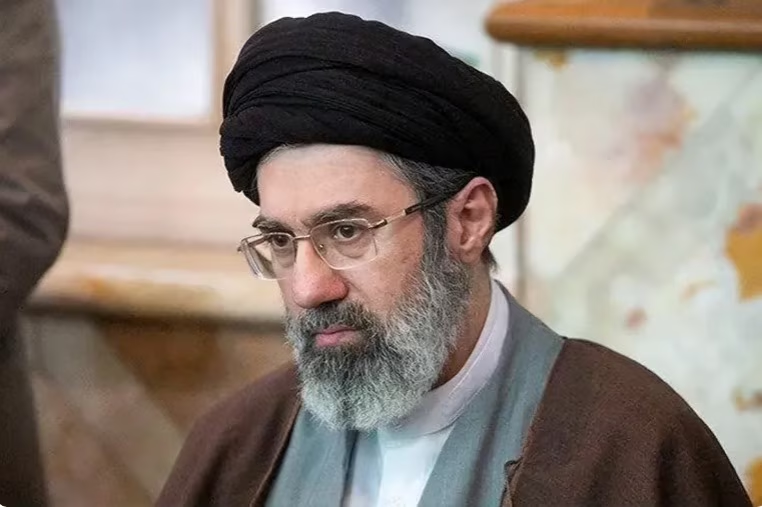
Dr. Abdul Majeed Sweilem: The selection of the new leader is a message in response to Netanyahu and Trump, who spoke about the necessity of an "moderate" Iranian leadership. Akram Attallah: His selection indicates that the Iranian regime is unwilling to make concessions and insists on continuing political and military confrontation. Daoud Kuttab: The selection of the new leader reflects the Iranian regime's ability to maintain continuity despite the pressures exerted on it during the past period. Dr. Hussein Al-Deek: The option of assassinating the new leader is unlikely until his orientations and the messages he may send to Washington through intermediaries become clear. Nizar Nazzal: The selection of Mojtaba as the new leader is a clear victory for the security current within the regime due to his strong relationship with the Revolutionary Guard. Areeb Al-Rantawi: The biggest challenge for the new leader is managing the war, controlling internal disputes, and overseeing the reconstruction of Iran after the war. Ramallah – Exclusive to "Al-Quds" – The selection of Mojtaba Khamenei, son of the former Supreme Leader Ali Khamenei, as the new Supreme Leader of the Islamic Republic of Iran, represents a pivotal moment in the political system's trajectory, amidst a highly complex regional and international stage. The decision is seen as carrying messages of defiance to Washington and Tel Aviv, and a consolidation of the previous approach led by the former leader for decades. Writers, political analysts, specialists, and university professors, in separate interviews with "Al-Quds", believe that Mojtaba Khamenei's selection confirms the ability of Iranian state institutions to manage the transfer of power and maintain the cohesion of the regime despite the escalating political and military pressures facing Tehran. According to writers, analysts, specialists, and university professors, this selection carries political implications that extend beyond the internal framework, as it is understood as a direct message to the United States and Israel that the Iranian regime is continuing its political and military approach, and is unwilling to make fundamental concessions under pressure, despite threats from US President Donald Trump to assassinate any leader who does not come without his participation. They point out that Mojtaba's selection reflects the rise of the hardline current within Iran's ruling institutions and the strengthening of the security and military establishment's role in shaping internal and regional policies. Most Capable of Managing the Current Stage Political writer and analyst Dr. Abdul Majeed Sweilem believes that the selection of a Supreme Leader for Iran did not come within the framework of what is being promoted about political inheritance within the regime, but rather as a result of a political and intellectual conviction among the Iranian leadership that Mojtaba Khamenei is the most capable of managing the current stage with its complexities and regional and international conflicts. He explains that Mojtaba Khamenei, during the past years, stood by his father, the former Supreme Leader Ali Khamenei, and played a pivotal role in managing many sensitive files within the Iranian state, which made him a well-known figure within decision-making circles. Sweilem points out that Mojtaba Khamenei is known for his political hardline stance and his close relationship with the Iranian Revolutionary Guard, which reinforced the Iranian leadership's conviction that he is the most capable of following up on conflict files and managing the next stage. Concerns Related to the Possibility of Targeting Him Sweilem clarifies that discussions within the Iranian leadership did not focus on Mojtaba Khamenei's capabilities or his eligibility for the position, as there were no serious disagreements about his personality or experience. Rather, the discussions primarily revolved around concerns related to the possibility of him being targeted by the United States or Israel. He indicates that the time it took to announce Mojtaba Khamenei's selection is largely due to security arrangements related to ways of protecting and concealing him, and ensuring his ability to oversee the course of the conflict from his new position. Sweilem explains that the position of Supreme Leader in Iran still retains its great political and religious importance, although his father's experience in this position was exceptional in terms of its depth and impact. Clear Political Messages to the Outside However, Sweilem points out that Mojtaba Khamenei possesses high organizational capabilities and extensive knowledge of various internal and external files, which made him the most qualified candidate for this position in the eyes of the Iranian leadership. Sweilem believes that the selection of the new leader also carries clear political messages to the outside, especially to Israeli Prime Minister Benjamin Netanyahu and US President Donald Trump, who have spoken on more than one occasion about the necessity of an "moderate" Iranian leadership. According to Sweilem, this selection came in response to those statements, to confirm that the Iranian regime makes its decisions independently and that it remains cohesive despite the pressures and losses it has suffered during the current confrontation. Sweilem indicates that the Iranian leadership, through this decision, wanted to send a message confirming the strength of the regime's cohesion and its ability to manage the most dangerous conflict since World War II, explaining that the continuation of the battle with such breadth and precision reflects the ability of Iranian state institutions to deal with major challenges. Assassination of the New Leader is Less Politically Viable Regarding the possibilities of targeting the new leader, Sweilem believes that this possibility is present and declared, but he points out that the Iranians took this matter into consideration during the selection process, and perhaps made prior arrangements related to his succession in the event of his assassination or if his ability to manage files was disrupted. Sweilem believes that the United States and Israel today realize that the structure of the Iranian regime enjoys a high degree of cohesion, which makes the option of assassinating the new leader less politically and morally viable than previously thought, and such an escalation may lead to counterproductive results that reduce the ability of Iran's opponents to appear strong or achieve strategic gains. Transition Towards More Hardline Political writer and analyst Akram Attallah explains that the appointment of Mojtaba Khamenei to the position of Supreme Leader in Iran carries deep political implications related to the nature of the next stage within the Iranian regime, pointing out that the step reflects a clear transition towards more hardline management of the state and regional policies. He indicates that Mojtaba Khamenei is known for his more hardline positions compared to his father Ali Khamenei, and that during the past years he played an influential role in managing state affairs from behind the scenes, in addition to his close relationship with the Iranian Revolutionary Guard, which indicates that the Iranian regime is unwilling to make concessions in the current stage and insists on continuing political and military confrontation. Attallah confirms that this development reflects a near-complete control of the hardline current over the joints of the Iranian state, in contrast to a noticeable decline of the reformist current within the regime. Attallah points out that this decline appeared in the positions and statements of Iranian President Masoud Pezeshkian during his visit to the Gulf states, where the limited influence of the reformist current was evident in light of the influence of the Revolutionary Guard and hardline forces within state institutions. Attallah indicates that the selection of Mojtaba Khamenei as the new leader can also be read as a continuation of his father's political and intellectual approach, and perhaps even a reinforcement of it, especially since the son is seen as an integral part of the hardline current within the regime, which means that Iran may remain linked to a stricter political line in the next stage. Attallah believes that former US President Donald Trump's threats regarding the assassination of the new leader if he did not participate in it, perhaps reflected an early awareness by Trump of the personality that might assume the position of leader. Attallah indicates that the new leader may become a primary target for the United States and Israel, especially since his selection reflects the Iranian regime's adherence to survival and continuity, which conflicts with Washington and Tel Aviv's desire to weaken or change it. The Iranian Regime's Ability to Maintain its Continuity Political writer and analyst Daoud Kuttab believes that the selection of a new Supreme Leader for the Islamic Republic of Iran reflects the Iranian regime's ability to maintain its continuity despite the political and military pressures exerted on it during the past period, pointing out that the selection process took place according to the institutional system adopted within the regime, ensuring the continuity of the state, the ruling structure, and the Shiite community, whose members constitute more than 150 million Shiite Muslims around the world. Kuttab explains that this step shows that the attempts by both Israel and the United States of America to destabilize the Iranian regime have not achieved their goals, as the Iranian leadership was able to proceed with the transfer of power according to its internal mechanisms. In contrast, Kuttab believes that US President Donald Trump's statements regarding his desire to influence the selection of the Supreme Leader to succeed Ali Khamenei represent an explicit form of colonial intervention in the internal affairs of states. Kuttab confirms that what used to happen historically through undeclared messages is now being openly discussed, which reflects an unprecedented level of intervention in the management of a state with an ancient civilization, believing that Washington's failure to impose this approach may turn into the beginning of a series of political failures for the Trump administration. The De Facto Ruler of Iran Professor of Political Science and International Relations and specialist in American affairs, Dr. Hussein Al-Deek, explains that the selection of Mojtaba Khamenei as Supreme Leader may open the door to dangerous scenarios that may lead to the overthrow of the regime or even the division of the country if the confrontation with the United States and Israel expands. Al-Deek indicates that Mojtaba Khamenei's selection was not entirely surprising, as many indications suggest that he was the de facto ruler of Iran during the past years in the presence of his father Ali Khamenei, and that he had long been seen as the potential successor to the leader. He points out that the position of Supreme Leader in Iran enjoys very broad powers, especially in light of the great influence he has, controlling the political, economic, and social joints of the state, in addition to natural resources. Assassination of the Former Leader Maintained the Approach Al-Deek indicates that Mojtaba Khamenei's selection carries clear political messages to the United States and Israel, as it reflects the continued control of the radical hardline current over power in Iran despite assassinations and military escalation, and also represents a message of defiance that the assassination of the former leader did not lead to a change in approach, but rather brought a more hardline leader. He explains that international experiences indicate different paths that countries may take after wars or the fall of regimes. Al-Deek cites the case of Japan, which transformed after World War II into a major economic power after the fall of its regime, in contrast to other models such as Syria, where the fall of the regime led to the international prosecution and flight of its symbols, as well as the model of Venezuela, which witnessed a transformation in its relations with Washington after the arrest of its president and the regime's alignment with a more stable relationship with the United States. Al-Deek indicates that attention is currently focused on Iran to know the path that the new leadership will take, believing that the continuation of the confrontation approach with the United States and Israel may lead to more war and destruction within Iran and perhaps the expansion of the conflict to other arenas in the region. Al-Deek cites the nature of the division within the Iranian regime with the statements of the Iranian President, which included an apology to Arab countries with talk of stopping their bombing, which was met with rejection by the head of the Expediency Discernment Council and former Parliament Speaker Ali Larijani, who affirmed the continuation of attacking Arab countries, which reflects the strength of the hardline current within ruling institutions. Al-Deek believes that the option of targeting the new leader with assassination will remain a possibility, but he rules out that US President Donald Trump will take this step before the orientations of the new leader and the messages he may send to Washington through intermediaries in the coming days become clear. Al-Deek confirms that the nature of the future relationship between Iran and the United States will be determined according to the orientations of the new leader; either the continuation of the militarization of the state and society and the control of the Revolutionary Guard, or a transition to a more open policy based on improving regional and international relations and focusing on development and internal stability, which the near future will reveal. Undeclared Inheritance of the System Researcher specializing in Israeli affairs and conflict issues, Nizar Nazzal, believes that the selection of Mojtaba Khamenei as the new Supreme Leader of Iran may indicate an undeclared shift towards a form of political inheritance within the Iranian regime, although the system that emerged after the Iranian Revolution against the Shah's regime was fundamentally based on rejecting the model of monarchical rule. Nazzal explains that the ascension of the son of the former leader Ali Khamenei to this position may make the regime appear closer to the model of ruling families, which may spark a debate within state institutions and religious circles in Iran. Nazzal indicates that Mojtaba Khamenei's appointment also represents a clear victory for the security current within the regime in Tehran, due to his strong relationship with the Iranian Revolutionary Guard, which means that the security and military establishment played a decisive role in favoring this option. Ensuring the Continuity of the Existing Political Line Nazzal explains that one of the goals of this decision is to ensure the continuity of the existing political line, both at the level of regional policies and the nuclear program, and to avoid entering a transitional phase that may open the door to fundamental changes in the state's orientations. Nazzal believes that the selection of a figure from the leader's inner circle may be an attempt to avoid a potential conflict between centers of power within the regime, whether between senior clerics or between different state institutions. Excluding Political Vacuum Nazzal indicates that the rapid transfer of power sends a clear message to the outside that the Iranian regime is still cohesive and that the state has not entered a state of political vacuum. Nazzal believes that US President Donald Trump's non-participation in the selection of the new leader does not necessarily mean that he will proceed to target him as he threatened, pointing out that these statements may fall within the framework of psychological warfare and an attempt to send deterrent messages to Tehran and pressure its ruling institutions. Targeting Mojtaba is a Declaration of Total War Nazzal indicates that targeting the new Supreme Leader Mojtaba Khamenei is considered a declaration of total war on Iran, especially since the leader represents the head of state and a central religious authority in the Shiite world, which may lead to the involvement of other regional parties in the conflict. Nazzal points out that the previous American experience in assassinating Supreme Leader Ali Khamenei showed that targeting military figures does not necessarily lead to the overthrow of the regime. Nazzal explains that the usual American strategy often relies on sanctions, pressure, and limited military strikes to target specific military structures, noting that some recent moves came in the context of pressures exerted by the Israeli government led by Benjamin Netanyahu on Washington. The Most Prominent Candidate Without Competition Areeb Al-Rantawi, director of the Jerusalem Center for Political Studies, believes that the election of Mojtaba Khamenei as Supreme Leader of the Islamic Republic of Iran represents a decisive political turning point in the history of the Republic, stressing that the exceptional circumstances preceding the selection and the assassination of his father Ali Khamenei and the subsequent American-Israeli threats to target the new leader made the son the most prominent candidate without competition and increased his chances of selection, despite the presence of a constellation of more experienced and knowledgeable clerics and politicians, with only one member out of 88 in the Assembly of Experts abstaining from voting. He points out that the selection of Mojtaba, who is the third leader, represents a "youthification" of the revolutionary system, and consecrates the continuation of the conservative revolutionary current according to his father's vision, and redefines the system's line in the foreseeable future, ensuring the continuity of the same regional and nuclear policies without entering a transitional phase that may open the door to change. Al-Rantawi points out that the success of the Assembly of Experts and Iranian institutions in smoothly transferring power indicates the regime's ability to face pressures and threats, but at the same time it will increase Washington and Tel Aviv's attempts to target the new leader, which reflects their realization that the successful transfer of power increases the regime's resilience and makes any assassination attempt more dangerous and complex. Extensive Relations Within Iran Al-Rantawi explains that the third leader, despite belonging to the conservative current, has extensive relations with other political factions, and is characterized by a moderate stance on some internal issues such as reform, fighting corruption, and the hijab issue, relying on "persuasion with kind words and good counsel" instead of enforcing laws by force. He points out that Mojtaba Khamenei's long experience in managing his father's office's relationship with various state institutions, including the Revolutionary Guard and the Basij, gives him tools to control the pace of power institutions and decision-making centers, and ensure the stability of the regime internally. Al-Rantawi explains that the biggest challenge facing the new leader lies in managing the war with Washington and Tel Aviv, controlling internal disputes related to the nuclear and missile program, and dealing with regional and international pressures, while taking into account the reconstruction of Iran after the war, which makes his internal and external tasks intertwined and complex at the same time. Iran Continues its Revolutionary Approach Al-Rantawi confirms that Mojtaba Khamenei's selection came as a clear message to the United States, Israel, and the "first generation" of revolutionary leaders, stating that Iran is continuing its revolutionary approach, and that any attempts to impose "moderate" leaders will clash with the resilience of the revolutionary current, while providing young people capable of leadership with space to interact with internal and external challenges, ensuring the survival of Iran, its system, and its Islamic Republic. Al-Rantawi believes that the new leader has great opportunities, but he will need to be cautious in navigating regional and international pressures, managing power institutions wisely, and seizing windows of opportunity to preserve the system and its continuity, while avoiding direct provocation of the United States and Israel, and dealing intelligently with the complexities of internal and external politics. Al-Rantawi believes that Mojtaba Khamenei's selection represents a dual message: the continuity of the Iranian regime and a strict challenge to external pressures, which reflects Iran's ability to withstand and deter in the face of the threats surrounding it, internally and externally. The Possibility of His Assassination is a Direct Threat to the Iranian Regime Al-Rantawi points out that Trump's statements rejecting Mojtaba Khamenei's selection and his vow to eliminate him represent a direct threat to the Iranian regime, but at the same time they may be a factor in strengthening the new leader's internal position, as "American rejection" has turned into a factor of internal unity and strengthening the legitimacy of the transfer of power. Al-Rantawi believes that Trump's attempts to target the new leader, if they materialize, may increase risks for the United States itself and exacerbate regional tensions, especially since any hostile action against the leader will be considered an aggression against Iranian state institutions and will trigger a series of Iranian responses that may affect both internal and external affairs.

ARAB AND WORLD
Tue 10 Mar 2026 12:37 pm - Jerusalem Time
Mojtaba Khamenei's Selection... Iranian Messages of Continued Confrontation Without Concessions
Tags
MORE FROM ARAB AND WORLD
Violent Israeli escalation in southern Lebanon: Intense raids and attempts of ground infiltration towards Majdal Zoun
International Analysis: Iran Imposes a 'Historical Trap' on Trump, Reviving the Ghost of the Carter Era
Trump threatens widespread military strikes against Iran in response to targeting of American helicopter


Share your opinion
Mojtaba Khamenei's Selection... Iranian Messages of Continued Confrontation Without Concessions