







Washington – Said Arikat – 3/10/2026
News Analysis
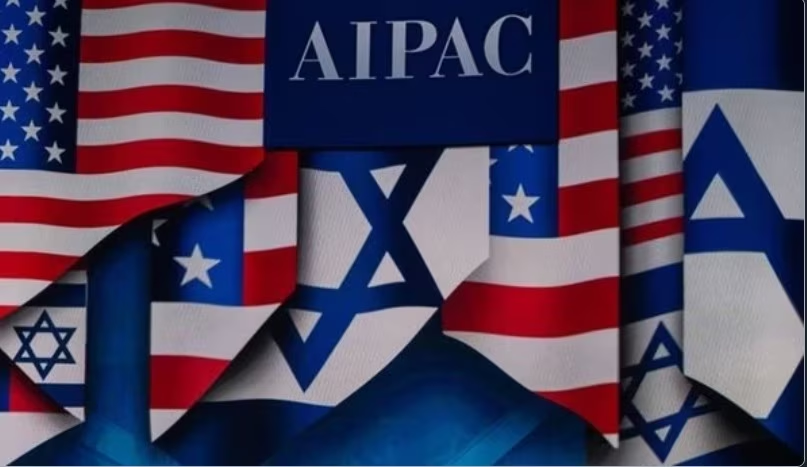
The ongoing war with Iran is no longer a military or geopolitical event whose impact is limited to the Middle East. Instead, it has gradually transformed into a pressure factor within American politics itself, beginning to expose the limits of influence of traditional lobbies in Washington, foremost among them: the American Israel Public Affairs Committee (AIPAC), the powerful Israeli lobby. It has also reopened a broader debate about the role of pressure groups in shaping U.S. foreign policy.
These shifts are clearly evident in the House races in Illinois, according to a report prepared by journalist Alex Kane, where it appears that a number of candidates who previously received support from AIPAC-affiliated networks have begun to adopt more cautious stances on the war with Iran. This move reflects a growing awareness of public sensitivity towards any prolonged military involvement in the Middle East.
For many years, AIPAC managed to establish widespread influence in Congress through an effective political funding network and bipartisan alliances, which contributed to solidifying a political discourse strongly supportive of Israel and hawkish towards Iran. However, the current war seems to be putting this model to an unprecedented test.
In electoral districts with a growing youth and progressive base, the political discourse has become more cautious towards the war. Some candidates have begun to speak about the necessity of parliamentary oversight over military operations, and about the risks of involvement in a wide regional conflict. Some even hint at the importance of prioritizing diplomatic channels over military escalation.
This shift does not necessarily mean a direct break with the pro-Israel lobby, but it reveals a decline in the ability of the traditional discourse based on confrontation with Iran to rally the same political consensus that existed in the past.
Observers point out that this change reflects a deeper transformation within the Democratic Party, where new political generations are more inclined to question military intervention policies, and more willing to criticize the role of pressure groups in influencing U.S. strategic decisions.
In this context, news director Josh Nathan-Kazis raises critical questions about the role played by American Jewish institutions in the public debate about the war. According to his analysis, some of these institutions have adopted a discourse strongly supportive of the military campaign against Iran, and this position has often been presented as an expression of consensus within the American Jewish community.
However, this argument ignores the great diversity of opinions within this community, and could place Jewish communities in a sensitive position if the war becomes widely unpopular within the United States.
The analysis warns that conflating the positions of political institutions with a collective identity can create misleading impressions in public debate, and fuel simplistic or anti-Jewish narratives, especially in times of major political crises.
These developments reflect a noticeable shift in the balance of power within the American political debate about the Middle East. After decades in which the pro-Israel lobby enjoyed significant ability to shape political discourse in Washington, today larger spaces for criticism and accountability are beginning to emerge, especially within progressive circles. This shift does not mean a collapse of the influence of these networks, but it indicates a gradual erosion of their ability to impose a broad political consensus, which may open the door to a more diverse discussion about U.S. policy priorities in the region.
In a broader discussion about the implications of the war, an episode of the podcast "On The Nose" addressed this issue from the perspective of the international system, where writer and analyst Peter Beinart discussed with Professor of International Law Aslı Ü. Bâli from Yale University the repercussions of the war on the image of American power in the world.
Bâli (who also participates in the activities of the Quincy Institute) believes that the pattern of wars in which the United States is engaged today reflects a shift in the method of using force. Instead of large-scale ground invasions, Washington is increasingly relying on airstrikes, regional partners, and military technological superiority.
But Beinart points out that this strategy may conceal a fundamental contradiction: while the United States still possesses immense military capability, its ability to rally domestic political support for long wars has become much weaker than it once was.
The discussion is not limited to politics, as the newsletter also touches on the reflections of the political climate on culture. It published a new literary work by writer and critic Wayne Koestenbaum that addresses the political and belonging anxiety that characterizes the current phase.
In light of recent Israeli airstrikes on Beirut, the newsletter re-published a previous investigation prepared by editor Maya Rosen about the ambitions of some Israeli right-wing currents to expand settlement activity towards southern Lebanon.
The investigation documents ideological discussions within some Israeli nationalist circles that adopt a broader geographical vision that transcends internationally recognized borders for Israel, raising concerns that military escalation could revive political projects that were, until recently, on the margins of discussion.
One of the most striking aspects of the repercussions of the Iran war is the relative exposure of the limits of AIPAC's influence within the American political landscape. While the organization succeeded for decades in building a strong network of influence within Congress and both parties, the changing public mood after long Middle East wars has made this influence less capable of controlling public debate. Candidates today are more sensitive to local public opinion, and less willing to unconditionally defend costly foreign policies. This does not mean an immediate sharp decline in AIPAC's influence, but it indicates the beginning of a phase in which its impact becomes a subject of public controversy and broader political discussion.
Ultimately, the war with Iran reveals that American foreign policy is no longer formulated solely in traditional elite circles in Washington, but has become more linked to the balance of public opinion and electoral considerations. With increasing internal polarization and declining trust in institutions, any foreign military adventure now carries significant domestic political risks. Therefore, the current debate about the war is not only about Iran, but reflects a deeper question about the United States' place in the world and the limits of military power in an era of increasing political and economic constraints.
Share your opinion
Iran War Reveals Limits of AIPAC's Influence, Opens Wider American Debate on Role of Lobbies in Foreign Policy