







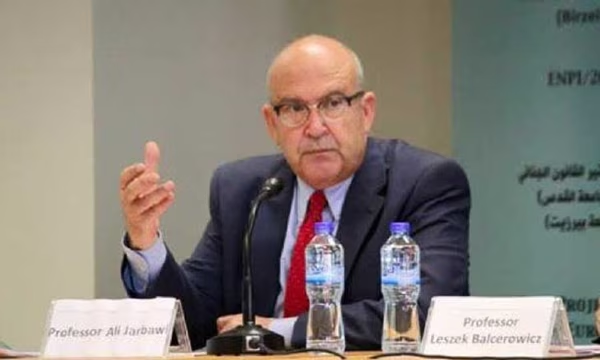
As the American-Israeli war on Iran enters its eleventh day, widespread repercussions are unfolding, not limited to the boundaries of military confrontation, but extending to affect other regional issues, foremost among them the Palestinian cause. According to Dr. Ali Jarbawi, Professor of Political Science at Birzeit University and former Palestinian Minister, the Palestinian cause has, in the shadow of this war, transformed into what can be described as a "forgotten conflict."
Jarbawi believes that what is happening in the region is no longer just a limited confrontation, but has become a regional war since its first day, due to the involvement of many parties. Although the apparent scene suggests that the conflict is between Israel and the United States on one side and Iran on the other, the reality reveals the direct or indirect involvement of major regional powers. Furthermore, the repercussions of the war have extended beyond the region to affect the global economy, especially amidst the disruption of energy markets and the possibility of closing the Strait of Hormuz, which has impacted global oil and gas trade.
The Palestinian Cause in the Shadow of a Larger War
Within this turbulent scene, Jarbawi believes that the Palestinian cause has fallen to a lower priority on the international agenda. Major conflicts, he says, often overshadow smaller ones, which applies to the current Palestinian situation. The regional war has overshadowed what is happening in the Gaza Strip, the West Bank, and Jerusalem, where international monitoring of events there has declined.
He points out that field developments clearly reflect this; international discussions about the political stages related to the war on Gaza have ceased, and the Rafah crossing has been re-closed after having been partially opened previously. At the same time, settler attacks in the West Bank have escalated and become more violent, while global attention to what is happening on the ground is absent.
From his perspective, Israel is exploiting the world's preoccupation with the war to accelerate its policies on the ground, especially in the area of settlement expansion and imposing new realities in the West Bank. Thus, Palestinians are paying the price for a conflict larger than themselves, a clear embodiment of the saying that "small conflicts pay the price for large conflicts."
Post-War Scenarios
In the long term, Jarbawi links the future of the Palestinian cause to the outcomes of the ongoing war. If Israel emerges victorious and is able to significantly weaken or change the Iranian regime, the regional balance of power may shift in a way that could increase pressure on Palestinians. Also, Gulf states, in this scenario, may become preoccupied with arranging their security and political affairs, which could reduce the Palestinian cause's presence in their priorities.
Limited Palestinian Options
In light of this reality, Jarbawi does not believe that Palestinians have wide options at the international or regional level at present, as most powers are preoccupied with the war and its repercussions. Therefore, he believes that the priority should be to arrange the internal Palestinian house, especially in light of the suffocating financial crisis suffered by the Palestinian Authority and the deteriorating economy in the West Bank due to Israeli policies and the withholding of Palestinian tax revenues.
He emphasizes that this economic crisis directly impacts the ability to manage the internal situation, increasing public frustration and weakening trust between society and the political leadership. Therefore, he believes that strengthening national cohesion and building a unified political discourse has become an urgent necessity, even if it is not sufficient to fully resolve the problem.
Escalation Probabilities in the West Bank
With the deterioration of the economic situation and the escalation of settler attacks, Jarbawi believes that the probabilities of escalation in the West Bank have increased. The lack of financial liquidity and the paralysis of economic activity create a tense social environment, accompanied by a growing state of insecurity in some areas.
In this context, he believes that strengthening the relationship between the official level and Palestinian society may help alleviate tensions and restore some degree of trust, even if partially.
End of the Two-State Solution?
Among the issues Jarbawi also addresses is the two-state solution, where he asserts that this solution has practically ended years ago, and what remains of it is merely a political slogan used in international discourse without real translation on the ground. Settlement expansion and the fragmentation of Palestinian lands have made the establishment of a viable Palestinian state almost impossible.
He believes that continued adherence to this slogan primarily aims to manage the conflict rather than resolve it, which buys time for the continuation of facts imposed on the ground. Therefore, he calls for posing new strategic questions about the future of the Palestinian national project and searching for realistic alternatives.
The Religious Dimension of the Conflict
Jarbawi also points to the escalation of the religious dimension in Israeli political discourse, especially with the rise of religious right-wing currents within the government. These currents, in his opinion, are based on a religious ideology that pushes towards controlling all of historical Palestine and perhaps expanding beyond it, as seen in Israeli policies towards neighboring countries such as Syria and Lebanon.
In this context, he draws attention to what is happening at Al-Aqsa Mosque, including incursions and restrictions on prayer, considering that reactions in the Islamic world are still below the level of the challenge posed by these policies.
Conclusion
In conclusion, Jarbawi believes that the Palestinian cause is going through a highly sensitive phase, as its internal crisis intersects with major regional transformations that may redraw the map of the region. While the world is preoccupied with a wide regional war, Palestinians find themselves in the position of a "forgotten conflict," making the arrangement of the internal house and the building of a new political strategy more urgent than ever.
Share your opinion
Ali Jarbawi: The Forgotten Conflict and How the Regional War Overshadowed the Palestinian Cause