






US President Donald Trump's administration faces significant challenges in presenting a coherent and convincing political narrative to the public regarding the ongoing military confrontation with Iran. Press sources reported that conflicting statements within the White House about the reasons and timing of the attacks caused confusion among international allies and within the US alike.
A report prepared by media sources in Washington clarified that Trump needed additional time to market the war option to his 'MAGA' political base, which voted for him based on promises to end foreign military interventions. The prevailing belief in the White House was that convincing this base would require weeks of systematic messaging that might extend until next April.
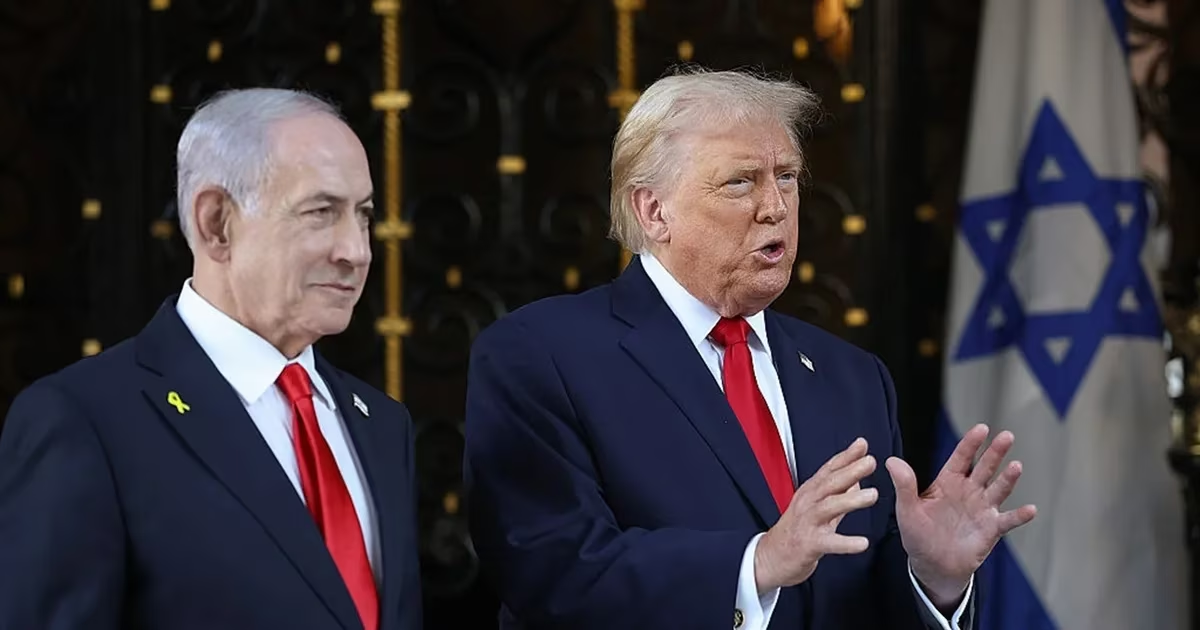
However, the course of events took a dramatic and sudden turn after a phone call between Israeli Prime Minister Benjamin Netanyahu and Trump on February 23. Netanyahu conveyed intelligence information indicating a rare meeting bringing together Iranian Supreme Leader Ali Khamenei with senior Revolutionary Guard commanders in one building in the capital, Tehran.
Netanyahu, in his conversation with the American president, considered targeting this meeting a 'fleeting opportunity' to eliminate the top leadership of the Iranian regime in one fell swoop. This intelligence offer put the American administration before an urgent military imperative that transcended the political and media plans that had been previously set to justify any potential escalation.
Before this shift, the American administration was sending contradictory signals; while the military fleet was moving towards the region, official statements emphasized the desire for a diplomatic solution. This delicate balance ended as soon as Trump approved the proposal to target the Iranian leadership, making subsequent justifications seem disjointed.
In a speech delivered from Mar-a-Lago, Trump announced the launch of 'Operation Epic Rage,' portraying it as a preemptive defensive step to protect Americans. Trump appeared wearing a white baseball cap, describing the Iranian regime as an 'evil group' posing an imminent threat to US national security.
Secretary of State Marco Rubio's statements further intensified the ambiguity when he indicated that Washington engaged in the war knowing in advance that Israel was prepared to attack unilaterally. Rubio clarified that the initiative to attack was necessary to avoid greater losses among US forces if Iran responded to the Israeli move.
These statements caused a shock in political circles in Washington, as they suggested that Israel had led the United States into war. This later prompted Trump to deny this interpretation, claiming that he might have forced the Israeli side to take certain positions in this conflict.
For his part, House Speaker Mike Johnson defended the military action, asserting that Israel was determined to act in self-defense with or without American support. Johnson indicated that the existential threat faced by Israel left no option but preemptive military action to prevent a widespread Iranian missile attack.
Reports indicate that military preparations were initially incomplete, as the Pentagon suffered in mid-January from a shortage of aircraft carriers and air defense systems in the region. Netanyahu repeatedly requested to postpone military operations until Israeli and American defensive preparations were complete to ensure the repulsion of any Iranian reaction.
By mid-February, the Pentagon had completed equipping a force capable of managing a military campaign lasting several continuous weeks. Meanwhile, Trump's envoys were conducting indirect nuclear talks in Geneva, aimed at preventing Iran from acquiring nuclear weapons or intercontinental ballistic missiles.
The US Central Intelligence Agency confirmed the accuracy of the information provided by the Mossad regarding the meeting of the Iranian leadership, which accelerated the decision-making process in the White House. Despite Trump's desire to wait for the State of the Union address, the pressure of field events imposed itself on the political timeline.
Hours before the confrontation erupted, Tehran presented a proposal for a nuclear agreement that Washington considered insufficient and full of security and technical loopholes. The American negotiating team left Geneva without reaching results, amid intelligence fears of Iran's ability to raise uranium enrichment to military levels within a few weeks.
Observers concluded that Trump found himself facing the most decisive decision of his second term, as the speed of developments confused the official discourse. Instead of gradually building political justifications, the White House was forced to defend a major military strike approved under the pressure of sudden intelligence opportunities.
Our goal is to defend the American people by eliminating imminent threats from the Iranian regime.
Share your opinion
Behind the Scenes of White House Confusion: How Netanyahu Pushed Trump Towards Confronting Iran?