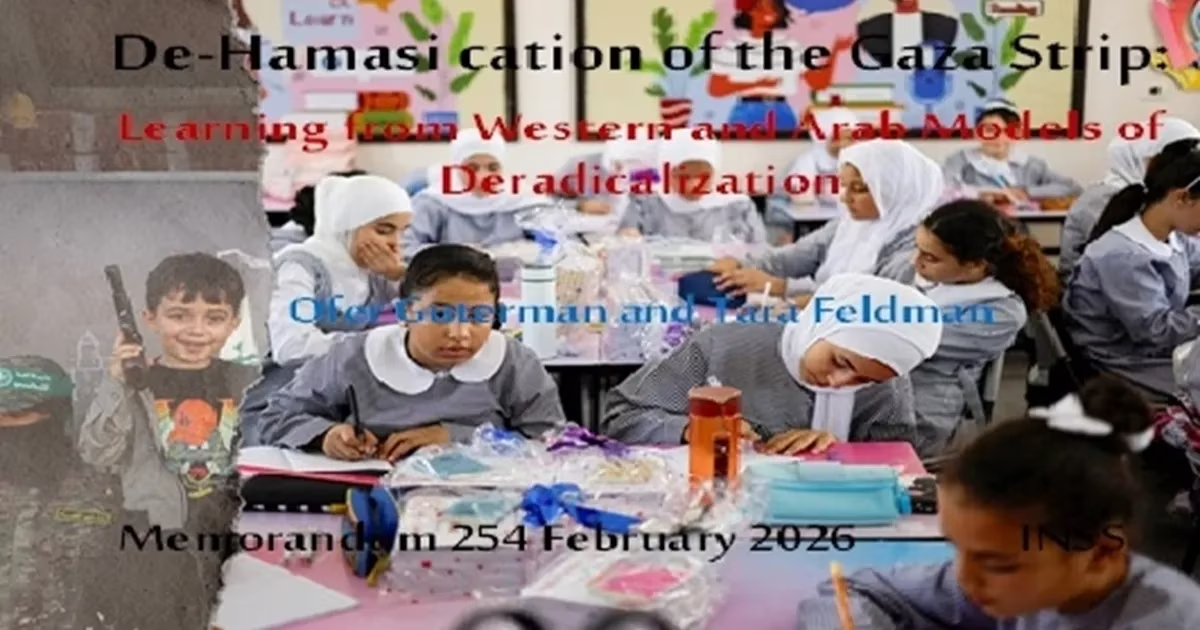







Post-war strategies in the Gaza Strip are at the forefront of concerns for policymakers in Israel and Western circles, as the occupation seeks to find a formula that ends the deeply rooted resistance. In this context, a recent study prepared by researchers at the Israeli Institute for National Security Studies (INSS) emerged, reviewing mechanisms for what it called 'comprehensive change' in the Strip to ensure that no influence of resistance movements returns.
The study considers the Gaza Strip to be one of the most complex arenas in the world due to what it describes as 'political and religious extremism' that has formed over decades. It believes that the current war and the massive destruction it has caused to infrastructure and casualties represent a 'rare opportunity' to re-engineer Gazan society and separate it from the Hamas ideology that has permeated all aspects of life.
Researchers Ofer Guterman and Tara Feldman introduced the term 'de-Hamasification' as an alternative to traditional de-radicalization terms, to emphasize the specificity of the situation in Gaza. This process aims to revoke the social legitimacy of the resistance and undermine its entrenched Islamic system, while attempting to maintain a formal space for peaceful political action to ensure credibility is not lost before the international community.
The proposed plan relies on 'push and pull' dynamics, where push factors include exploiting military defeat and destruction to create popular disillusionment with resistance options. Pull factors, on the other hand, involve offering economic and educational alternatives and a limited political horizon, aimed at creating a new civil identity that moves away from confrontation with the occupation.
The study reviewed Arab models for combating 'extremism,' preferring the Egyptian model based on security containment, and the Gulf model (Emirati and Saudi) based on comprehensive social transformation. The study concluded by favoring the Emirati model for its proactive approach, with the possibility of integrating elements of the Egyptian model if the full implementation of the Gulf vision is not feasible.
The study believes that the Palestinian Authority, despite its current weak capabilities, remains an indispensable pillar in the national and Arab perspective. However, the study stipulates the necessity of 'rehabilitating' this authority to be capable of implementing anti-resistance measures and providing legitimate cover for the required transformations in the Strip under international and regional supervision.
The Israeli vision proposes establishing a 'National Committee for Gaza Management' operating under an international guardianship system called the 'Peace Council,' to ensure Hamas does not return to power. This includes rebuilding and fortifying governance institutions, and presenting a 'moderate' religious and media discourse consistent with the Israeli security vision and new regional orientations.
The study emphasizes that comprehensive Israeli security control remains a fundamental condition for the success of any civilian or social operations in the Strip. It considers that continuous military suppression of organizations is the only guarantee to prevent the failure of 'de-radicalization' efforts or the resistance regaining the initiative in areas that are cleared.
The plan links the speed of civil reconstruction to the success of the transformative narrative, warning that long delays could lead to counterproductive results. It proposes implementing reconstruction projects exclusively in areas confirmed to be disarmed and completely out of the control of resistance factions, to ensure aid is used as a leverage tool.
The study calls for the practical and leading involvement of Arab states, considering the Arab model to be more suitable for the culture of Gazan society than Western models. Israel realizes that this Arab engagement requires offering symbolic 'political concessions' related to limited Palestinian independence, to ensure these countries accept participation in the material and political costs.
Institutionally, the study calls for 'purging' mosques, religious, and educational bodies of any elements associated with the resistance, and replacing them with trained personnel who promote a discourse of 'non-violence.' This includes reforming curricula and producing cultural and artistic content aimed at redefining Palestinian identity away from the concept of armed struggle.
The plan emphasizes the importance of 'authoritarian tolerance,' an approach that promotes religious moderation through coercive and centralized means that ensure the rule of law imposed by the new system. This requires building institutional immunity against the return of Hamas through strict legal frameworks and transparent criteria for appointments to public positions in the Strip.
Despite these ambitious plans, other reports and sources indicate that the Palestinian spirit remains resistant to subjugation, as resistance is considered an integral part of national identity. Analysts believe that attempts to 'occupy consciousness' may face dismal failure, as happened in previous international experiences, given the depth of historical injustice faced by Palestinians.
In conclusion, this study remains an expression of an Israeli desire to achieve a cultural and social victory that complements military action, but it clashes with a complex reality on the ground. History proves that excessive pressure and destruction often generate generations more committed to their national rights, making 'social engineering' a task close to impossible under continued occupation.
De-radicalization is not a subsequent stage to Hamas's defeat, but rather an essential element in strategically weakening it by offering an alternative in governance and ideology.



Share your opinion
Israeli Study Proposes 'De-Hamasification' of Gaza Through Arab Models and Comprehensive Social Engineering