







News Analysis
Within hours of Washington launching “Operation Epic Fury” against Iran, Tehran retaliated with coordinated strikes on American military installations across the Middle East. Six U.S. troops were confirmed killed. Billions of dollars in equipment were reportedly destroyed or damaged.
Iran’s Supreme National Security Council chief, Ali Larijani, vowed that Iran would make the “Zionist criminals and the vile Americans regret” the attack. The rhetoric was incendiary but unsurprising. What proved more consequential was how swiftly America’s vast network of regional bases—long described as pillars of deterrence—became a latticework of targets.
The episode revives a question that has lingered for decades but is rarely confronted directly: does maintaining an expansive U.S. military footprint across the Arab world enhance American security—or lock the United States and its partners into recurring cycles of escalation?
A Vast Architecture of Exposure
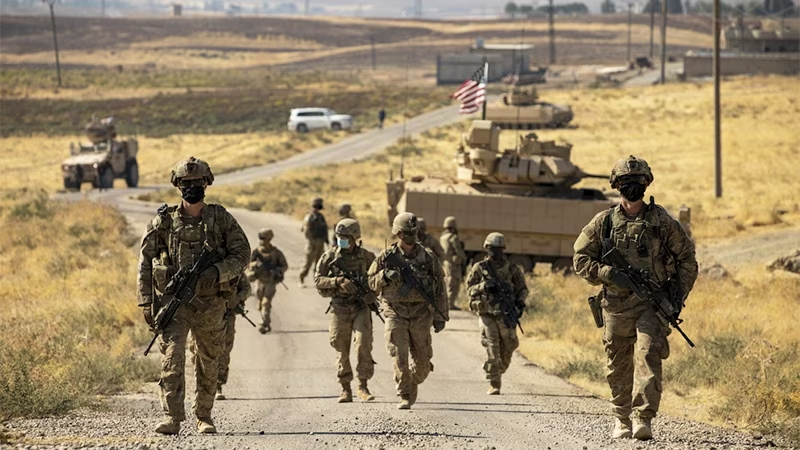
The United States maintains 19 permanent and temporary military installations across the Middle East, including eight permanent bases in Bahrain, Egypt, Iraq, Jordan, Kuwait, Qatar, Saudi Arabia, and the United Arab Emirates. Between 40,000 and 50,000 American troops are stationed in the region at any given time.
At the center of this posture sits Al Udeid Air Base in Qatar, the forward headquarters of U.S. Central Command and home to roughly 10,000 personnel. Two nuclear-powered aircraft carriers—the USS Abraham Lincoln and the USS Gerald R. Ford—have reinforced the regional presence, carrying more than 130 fighter jets between them.
Strategically, this network forms an arc around Iran’s western and southern periphery. From Tehran’s vantage point, it is less a defensive shield than a permanent encirclement. Iranian officials have long labeled these installations “legitimate targets.” In the latest exchange, that description moved from rhetoric to operational doctrine.
Facilities in Bahrain, Iraq, Jordan, Kuwait, Qatar, the UAE, and Saudi Arabia were struck by missiles or drones. The headquarters of the U.S. Navy’s Fifth Fleet in Bahrain was hit. Camp Arifjan in Kuwait suffered casualties. Al Udeid sustained damage, including to high-value radar systems. Bases and oil infrastructure in the UAE and Saudi Arabia faced repeated strikes.
The paradox of permanent basing is stark: forward deterrence can quickly become forward exposure.
Host Nations as Collateral
In Washington, the bases are framed as instruments of American power projection. In the region, they are also magnets for retaliation.
Missiles fell near Manama. Drones targeted Kuwaiti installations. Explosions echoed in Doha. Dubai’s Jebel Ali port—frequently visited by U.S. naval vessels—reported fires after suspected strikes. Saudi Arabia’s Ras Tanura refinery temporarily paused production following a drone attack.
Whether every strike caused severe damage is less important than the strategic signal: when Washington goes to war, Arab capitals absorb the shock.
This reality complicates the political calculus for host governments. Security guarantees and defense cooperation come with tangible economic and diplomatic benefits. But they also transform these states into immediate participants in conflicts they may neither initiate nor fully control. The line between ally and proxy becomes blurred when foreign installations invite retaliatory fire.
Deterrence Under Strain
Proponents of the U.S. posture argue that the network deters Iranian aggression and reassures Gulf partners. Yet the recent escalation illustrates an uncomfortable inversion: the infrastructure meant to deter provided Tehran with a pre-mapped set of targets.
Fixed installations—expansive airfields, dense aircraft concentrations, multimillion-dollar radar arrays—are inherently vulnerable in an era defined by precision-guided missiles and inexpensive drone swarms. Their scale and permanence make complete defense nearly impossible.
As President Donald Trump and Chairman of the Joint Chiefs General Dan Caine have acknowledged, the confrontation may continue and casualties could mount. That prospect highlights a structural risk embedded in forward basing: once hostilities begin, escalation can become self-sustaining. Each retaliatory strike validates the logic of the next.
A Changing Strategic Environment
The Middle East of 2026 differs profoundly from that of 1991 or 2003. Threats are more asymmetric. Precision strike capabilities are cheaper and more widely available. Regional governments pursue diversified foreign policies, balancing relations with Washington, Beijing, Moscow, and Tehran. Public opinion across much of the Arab world is increasingly sensitive to perceptions of foreign military entrenchment.
The core issue is not simply the number of bases the United States maintains. It is whether a large, permanent footprint remains the most effective—or safest—instrument for advancing American interests.
If every confrontation with Iran automatically exposes dozens of installations and tens of thousands of personnel to retaliation, the strategic calculus demands reassessment. Forward presence projects power. It also imports vulnerability.
Events on September 9, 2025, further complicated the narrative. When Israel struck Doha, the American installation at Al Udeid did not intervene to defend its host nation. The base neither deterred nor responded in protection of Qatari sovereignty. For many in the region, that episode reinforced a persistent suspicion: American bases are structured primarily as platforms serving Washington’s—often aligned with Israel’s—strategic priorities, rather than as shields for their hosts.
If that perception hardens, the implicit bargain sustaining America’s regional footprint may prove narrower—and more fragile—than policymakers assume.
Share your opinion
American Bases in the Middle East: Security Umbrella or Permanent Liability?