







News Analysis
Washington — The Trump administration’s widening war against Iran is being justified with sweeping rhetoric about security and deterrence, yet the evidence presented so far reveals a troubling reality: the United States appears to have entered a major Middle Eastern conflict without demonstrating an imminent threat, a coherent strategy, or a credible plan for ending the war it has begun.
Defense Secretary Pete Hegseth on Monday defended the joint U.S.–Israeli assault as a necessary response to Iranian nuclear ambitions and alleged terrorist threats. Speaking at the Pentagon’s first comprehensive briefing since hostilities began, Hegseth insisted Washington was acting defensively. “We didn’t start this war, but under President Trump we will end it,” he said, describing the campaign as retribution against Iran’s leadership.
Yet beyond forceful language, officials offered little new intelligence showing that Iran was preparing an immediate attack on the United States or its allies — the traditional legal and strategic threshold used to justify preventive military action. Instead, the administration’s arguments relied heavily on long-standing accusations about Iran’s intentions rather than demonstrable urgency.
The gap between justification and action has revived uncomfortable memories of earlier American wars launched on contested premises, where worst-case assumptions replaced verifiable threats and military escalation preceded political planning.
Hegseth said U.S. forces were striking Iran “surgically, overwhelmingly and unapologetically,” aiming to destroy missile infrastructure and halt any path toward nuclear weapons. But Gen. Dan Caine, chairman of the Joint Chiefs of Staff, offered a far broader objective: preventing Iran from projecting power beyond its borders. That formulation effectively transforms a limited defensive rationale into an open-ended regional mission with no clear definition of success.
“This work is just beginning,” Caine acknowledged, undercutting any suggestion of a short campaign. His remarks reinforced fears that Washington may be drifting into another prolonged conflict defined less by achievable goals than by expanding military momentum.
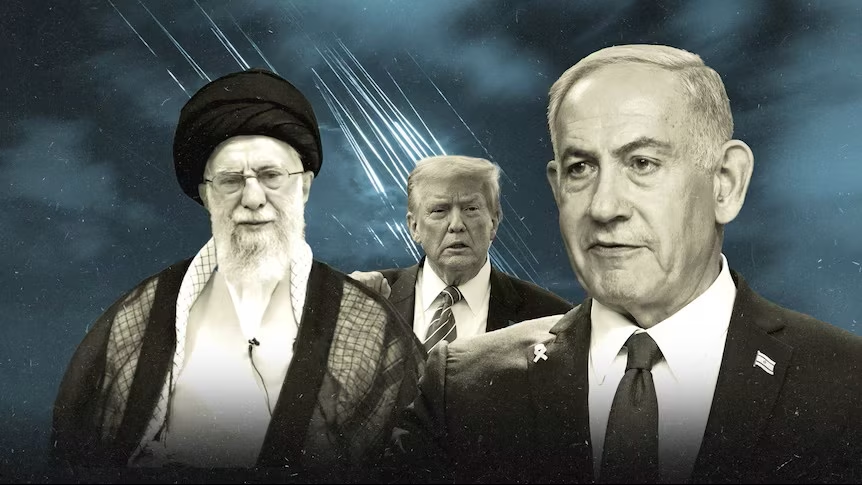
President Donald Trump has gone even further, openly declaring that the war seeks to topple Iran’s Islamic Republic, which has ruled since 1979. Yet neither the White House nor the Pentagon has explained how regime change could realistically occur without a massive ground invasion — an option American officials appear unwilling to consider after the costly experiences of Iraq and Afghanistan.
Air campaigns alone rarely collapse entrenched governments. Instead, they often consolidate nationalist resistance. The killing of Iran’s Supreme Leader, Ayatollah Ali Khamenei, rather than weakening the state, risks transforming the conflict into a generational struggle fueled by revenge and domestic unity against foreign attack.
Hegseth attempted to deny the campaign constituted regime change even while remarking that the “regime sure did change,” highlighting contradictions that have come to define the administration’s messaging.
Critics increasingly argue that the war’s strategic logic lies less in American national security than in alignment with Israeli Prime Minister Benjamin Netanyahu’s long-standing objective of neutralizing Iran militarily. For decades, Netanyahu has warned that Iran represents an existential danger requiring decisive force, a position successive U.S. administrations resisted out of fear of regional escalation.
Now Washington appears to have embraced that vision without fully accounting for its consequences. No administration official has clearly articulated why Iran posed an immediate danger to Americans at the precise moment strikes were launched, raising questions about whether U.S. policy is being driven by alliance politics rather than necessity.
Domestic political reaction reflects that uncertainty. House Minority Leader Hakeem Jeffries questioned why American troops are dying in a war Congress never authorized and whose objectives remain undefined. Democrats are seeking a vote under the War Powers Resolution, arguing that constitutional limits on presidential war-making authority have been bypassed.
“They’re starting a war that we all know will not end well,” Jeffries warned, echoing concerns shared quietly by lawmakers in both parties.
Events on the ground are already demonstrating how quickly escalation can escape control. At least four American service members have been killed, while Kuwait mistakenly shot down three U.S. aircraft, underscoring the confusion and volatility surrounding the conflict. Iran and allied militias responded with missile attacks across multiple countries, striking Israel, U.S. facilities, and regional partners.
Even cities long considered safe economic hubs have felt the impact. Incoming fire near Dubai disrupted global aviation, stranded travelers, and rattled financial markets. Oil prices surged sharply, signaling fears that wider war could threaten the flow of energy through the Persian Gulf, a lifeline of the global economy.
Iran has long warned that any direct attack would trigger region-wide retaliation. That warning now appears less like propaganda and more like unfolding reality.
Perhaps most striking is the administration’s limited public explanation of its long-term vision. Trump has largely avoided sustained public engagement since ordering the strikes, leaving senior officials to articulate shifting rationales that alternate between deterrence, punishment, and regime change.
Historically American presidents benefit from early wartime unity, yet public opinion remains divided, reflecting fatigue after decades of conflict. Without clear evidence, defined objectives, or a realistic exit strategy, this war risks becoming another open-ended intervention with consequences far beyond Iran itself. And history offers few comforting precedents.
Share your opinion
War by Assertion: The Case Washington Hasn’t Made