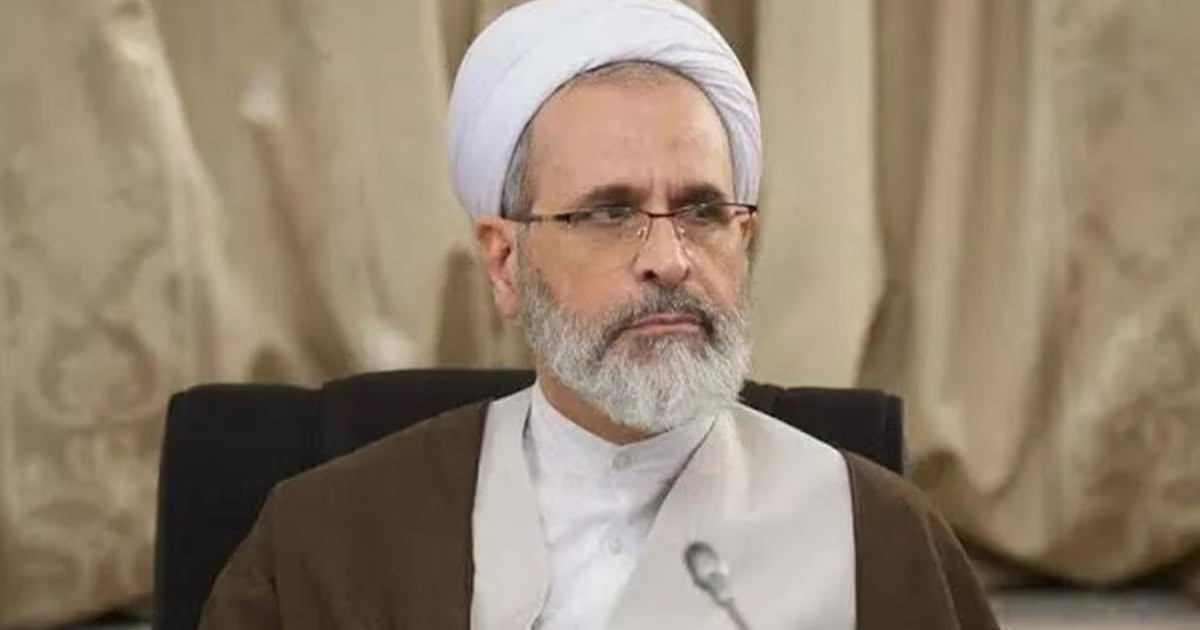







Iranian authorities officially announced the country's entry into a transitional phase following the assassination of the Supreme Leader of the Islamic Republic, Ali Khamenei, in an incident that shook the foundations of the political system in Tehran. The Secretary of the Supreme National Security Council, Ali Larijani, confirmed that arrangements for the transfer of power are underway in accordance with established constitutional frameworks to ensure the stability of state institutions.
In a swift move to address the leadership vacuum, the formation of a provisional leadership council was announced to urgently manage the country's affairs. This council includes Iranian President Masoud Pezeshkian, Head of the Judiciary Gholam-Hossein Mohseni Eje'i, and the jurist from the Guardian Council, Ali Reza Arafi.
Mohsen Dehnavi, spokesman for the Expediency Discernment Council, revealed that the council chose Ayatollah Ali Reza Arafi to be the third member of the provisional leadership council. This selection comes due to his religious and political weight, as he is a member of both the Assembly of Experts and the Guardian Council, making him a formidable figure in the current governing equation.
Attention is now focused on the Assembly of Experts, which is constitutionally mandated to elect the new Supreme Leader of the Republic as soon as possible. This council consists of 88 Shia clerics and 5 Sunni members. For an election session to be held, two-thirds of the members must be present, and the proposed name must be approved by a two-thirds majority.
Article 111 of the Iranian Constitution stipulates that in the event of the leader's death or removal, a temporary body assumes leadership duties to ensure there is no vacuum at the top. The article clearly states that diagnosing the leader's incapacity or loss of required qualifications falls within the powers of the Assembly of Experts, which must act immediately to announce a replacement.
Ali Reza Arafi, born in 1959 in Meybod, is considered one of the most prominent candidates to assume the position of the third Supreme Leader in the history of the Republic. Arafi comes from an ancient religious family that opposed the Shah's regime, and his father, Mohammad Ibrahim Arafi, was close to the founder of the Republic, Ayatollah Khomeini, which gives him historical and religious legitimacy.
Arafi currently holds sensitive positions, including the management of the Qom Seminary and the presidency of Al-Mustafa International University, which has enabled him to build a wide network of relationships within the religious establishment. He is also known for his conservative and hardline rhetoric and his close ties to the Iranian Revolutionary Guard Corps, a crucial factor in his favor within decision-making circles.
In addition to Arafi, other names stand out on the list of potential candidates, including Mojtaba Khamenei, the son of the late leader, who enjoys wide influence within the security apparatus and the Basij. Despite his field strength, his lack of high jurisprudential standing among senior clerics may hinder his ambitions to reach the position of Vali-e Faqih.
Also appearing on the scene is Mohammad Mehdi Mir Bagheri, a hardline cleric who heads the Islamic Sciences Academy in Qom and is a member of the Assembly of Experts. Mir Bagheri represents the most radical current in the religious establishment and enjoys the support of sectors that believe in the necessity of tightening ideological control in the coming phase.
Among the proposed figures is also Hassan Khomeini, the grandson of the founder of the Republic, who holds the position of custodian of his grandfather's shrine. Despite his great symbolism, he is classified within the less hardline current, which may make consensus on him difficult given the conservative wing's control over key positions in the Assembly of Experts and the Revolutionary Guard.
Hashem Hosseini Bushehri, the First Deputy Chairman of the Assembly of Experts, is also a prominent name in the nominations. Bushehri was very close to Khamenei and has long experience in managing the affairs of the religious establishment, making him a consensual candidate in case of a split over other names.
Article 109 of the Constitution sets strict conditions for those who assume the position of leader, including scientific competence for jurisprudential ijtihad, justice, and piety. The article also emphasizes the necessity of having correct political and social vision, and the ability to manage and sufficient courage to lead the nation in complex circumstances.
Informed sources indicate that a special committee within the Assembly of Experts had already begun some time ago to study the files of potential candidates and verify their eligibility. With the assassination, the pace of this committee's work accelerated to submit its final report to the council, which will hold a historic session to determine the future of leadership in Iran.
The biggest challenge facing the new leadership remains maintaining internal cohesion and confronting the regional repercussions of the assassination. Under the system based on the Guardianship of the Islamic Jurist, the personality of the next leader will largely determine the course of Iranian foreign policy and its relationship with international powers in the coming phase.
The transitional phase after Khamenei's assassination has begun, and a provisional leadership council will be formed to take responsibility until the next leader is elected.
Share your opinion
Iran Enters Transitional Phase After Khamenei's Assassination: Ali Reza Arafi Leads Succession Scene