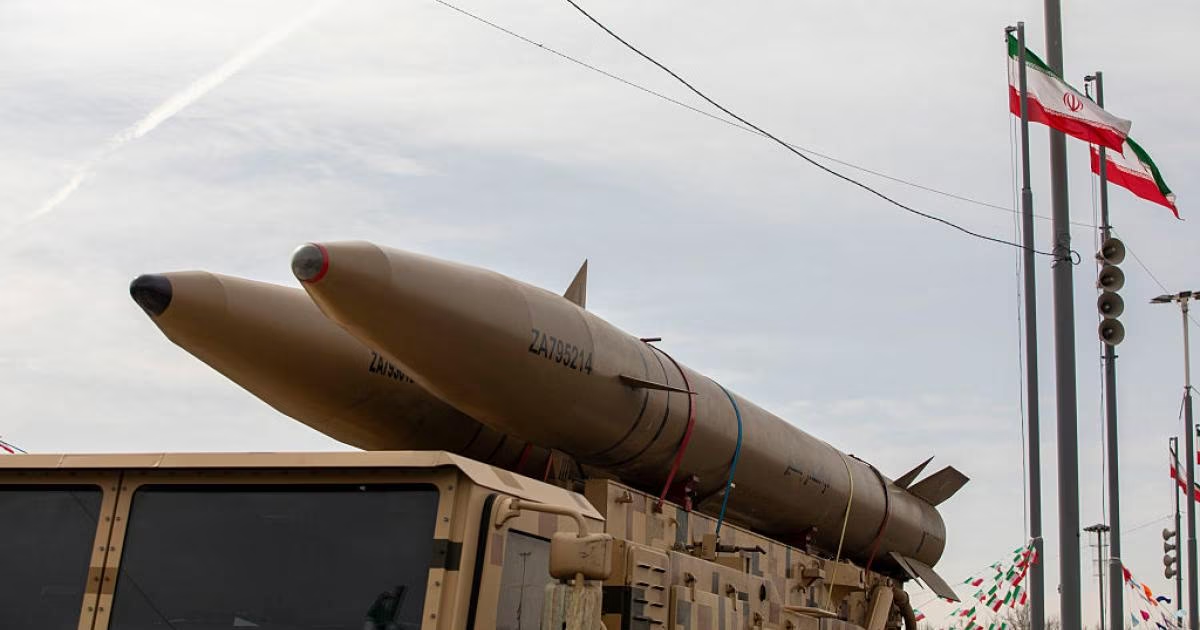







Iran's missile system takes center stage in the military landscape with every new escalation in the region, as the rapid technological development of these weapons emerges as one of the most significant security and political challenges. This arsenal is a strategic tool employed by Tehran to enhance its regional influence and ensure its ability to retaliate against any potential external threats.
Ballistic missiles are known as weapons that rely on rocket propulsion in their initial stages before following a free-fall trajectory towards their targets, capable of carrying various warheads. These warheads include conventional explosives or unconventional munitions, making them a deadly weapon that raises concerns among international powers regarding the stability of the Middle East.
US intelligence sources reported that Tehran has succeeded in building the largest stockpile of ballistic missiles in the Middle East, with some reaching a range of approximately 2,000 kilometers. This declared range places many capitals and military bases, including locations within Israel, within the direct targeting circle of Iranian capabilities.
Iran's missile capabilities are distributed across multiple strategic locations, some concentrated in and around the capital Tehran, while other facilities are located in remote provinces. Reports reveal the existence of at least five fortified underground missile cities, located in areas such as Kermanshah and Semnan, and near the Persian Gulf coasts.
The list of long-range missiles includes advanced models such as the 'Sejjil' missile, which has a range of 2,000 kilometers, and the 'Emad' missile with a range of 1,700 kilometers. The arsenal also includes 'Ghadr' and 'Khorramshahr' missiles, which cover distances up to two thousand kilometers, enhancing the flexibility of Iranian military operations.
Media sources previously indicated that the 'Sejjil' missile boasts superior technical capabilities, capable of flying at speeds exceeding 17,000 kilometers per hour. Additionally, 'Kheibar' and 'Haj Qassem' missiles stand out as offensive tools capable of bypassing traditional air defenses due to their high range and speed.
Iran's arsenal is not limited to long-range missiles but also includes short and medium-range missiles such as 'Shahab-1' and 'Zolfaghar'. Tehran continuously works on developing new versions of these missiles, such as 'Emad-1', to increase their accuracy and destructive capability in the field.
In June 2025, these missiles were actually used during a 12-day military confrontation, where Tehran launched ballistic barrages that resulted in material and human losses. Iranian authorities affirm that these operations fall within their right to deterrence and retaliation against any aggressions affecting their sovereignty or interests.
Iran's development strategy relies on building underground storage and production centers equipped with advanced transport and launch systems, making them difficult to detect or destroy. Iran set a military precedent in 2020 when it launched a ballistic missile from a hidden underground facility for the first time.
Iranian military industries have successfully replicated and developed foreign technologies by dismantling and studying the components of imported missiles, enabling them to produce improved local versions. The use of lighter materials and modification of missile structures has significantly extended their geographical range and improved their field efficiency.
In a remarkable qualitative development, official Iranian sources announced in 2023 the production of the first hypersonic ballistic missile, a weapon that exceeds the speed of sound by at least five times. These missiles are characterized by their variable trajectories, making them very difficult for modern air defense systems to intercept or shoot down.
International reports indicate that Iran's missile program drew its roots from North Korean and Russian designs, with technical support from China at various stages. This blend of foreign expertise and local efforts led to the birth of a complex and diverse system of offensive and defensive weapons.
Iran also possesses significant capabilities in cruise missiles, most notably the 'Kh-55' air-launched missile, which has a range of 3,000 kilometers. The danger of this type of missile lies in its ability to fly at low altitudes and carry heavy warheads, making it a strategic weapon par excellence.
Tehran insists that its missile program is purely defensive and aims to protect its national security, denying any intention to develop nuclear warheads. Nevertheless, this arsenal remains a focal point in political negotiations and regional security arrangements, given its direct impact on the balance of power in the region.
Iran possesses the largest stockpile of ballistic missiles in the Middle East, granting it a strategic deterrent capability that extends beyond its geographical borders.



Share your opinion
Iran's Missile Arsenal: Transnational Ballistic Capabilities and Growing Security Challenges