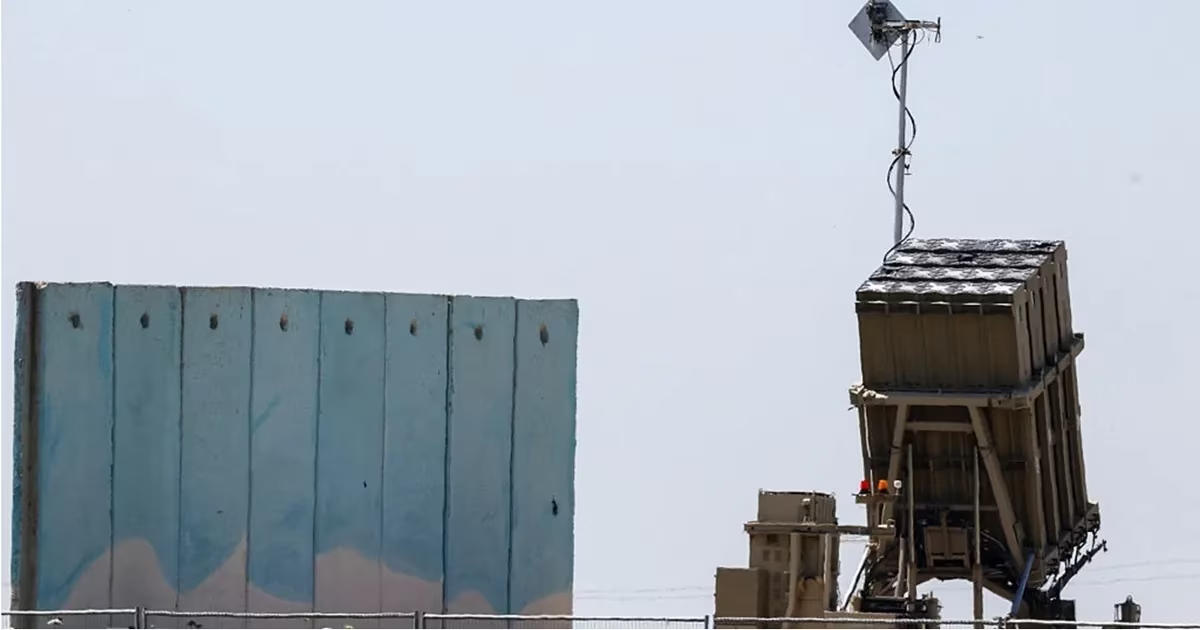







The Israeli occupation authorities announced an increase in the readiness of their defensive systems to confront any potential Iranian missile attacks, coinciding with joint military movements with the United States. This strategy relies on a multi-layered defense system aimed at intercepting threats at different atmospheric levels, starting from outer space down to short-range targets.
Media reports indicated that the lessons from military confrontations over the past two years have forced the occupation army to adopt a policy of 'armament economy' due to the high intensity of launches. Despite success in intercepting many missiles, the occupation incurred heavy material losses, which led the seven-battalion air defense system to redeploy and coordinate closely with US forces.
Military experts believe that the most dangerous scenario is Tehran possessing a stockpile of heavy missiles that have not yet been used in previous attacks. It is believed that in the event of a full-scale confrontation, Iran might resort to targeting symbolic non-military centers, which would require preemptive American intervention to disable launch platforms through a barrage of cruise missiles.
Informed sources revealed that the head of the occupation government, Benjamin Netanyahu, had previously requested a delay in military operations against Iran due to a severe shortage of interceptor missile stockpiles. However, the arrival of significant American reinforcements and the deployment of advanced systems helped fill these gaps, especially after the significant depletion of stockpiles in the June 2025 confrontations.
The 'Arrow 3' system forms the first line of defense for the occupation, designed to destroy ballistic missiles outside the atmosphere at distances up to 2400 kilometers. This system relies on pioneering technologies that allow it to deal with long-range strategic threats before they reach nearby airspace, reducing the risk of debris falling over populated areas.
The second defensive layer is the 'Arrow 2' system, which is responsible for intercepting ballistic missiles within the atmosphere at altitudes up to 100 kilometers. This system integrates with the American 'THAAD' system recently deployed in the region, providing dual protection and a high capability to track targets during the acceleration or descent phase.
Regarding medium-range threats, the occupation relies on the 'David's Sling' system, which has undergone extensive upgrades to counter cruise missiles and drones. This system operates using a direct hit method and is designed to deal with heavy projectiles that escape the upper layers, covering a range of 15 to 70 kilometers from the ground.
The Iron Dome comes in fourth place as a primary tool for dealing with short-range missiles and mortar shells, in both its land and naval versions installed on 'Sa'ar 6' ships. The naval dome plays a vital role in protecting gas platforms and strategic infrastructure offshore, supported by 'Barak' missiles designed for more distant and complex targets.
Laser technology, known as 'Iron Beam,' represents the fifth and newest layer in the occupation's defensive arsenal, aiming to provide low-cost and high-precision solutions. This system allows for the interception of drones and projectiles using advanced electro-optical guidance, which reduces the overall reliance on expensive traditional interceptor missiles.
Despite this extensive technological display, military reports confirm that these systems do not provide one hundred percent complete immunity against intensive Iranian attacks. Previous experiences have proven the ability of simultaneous missile barrages to overwhelm defense systems, keeping the occupation's home front in a constant state of anxiety from any large-scale escalation.
The worst-case scenario is Iran using heavier missiles not yet deployed if it feels an existential threat.




Share your opinion
Five Defensive Layers.. How is the Occupation Preparing to Confront Iranian Missiles?