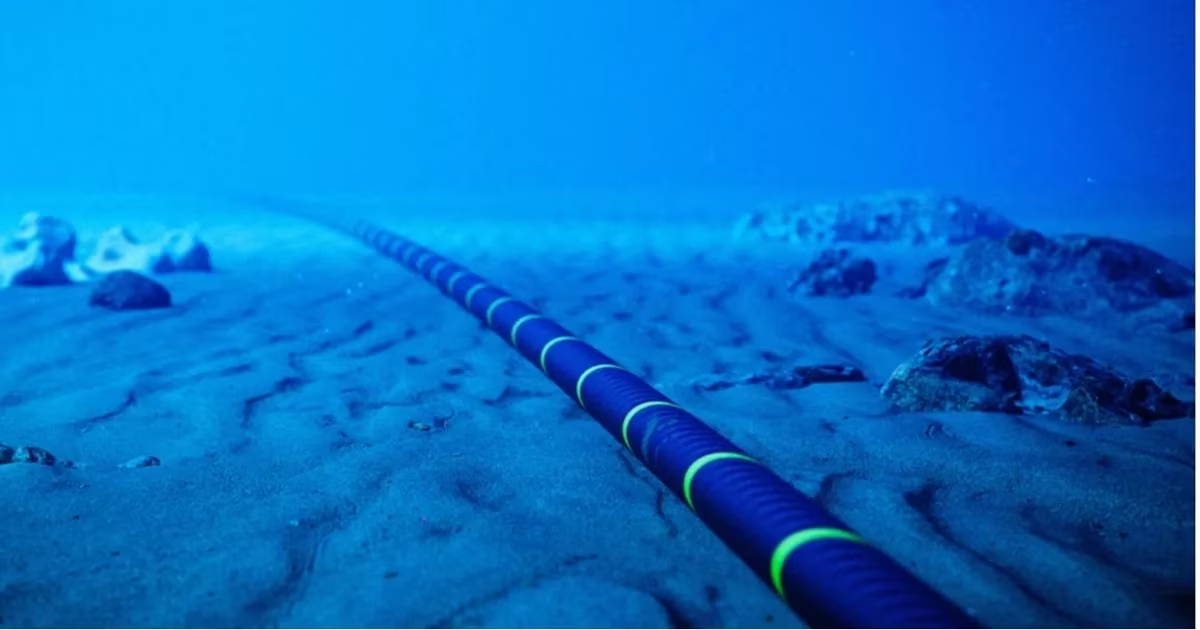







Concerns are escalating in Israeli circles about strategic shifts in the digital infrastructure map of the Middle East, where submarine communication cables are the backbone of the global digital economy. Currently, more than 95% of intercontinental data traffic passes through these physical cables, giving countries that host landing points significant political influence and huge economic returns.
Sources reported that recent years have witnessed the inauguration of advanced cable systems that have changed the routes of information flow between Europe, the Gulf states, and India. Google's 'Blue-Raman' system stands out as one of the most important of these projects, connecting the European continent to Israel via the Mediterranean, then extending south towards Saudi Arabia to India, forming a vital route that bypasses total reliance on passing through Egyptian territory.
Through these projects, Israel seeks to strengthen its position as an indispensable link in the regional system, especially with the planning of the 'Centurion' project. This system aims to connect India and the Gulf to the Mediterranean via Tel Aviv, contributing to the distribution of operational risks and an unprecedented increase in data transfer capacity between Asia and Europe.
However, recent Saudi trends have raised widespread concern, as Riyadh is seriously considering an alternative route that passes through Syrian territory instead of Israel. This shift, if implemented, would mean excluding Tel Aviv from the strategic 'data corridor', raising questions about the political and security motives behind this sovereign Saudi decision.
Observers believe that the Saudi desire for control is the primary driver of this trend, as Riyadh seeks to avoid technical dependence on any other regional entity. The more Israel's position as a data transit hub strengthens, the greater the likelihood of it becoming an influential party in Gulf information security, which Saudi Arabia prefers to avoid by building independent infrastructure.
The second reason for the potential change is related to the current political timing and the increasing tensions between Tel Aviv and Riyadh regarding multiple regional issues. This climate pushes towards reducing friction in sensitive infrastructure areas and searching for alternatives that may include rapprochement with Turkey through its influence in northern Syria to secure alternative routes.
Despite its political feasibility, the Syrian route raises complex technical and operational questions due to the instability of the security environment there compared to current routes. Nevertheless, it seems that Saudi Arabia's strategic incentive outweighs the technical obstacles in an attempt to draw a new digital map that does not necessarily pass through Israeli ports.
In contrast, Israel relies on its strategic partnership with Greece and Cyprus in the Eastern Mediterranean to confront these shifts. This cooperation may deepen in the fields of energy and security, with talks of establishing a joint military force aimed at protecting marine infrastructure and ensuring the stability of data and energy flow in the region.
Sources indicate that Israel is required to leverage its relations with Athens to prevent a change in cable routes, considering that the success of the Syrian route would represent a commercial victory for Turkey. The current competition is not limited to underwater cables; it is a fierce struggle over who holds the keys to digital flow in the Middle East in the coming decades.
Israel's loss of centrality in these projects means a decline in its role from 'a country through which the world passes' to merely 'a country connected to the world'. In an era entirely dependent on artificial intelligence and cloud computing, the speed of information flow directly translates into indispensable political influence and economic power.
Reports confirm that the East-to-Mediterranean Data Corridor (EMC) project, which brings together Saudi Arabia and Greece, represents a real testing ground for these balances. If Riyadh succeeds in imposing a route that bypasses Tel Aviv, it will reshape geopolitical alliances in the region based on shared digital interests.
Israeli experts warn that a slowdown in diplomatic action could lead to a long-term strategic loss, as cable extension decisions determine connectivity routes for decades. The loss is not limited to direct financial returns but extends to include the loss of important security and technical leverage in confronting regional powers.
The question remains about Tel Aviv's ability to offer technical or security incentives that deter regional parties from seeking alternatives. The digital conflict has become no less important than traditional military conflicts, as data represents the 'new oil' that every country seeks to control its transport pipelines.
In conclusion, the Saudi trend represents a clear message about new foreign policy priorities that place strategic independence above purely commercial considerations. With continued technological development, the Eastern Mediterranean region will remain an arena for competition between major projects seeking to define the boundaries of the new digital world.
Determining the controlling entity of the data flow center is not a technical matter but a strategic one that will define the connectivity map for decades to come.




Share your opinion
Anxiety in Tel Aviv over Saudi tendency to exclude Israel from global data cable routes