






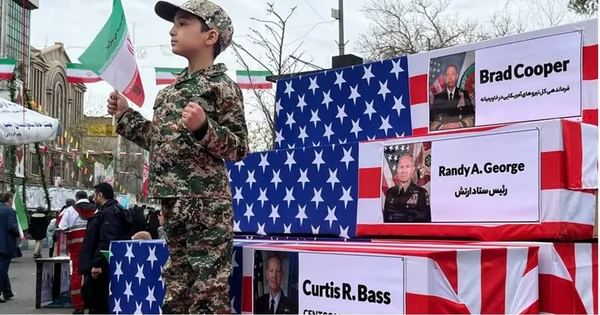
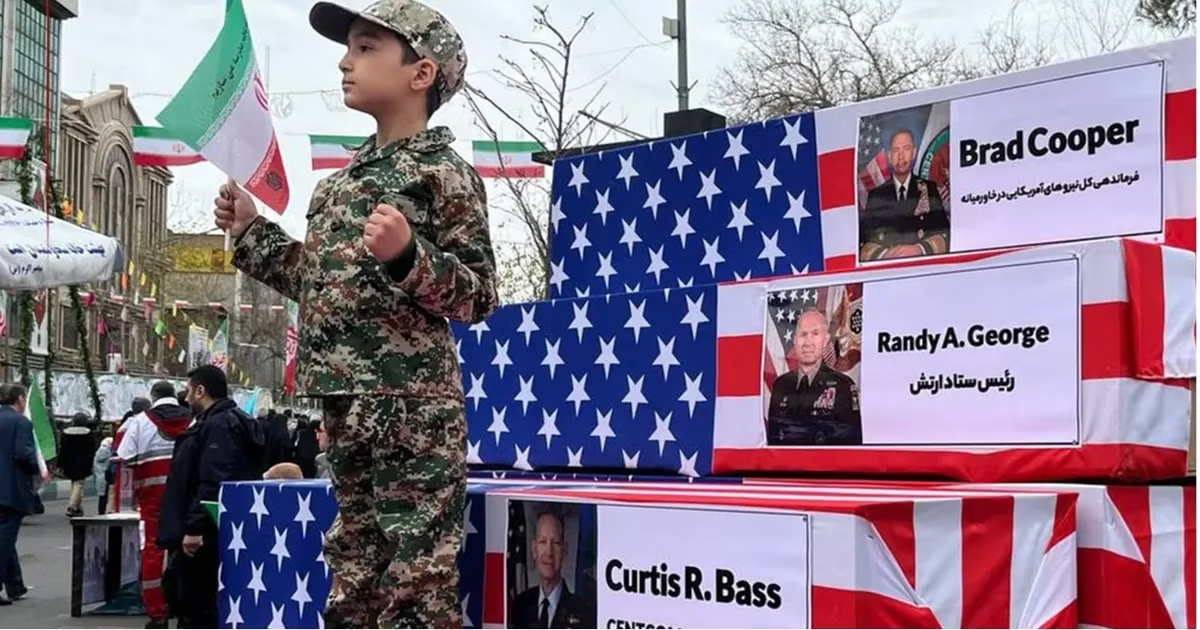
Recently, the drumbeat of war in the Middle East has been escalating, with American military reinforcements off the Iranian coast reaching unprecedented levels of readiness. It seems that the chasm between Washington and Tehran is widening, making diplomatic solutions a distant option, as each side adheres to its rigid positions on outstanding issues.
Observers believe that the American negotiator has become more rigid in demanding concessions, considering that any flexibility at the present time might be interpreted as a free retreat in front of the adversary. In contrast, the Iranian regime finds itself in a tight corner it has not experienced for decades, as its internal legitimacy and external pressures are subjected to severe tests that could destabilize it.
Recalling the experience of the invasion of Iraq casts a dark shadow over the current scene, as facts have proven that wars are not just a military stroll, no matter how imbalanced the balance of power. The fall of the Iraqi regime previously led to a reshaping of the regional sphere in a way that produced geopolitical disasters, and the peoples of the region paid heavy prices for their security and stability.
There are no real signs of progress in negotiations on the horizon, as the United States cannot retreat without achieving gains commensurate with the size of its military buildup. Similarly, the Iranian regime refuses to make fundamental concessions on ballistic missile and nuclear programs, as they represent essential pillars for its survival and the continuity of its political project.
A fundamental question arises in Arab circles about the shape of the region the day after the fall of the Iranian regime, and whether the new equations will serve stability or increase the intensity of chaos. Despite widespread criticism of Tehran's regional policies and its interventions in Arab affairs, a complete collapse of the regime could open the gates of hell for everyone.
Analyses suggest that the Iranian regime, which possesses a deeply rooted institutional and security structure, will not fall easily without a long-term war of attrition. If it feels an existential threat, it may resort to a retaliatory policy targeting neighboring countries and vital interests in the region, especially given the difficulty of direct access to fortified American targets.
Threatening to close vital waterways, such as the Strait of Hormuz and Bab al-Mandab, represents an economic nightmare for Arab countries that rely on these routes to export their energy. Tehran is likely to use its proxies in the region to carry out these threats, putting global trade and Arab national security in the eye of the storm.
There are serious fears that the overthrow of the regime could lead to the dismantling of the Iranian state and its transformation into warring cantons, a scenario whose impact could extend to other countries in the region. This geopolitical fragmentation will create a state of security vacuum that will only benefit powers aspiring to dominate the resources of the Middle East.
Talk of war coincides with the emergence of declared Israeli ambitions to expand its regional influence, exploiting the state of weakness and fragmentation that may afflict its neighbors. Experts believe that weakening major regional powers paves the way for the implementation of settlement and expansionist projects that transcend the current geographical borders of occupied Palestine.
Even if a new Iranian regime emerges, expectations indicate that it may be a creation of international powers, making it a tool in the hands of external axes rather than a stable neighbor. There is a fear of forming new alliances that include 'post-mullah' Iran with powers such as India, placing the Arab world between the jaws of a strategic pincer.
Reproducing the cycle of wars and attrition in the region will only lead to further squandering of wealth and the loss of the future of coming generations. The zero-sum competition between regional powers has proven its failure to achieve security, but rather contributed to deepening the sectarian and political divisions that have ravaged the body of the Arab nation.
Cold political calculations impose on Arab capitals the necessity of acting to prevent a slide towards a comprehensive military confrontation whose outcomes are unknown. The goal must be to preserve the state entity and prevent chaos, while working to modify the behavior of the Iranian regime through diplomatic channels and measured pressures.
Any change imposed by external military force often ends in counterproductive results, as previous experiences in the Arab region and its surroundings have shown. Therefore, Arab interests dictate avoiding being drawn into projects that may appear outwardly to be salvation from an enemy, but inwardly carry the seeds of comprehensive destruction.
In conclusion, the bet remains on the awareness of Arab peoples and regimes of the necessity of protecting their collective security away from sharp international polarizations. For a war on Iran, if it occurs, will not be just a passing event, but will be an earthquake that will redraw the map of the region in a way that may not serve Arab interests for many decades.
Cold calculations compel Arabs to press to prevent war, because the catastrophic results will ultimately serve expansionist projects in the region.
Share your opinion
Why do Arabs fear the scenario of regime change in Iran? A reading of the geopolitical repercussions