






Washington — Saeed Erikat – 27/2/2026
News Analysis
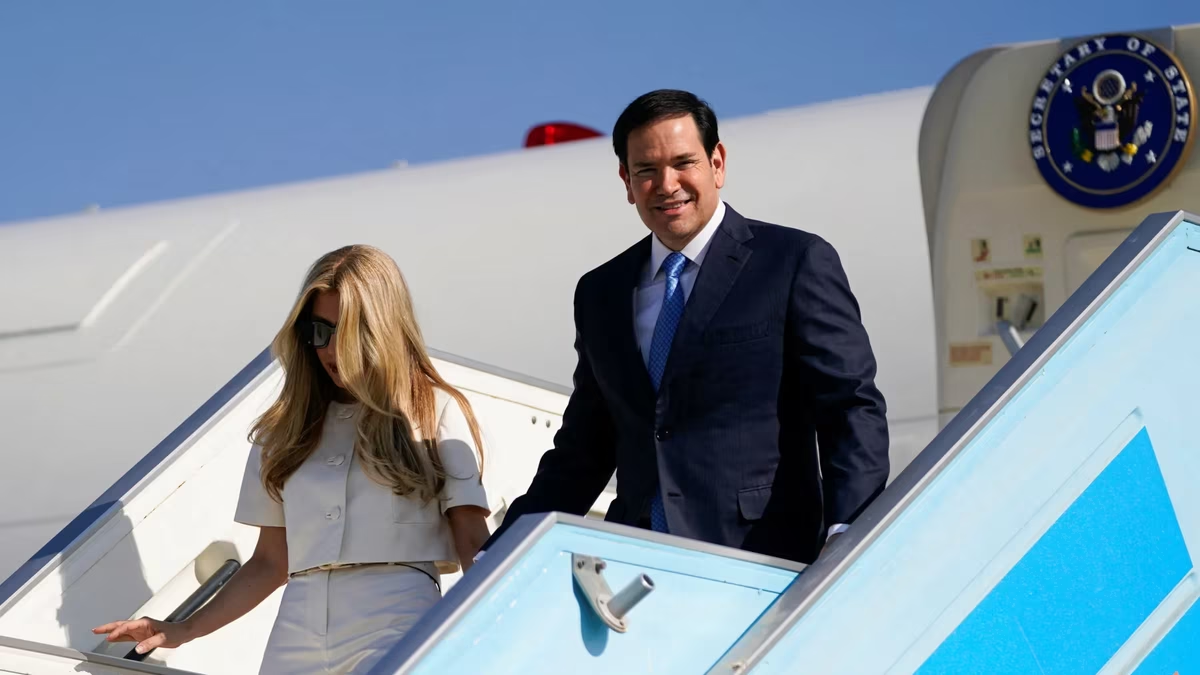
The anticipated visit of US Secretary of State Marco Rubio to Israel from March 2-3, 2026, reflects an American attempt to reset the course of regional policy in the Middle East, amidst the ongoing repercussions of the Gaza war and escalating fears of expanding regional tensions.
According to the US State Department, Rubio will discuss a range of issues with Israeli officials, most notably Iran's regional influence, tensions on the northern border with Lebanon, in addition to ongoing efforts to implement the 20-point peace plan proposed by President Donald Trump for the Gaza Strip. Although the visit is presented within a routine diplomatic framework, its timing reveals a sensitive transitional phase in US strategy towards the region.
From War Management to Engineering the Political Phase
Nearly two years after the war that altered political and security balances in the Middle East, Washington appears to be moving from a phase of crisis containment to an attempt to formulate long-term arrangements for the post-conflict phase. Rubio's visit comes in the context of this shift, as the US administration seeks to develop a practical vision for the political and security management of Gaza after the war.
The American peace plan, whose full details have not yet been revealed, is based on linking reconstruction with new security measures and different governance arrangements aimed — according to American officials — at preventing the Strip from returning to cycles of repeated military confrontation.
However, this approach reflects an old problem in American diplomacy: reconstruction requires political legitimacy, while legitimacy itself remains hostage to sovereign and security issues that have not yet been resolved. Therefore, observers believe that Rubio's mission is not aimed at achieving an immediate diplomatic breakthrough as much as it aims to unify the American-Israeli vision on what can be considered a realistic path for the next phase.
Iran and the Regional Deterrence Equation
Iran's regional role is expected to be central to the talks. Washington believes that Tehran's support for its allies in the region is a key factor in the continuation of instability, while Israel considers the Iranian presence near its borders to be the most prominent long-term strategic threat.
Accordingly, Rubio's visit carries a dual dimension: reaffirming the American commitment to Israel's security, and at the same time attempting to adjust the deterrence equation to prevent the region from sliding into a wider confrontation. The main challenge for Washington is to deter escalation without reaching a comprehensive direct confrontation.
The danger of this balance is highlighted by the increasing tensions on the Lebanese-Israeli border, where intermittent clashes raise fears of a limited conflict turning into a multi-front war. In this context, American diplomacy seems closer to managing risks than to resolving the roots of the conflict.
Rubio's visit reveals a deeper shift in American strategic thinking. Instead of seeking a comprehensive settlement — as was the case in previous stages of American diplomacy — Washington today tends towards a gradual approach based on first stabilizing the situation, through deterrence, regional cooperation, and economic reconstruction.
This approach reflects lessons learned from past failures, where major initiatives often clashed with political realities that could not be overcome by theoretical agreements alone. However, the gradual approach also carries clear risks, as it could turn into permanent crisis management instead of resolution.
Reconstructing Gaza, without a convincing political horizon for Palestinians, could create a fragile stability that does not address the deep causes of the conflict. Moreover, the multitude of international and regional mediators today reduces the United States' ability to monopolize the role of the main mediator, as it did in past decades.
Test of American Influence
The visit also represents a test of the actual extent of American influence in affecting Israeli decisions, especially given the complexities of internal politics on both sides. In the past, a close strategic partnership was sufficient to translate diplomatic coordination into tangible political changes, but today this ability is more constrained by intertwined internal and regional factors.
It is likely that the success of the visit will not be measured by major announcements, but by its ability to prevent deterioration: containing escalation on the northern front, maintaining security coordination, and keeping the Gaza reconstruction process ongoing pending more mature political conditions.
In conclusion, Rubio's visit reflects a shift in the nature of the American role in the Middle East — from a maker of major settlements to a manager of complex balances. While Washington seeks to remain an indispensable player in the region, the question remains open as to whether crisis management policy can truly produce lasting stability, or if it merely postpones potential future explosions.
Share your opinion
Rubio's Visit to Israel: An American Attempt to Shape the Post-Gaza Phase Amidst a Turbulent Regional Environment