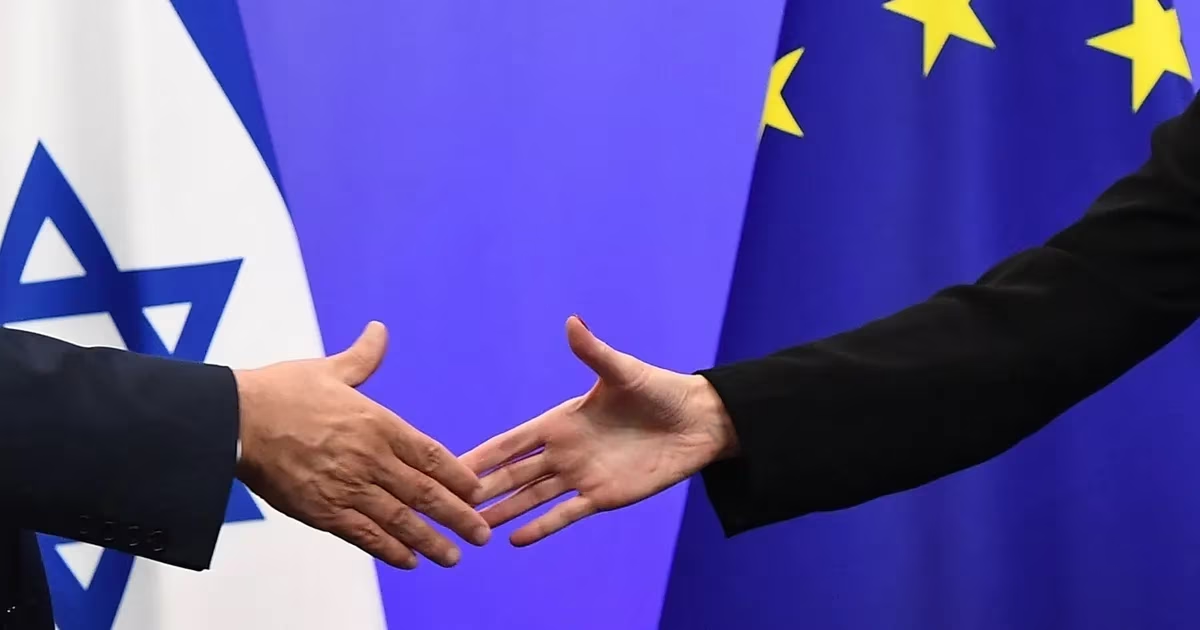







Voices within the political and strategic circles in the occupying state have escalated, emphasizing the necessity of preserving and developing the partnership with the European Union, warning against the repercussions of losing this vital ally. These calls come at a time when international relations are witnessing increasing complexities, with Brussels viewed as an indispensable regulatory and economic pillar amidst the changing global landscape.
Shai Gal, an expert in international politics and crisis management, affirmed that recent aggressive statements by Israeli officials against the European Union do not serve national interests. He clarified that these stances, including statements by Justice Minister Yariv Levin, are often directed at internal electoral consumption and do not reflect a long-term strategic vision for the state.
Gal described the European Union as the occupation's primary and essential trading partner, emphasizing that it is not merely a political bloc or a leftist ideology, as some promote. He pointed out that this bloc represents the largest integrated economy in the world, making it a crucial element in the stability of the Israeli economy and its future growth.
Economic figures demonstrate the extent of mutual dependence, with over a third of Israeli imports coming from EU countries, while a third of Israeli exports go to European markets. Hundreds of Israeli companies directly rely on access to these markets to ensure their continuity and expansion in various vital sectors.
Cooperation extends beyond trade aspects to vital infrastructure, including aviation, technical standards, and financial regulations. The partnership with Europe also plays a pivotal role in scientific research, infrastructure security, civilian cybersecurity, in addition to sensitive energy files.
The analysis indicated a perception gap between the two sides, where political noise sometimes overshadows the essence of common interests. While Europe views Israel as a unique case separate from its regional context, the occupation sometimes tries to pretend it has no absolute need for European support, which the author described as an illusion.
In contrast, Europe finds in Israel an important source of operational and technological assets, especially in intelligence, security, and defense. The author believes that portraying Israel as a perpetually problematic party contributes to marginalizing genuine European interests and weakens effective communication channels between the two sides.
Gal addressed the issue of European criticism of the occupation's policies, urging Tel Aviv to distinguish between political opposition and antisemitism. He considered that conflating concepts harms Israel's credibility and weakens genuine efforts to combat hatred, emphasizing that most European countries seek meaningful dialogue, not a war of slogans.
The author stressed that the stances of countries like Spain, Ireland, and Belgium do not necessarily mean that the European Union as a whole adopts a hostile position. The Union operates according to complex mechanisms and balances between the Commission, Council, and Parliament, which requires more intelligent Israeli engagement and understanding of voting rules and coalitions.
Brussels' importance is doubly highlighted in light of what the author described as the 'volatile American reality' under Donald Trump. Analysts believe that American policy, based on immediate deals and interests, makes strong and stable strategic alternatives like the European Union necessary.
The analysis cited Trump's handling of the Greenland island and Denmark issue as an example of Washington's potential abandonment of its allies if interests conflict. This behavior created a conviction among some Israeli circles that the alliance with Washington could become a bargaining chip at any moment, necessitating caution.
The Israeli expert called for quiet coordination with European capitals that share Tel Aviv's concern about unexpected scenarios in American policy. The goal is not to stand against the United States, but to protect common interests from fluctuations and red lines that the American president might cross.
The article concluded that coordination with Brussels is less personal and more institutional and mechanistic compared to dealing with Washington, making it more predictable. Given these facts, the relationship with Europe becomes a strategic 'insurance policy' that protects Israel from major political shocks.
This reading confirms that the professional and political elite in Tel Aviv fully realize the extent of the risks resulting from isolation from the European sphere. Therefore, the call to strengthen ties with the European Union represents a security and economic necessity that transcends fleeting political disagreements or sharp media statements.
The European Union is not an ideological camp; it is the world's largest integrated economy and an insurance policy against American volatility.




Share your opinion
Israeli Calls to Fortify Partnership with Europe to Counter Trump's Policy Volatility