






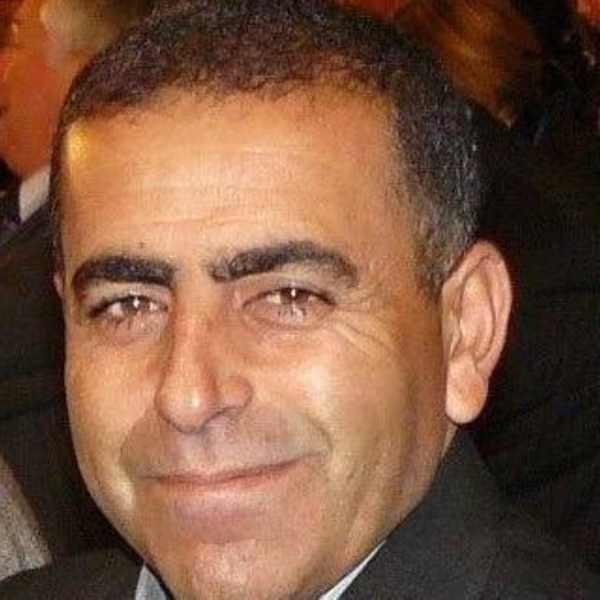
What is happening today in the Palestinian arena is not merely a verbal or political conflict, but a reflection of profound transformations imposed by the October events and the subsequent devastating war and severe political and security blockade, which made all previous calculations subject to reconsideration. Azzam al-Ahmad's statement, Secretary of the Palestine Liberation Organization and a prominent leader in the Fatah movement, when he affirmed that Hamas is not a terrorist organization and rejected its disarmament by external decision, cannot be understood in isolation from this complex context. It does not constitute a direct challenge to the United States as much as it indicates a political window opened to manage the transitional phase before it is lost, and it clarifies that there is room to deal with Hamas within the new political reality without escalation that harms international efforts to restore stability.
After pushing its armed resistance program to its limits, Hamas today finds itself facing a real transitional phase, similar to what the Fatah movement went through when it shifted from armed struggle to political action within a comprehensive national framework represented by the Palestine Liberation Organization. The peak of its military program has been exhausted, and the path before it is limited between continued isolation and confrontation or engaging in political transformation that allows it to participate within the Palestinian system. This transformation does not mean losing its identity completely, but rather readjusting its roles in line with the new phase. Managing this change rationally could transform the potential threat from Hamas into an element of control and stability, while ignoring it could complicate any efforts to rearrange the Palestinian scene.
At the same time, the Palestinian National Authority and the Organization are under significant pressure to implement real reforms, but they show clear pragmatism, realizing that any future step in Gaza requires balancing with American and international interests to maintain stability. Completely excluding Hamas or attempting to impose full hegemony over Gaza could lead to a security and social vacuum, as it is not just an armed faction, but a broad popular base extending within the Strip and capable of influencing the stability of any political arrangements or reconstruction. Ignoring this reality makes any American or international plan mere illusions prone to failure, and therefore there appears to be practical tolerance for some administrative and police elements that served Hamas, provided they operate under the supervision of the National Authority and under international oversight to ensure that a dual power equation is not reproduced.
The matter is not limited to the administration of Gaza only, but extends to the Palestinian national structure itself. The existing structures, including the PLO, may not fully reflect today's complex reality, and thinking about creating a new comprehensive Palestinian body with a name and political program that keeps pace with the phase may be a necessity to accommodate all active forces on the ground. This does not mean completely dismantling the Organization or losing its international legitimacy, but rather redefining and expanding it to include everyone within a clear political program while maintaining international recognition. The Israeli experience can be studied, where the Islamic Movement and parties like the United Arab List in Israel have shown that an Islamic current can practice politics within the official system without losing its identity, as a model that could be beneficial in the Palestinian context, taking into account the complex relationship between Hamas and Fatah.
The transformation witnessed in the Palestinian reality is not just a tactical adjustment, but a comprehensive redefinition process that includes updating the Organization's charter, renewing its leaderships, and opening the door to forces that accept working within a comprehensive national program, including Hamas if it accepts the necessary political transformation. Managing this transition rationally will allow transforming the challenge from Hamas into an element of stability, while ignoring it or proceeding with dismantling the current framework could create a greater rift and complicate any international or American efforts to rearrange the scene.
The current phase represents a historical moment that could redraw the Palestinian scene, as international and regional pressure converges with the internal necessity for change, and the need arises to manage an organized transition that preserves legitimacy and accommodates realistic transformations, and allows for long-term stability, with the understanding that any success depends on the ability of all parties to adapt to a new reality, where the integration of forces, the reform of national structures, and dealing with Hamas as a popular and political force become part of survival strategies and controlling the Palestinian future. Redefining and formulating the national framework in accordance with the new reality without losing the historical gains of international legitimacy represents the main challenge facing Palestinians today.
Share your opinion
PLO Secretary's Statement: Challenging America or Opening a Window for Change?