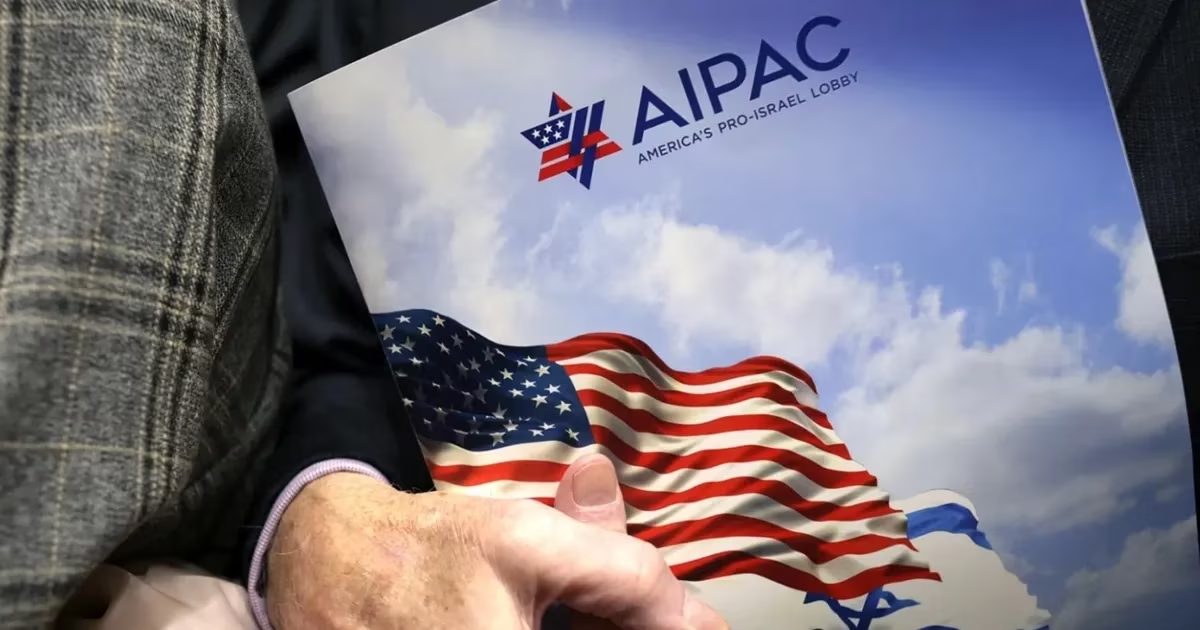







The American Israel Public Affairs Committee (AIPAC) is facing an unprecedented crisis in maintaining its traditional narrative, which considers support for the Israeli occupation a strategic necessity for American national security. Analytical sources reported that the assumptions on which the organization has operated for decades no longer resonate widely in Washington's decision-making circles, especially with the shifting international balance of power and the emergence of new global challenges that top the American administration's priorities.
Observers believe that the environment in which AIPAC thrived during the Cold War years has fundamentally changed. Israel is no longer classified as the sole strategic asset for countering foreign influence in the region. This shift has weakened the fundamental pillars that enabled the organization to impose its dominance on the political discourse in the United States, making massive financial spending on lobbying campaigns insufficient to address structural challenges.
Paradoxically, recent normalization agreements have contributed to undermining some of the arguments AIPAC used to promote, as they proved that countries in the region can build their relationships based on their own interests and regional power dynamics. This regional integration may proceed in ways that do not necessarily require traditional American mediation or the advocacy style that the organization championed for many years.
The collapse of bipartisan consensus between the Republican and Democratic parties is considered the biggest challenge facing the Israeli lobby, as support for the occupation is no longer a position that transcends internal political differences. The increasing polarization in American politics has reflected genuine differences over strategic priorities, making opposition to AIPAC's positions politically possible after it was previously described as political suicide.
In a related context, young voices within the Democratic Party have begun to seriously question the extent to which absolute support for Israeli governments aligns with contemporary American values and interests. Conversely, some right-wing voices have started to question the utility of massive foreign aid, creating a competitive environment with the emergence of alternative organizations like J Street, which broke AIPAC's monopoly on the market of political ideas related to the Middle East.
The ongoing war in the Gaza Strip revealed additional weaknesses in AIPAC's performance, as its automatic defense of Israeli military operations led to a clash with broad segments of American public opinion. This stance put the organization at odds even with segments of American Jews who now see the occupation policies as a threat to regional stability and international humanitarian values.
In conclusion, the Middle East no longer occupies the same central position in American strategic thinking amidst intense competition with China and the repercussions of the war in Ukraine. Although AIPAC still possesses financial resources and deep connections in Congress, it now operates in an environment where its dominance is no longer assumed, as alternative voices are heard and more influential in shaping foreign policy.
AIPAC's recent trajectory reveals its struggle to adapt to radical changes in the strategic landscape, more than it reveals ethical issues.



Share your opinion
Erosion of AIPAC's Influence in Washington: Has the Era of Absolute Dominance by the Israeli Lobby Ended?