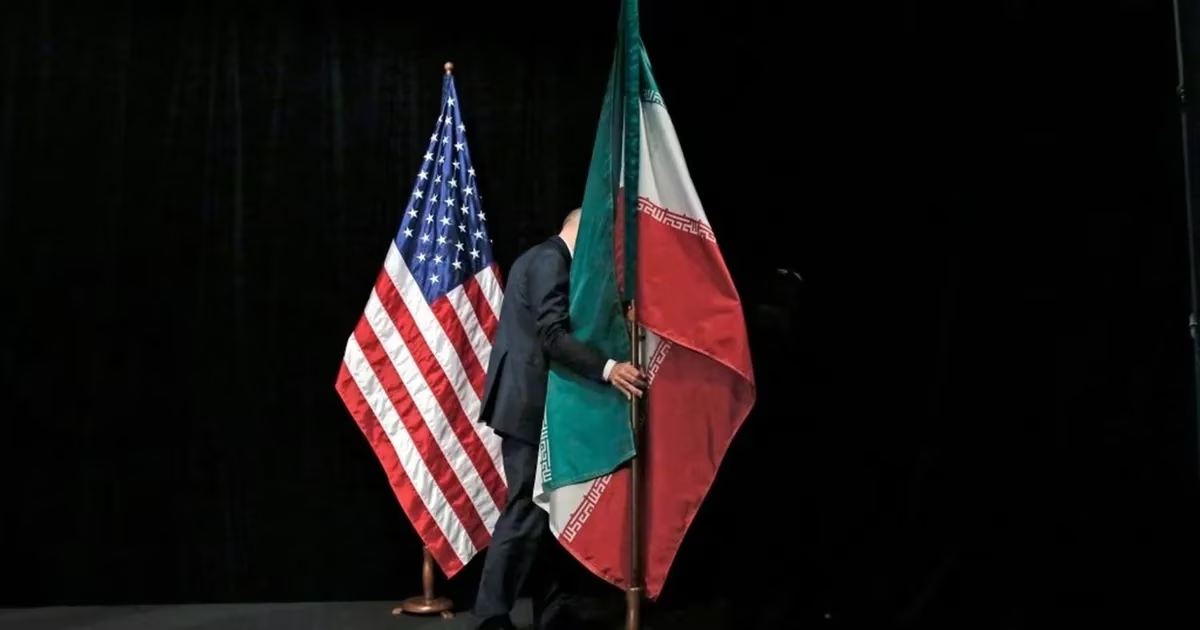







Hebrew journalistic circles have discussed the expected trajectories of the relationship between the United States and Iran, in light of escalating field tensions and increased American military deployments in the region. Analytical readings questioned the possibility of a third option that transcends the dichotomy of a comprehensive nuclear deal or direct military confrontation, especially with recurring reports of aircraft carrier movements.
The sources considered that the current geopolitical reality might not be confined to two polar options, but rather that a tactical agreement might be being prepared, allowing all parties to exit the crisis without declaring surrender. This analysis comes at a time when the echo of American air reinforcements resonates, coinciding with diplomatic meetings between Trump administration envoys and the Iranian Foreign Minister in Geneva.
Military movements raise a fundamental question about Trump's objectives, and whether he is sending troops to launch an actual military campaign or to impose a new zone of control that makes the cost of refusing negotiations prohibitive for Tehran. Observers believe that this approach represents the core of Trump's negotiating doctrine, which relies on creating a tangible threat to break stalemates in complex issues.
Hebrew analyses recalled the 2017 experience with North Korea, when Washington used extreme rhetoric that ultimately led to the historic Singapore summit. Although that path did not lead to complete nuclear disarmament, it achieved a significant tactical shift in managing the conflict and mitigating direct threats.
In the Russian-Ukrainian arena, Trump applied a dual ultimatum strategy by pressuring all parties involved in the conflict to reach settlements. He hinted at stopping aid to Kyiv in the absence of flexibility, and threatened Moscow with a qualitative weapon to break the truce if it did not cease fire, reflecting a strict pragmatic approach.
The current military buildup against Iran indicates an attempt to use a 'big stick' to bring about political movement similar to what happened in other international issues. When the alternative to an agreement becomes dangerous and costly, parties begin to consider compromises that were previously classified as impossible, which may open the door for partial deals.
The 'third option' is known as a tactical deal that differs fundamentally from historical strategic agreements that seek to resolve conflicts from their deep roots. This path represents a practical mechanism for risk management, aiming to contain the current situation and prevent its explosion without the need for major sovereign concessions from any party.
This agreement's principle is based on 'silence for oxygen,' a solution designed to manage the crisis rather than perfectly end it. This path is expected to require the Iranian side to relinquish some tactical assets, such as reducing certain levels of uranium enrichment or restricting the movements of proxies in the region.
In return, Tehran will receive much-needed 'economic oxygen' amidst crippling sanctions, through exemptions allowing oil sales and the unfreezing of some financial assets. This trade-off aims to alleviate internal Iranian pressure in exchange for regional security guarantees requested by Washington and its allies.
As for the American side, this agreement achieves what is described as 'industrial peace' and freezes the status quo at a controllable point. This path allows Trump to fulfill his electoral promises related to avoiding involvement in costly and perpetual wars of attrition in the Middle East.
The Israeli reading confirms that Trump prefers tangible and quick results over lengthy negotiations that may not lead to immediate outcomes. Therefore, the display of military power serves a dual purpose: deterrence on the one hand, and improving negotiating terms at the table on the other, to ensure real Iranian concessions.
The question remains about the Iranian regime's ability to accept such tactical trade-offs without it appearing as a strategic retreat to its people and allies. However, increasing economic pressures may push decision-makers in Tehran to maneuver within the 'third way' to avoid a comprehensive confrontation scenario.
Movements in Geneva and the buildup in the region's waters indicate that we are facing an advanced stage of diplomatic and military 'finger-pointing.' The coming weeks are likely to see a clearer crystallization of this tactical path, especially if American pressure succeeds in pushing Tehran to the negotiating table with new conditions.
In conclusion, Hebrew sources believe that current American policy is redefining the rules of engagement with Iran by integrating direct military threat with conditional economic opportunities. This mix aims to create a new reality in which all parties are forced to accept half-solutions to avoid the major catastrophe that could result from any armed conflict.
The third way is a tactical agreement and a risk management mechanism based on the principle of silence for oxygen, not an ideal agreement to resolve the conflict from its roots.



Share your opinion
An Israeli Reading of Washington and Tehran's Options: Is Trump Paving the Way for a Tactical Agreement Away from War?