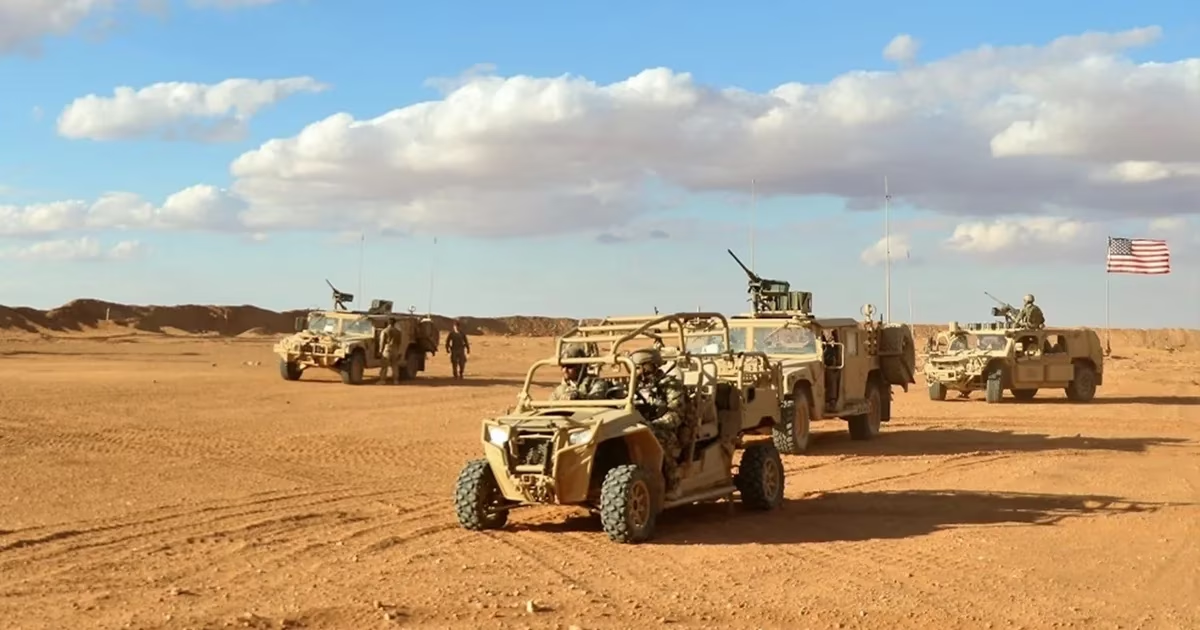







The political history of great powers indicates that attrition does not always occur through major military defeats, but rather by clinging to secondary fronts that no longer serve the vital interests of the state. The US military presence in Syria is currently going through this critical phase, where remaining in field positions has become less rational than making a deliberate strategic withdrawal decision.
Since the military intervention began in 2014 to confront ISIS, the United States has succeeded in dismantling the group's geographical structure and preventing its use of Syrian territory as a platform for international threat. However, the mission gradually expanded to include containing Iranian influence and managing complex balances, which transformed the military presence into a long-term commitment with low strategic returns.
International press reports during 2024 revealed serious discussions within the US Department of Defense about the future of forces deployed in northern Syria. These reviews come amidst rising security risks and changing global priorities imposed by new challenges in geographical areas more critical to US national security.
Official figures released by the Pentagon indicate that the number of US troops in Syria ranges between 800 and 900 soldiers, a limited but high-risk deployment. These forces have been subjected to more than 150 rocket and drone attacks since October 2023, raising the cost of operational protection to unprecedented levels.
Financially, billions of dollars are drained annually within the allocations for Operation 'Inherent Resolve' to support this limited military presence. This spending raises fundamental questions in Washington about the feasibility of continuing these costs at a time when the US administration seeks to rationalize military spending and direct it towards more vital operational theaters.
The shift in American strategic thinking has become evident in the national security documents for 2022 and 2023, where great power competition, primarily with China, topped the list of threats. This trend necessitates a transition from an open deployment model in the Middle East to a 'smart balancing' model that focuses on remote deterrence.
Experts believe that military and political resources are not limitless, and their allocation to low-priority theaters such as Syria may weaken the ability to deter in sensitive areas like Eastern Europe. Therefore, the presence in Syria appears to be a remnant of the 'War on Terror' era that no longer aligns with Washington's new grand strategy.
Regarding deterrence and credibility, some argue that withdrawal might be interpreted as a sign of weakness, but reality indicates that deterrence depends on actual capability, not symbolic presence. The United States possesses the ability to intervene rapidly from neighboring regional bases and employ advanced intelligence and cyber tools to manage balances without the need for a permanent physical presence.
Any decision for a US withdrawal will have a direct impact on the calculations of regional powers, foremost among them Israel, which views this presence as an indirect balance against Iranian expansion. However, Tel Aviv primarily relies on its own capabilities to carry out preemptive operations, which reduces the impact of the US field absence on it.
For Turkey, the Syrian file is linked to security concerns regarding Kurdish forces in the northeast, making it a key party in any future security arrangements. An organized withdrawal requires close coordination with Ankara to ensure that a security vacuum does not occur, which could lead to a new military escalation on the Turkish-Syrian border.
Jordan, in turn, is monitoring developments cautiously, as border security and preventing arms and drug smuggling operations are a top priority for Amman. Continued effective intelligence coordination remains an urgent Jordanian demand, whether the direct US presence continues or is replaced by internationally supported regional security arrangements.
From a purely strategic perspective, the US mission in Syria has exhausted its original justifications, and the military presence is no longer capable of decisively preventing Iranian influence. Instead, this presence exposes American soldiers to the risks of an uncalculated escalation that could drag Washington into conflicts it does not wish to engage in.
Safe and organized withdrawal requires parallel paths, including strengthening regional intelligence coordination to prevent the return of extremist organizations. Local security arrangements must also be supported to give regional powers greater responsibility in managing their affairs, with a readjustment of legal frameworks for the use of force when absolutely necessary.
In conclusion, the issue is not just about Syria, but about the United States' ability to redefine the concept of power in a multipolar world. Proving that a deliberate withdrawal is an act of strength, not a sign of weakness, will be the true test of the American role in the international system over the next decade.
A successful strategy is not one that avoids withdrawal, but one that knows when to end a mission that has exhausted its usefulness and no longer yields security returns commensurate with its cost.


Share your opinion
US Withdrawal from Syria: A Strategic Imperative Amid Shifting International Priorities