





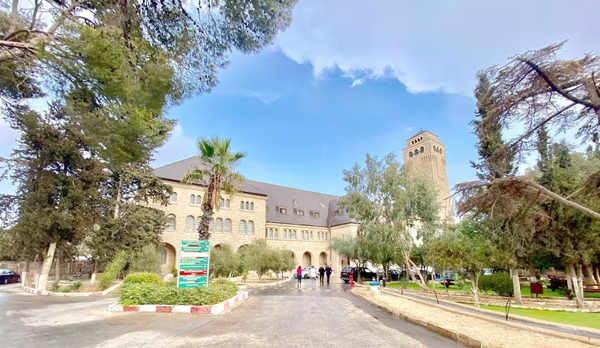
Dr. Hani Abdeen: From treating refugees to a national reference in oncology and bone marrow transplantation. Dr. Fadi Al-Atrash: We are elevating our quality services for Palestinian patients despite increasing difficulties. Palestinian hospitals in Jerusalem constitute a fundamental pillar of the Palestinian health system, playing a pivotal role in providing advanced specialized services to thousands of patients from Jerusalem, the West Bank, and the Gaza Strip. The role of these hospitals is not limited to providing treatment; it extends to training medical staff, contributing to the development of health policies, and preserving national identity in the city amidst complex political and economic challenges. Al-Mutlaa Hospital \"Augusta Victoria\" stands out as one of the most important of these institutions, due to its precise specializations, particularly in the treatment of tumors, blood diseases, bone marrow transplantation, and elderly care. For decades, it has served as a reference center for Palestinian patients and a primary destination for complex cases requiring advanced medical care within a professional and humane environment that respects patient dignity and privacy. \"Y\" met with Dr. Hani Abdeen, the Medical Director of the hospital, and Dr. Fadi Al-Atrash, the Executive Director of the hospital, to shed light on the medical and health services and their development, medical and clinical education, and the training of future cadres for the Palestinian health system, in addition to the challenges and financial crisis affecting it, and its future plans. Establishment after World War II Abdeen began his speech by saying: Al-Mutlaa Hospital was established in 1950, after World War II, and in its early days, it was the main headquarters for treating Palestinian refugees after the Nakba. It developed in multiple areas until 1996, when it faced a funding crisis due to a defect in the support provided by UNRWA, which affected the continuity of service provision. He added: After the arrival of the Palestinian Authority in 1994, and the presence of the Palestinian Ministry of Health as an official reference, the hospital was no longer the only accredited entity for treating refugees, which necessitated a review of its strategy and the development of its services to meet the needs of the Palestinian community as a whole, both refugees and others. The hospital's location necessitated adopting an integrated, not competitive, policy Abdeen pointed out that the hospital's location on the Mount of Olives, about half a kilometer from Al-Makassed Hospital, necessitated adopting an integrated, not competitive, policy, so that complementary services to those provided by Al-Makassed are developed, and duplication in specializations is avoided. He explained that among the most prominent areas the hospital focused on was the development of cancer and blood disease treatment services, in addition to establishing a dialysis center for children, as at that time there was no Palestinian center treating children with chronic kidney failure. The integrated infrastructure for tumor treatment was also established, including radiotherapy, chemotherapy, and palliative care, in addition to updating the necessary medical equipment. Later, a bone marrow transplant unit was established for adults and children, especially thalassemia patients, where the success rate in this field reached about 98%, which is a very high rate. Enhancing Clinical Medical Education Medical Director Abdeen affirmed that the hospital did not only develop therapeutic services but also worked to enhance clinical medical education, recognizing the urgent need to prepare specialized health cadres locally, instead of relying on external scholarships. The hospital obtained recognition from the Palestinian Board in oncology, hematology, and radiotherapy specializations, and also received recognition from the Arab Board, making it the only hospital in Palestine accredited in palliative care. Abdeen explained that palliative care is concerned with alleviating the pain of patients who have reached advanced stages of cancer, improving their quality of life, and providing humane care that preserves their dignity, in addition to educating families on how to deal with the patient, with the possibility of receiving home care whenever possible. He pointed out that the hospital pays increasing attention to scientific research in the field of oncology and works to integrate medical research as an essential part of staff training, in cooperation with local universities, especially Al-Quds University, which contributes to the development of scientifically based treatments that serve Palestinian patients. Commemorating World Cancer Day through media campaigns and readable and visual materials Regarding awareness activities, Abdeen explained that the hospital is keen to commemorate World Cancer Day through media campaigns and readable and visual materials, in addition to launching awareness podcasts. It also organizes special events for breast cancer and operates a mobile clinic that travels to areas of Jerusalem and its suburbs, the West Bank, refugee camps, and remote and medically marginalized areas to conduct early examinations, especially mammography, with the aim of early detection before the disease worsens. Dr. Abdeen clarified that the mobile clinic also includes a diabetes clinic, which provides its services in Jerusalem and the West Bank, including Bethlehem, Qalqilya, Tulkarm, Hebron, and Masafer Yatta, by educating patients and providing treatment and medical guidance. Future Plans Regarding future plans, Abdeen affirmed that the hospital aspires to expand cancer patient services, so that all examinations are available in one place, without the patient having to move between different institutions. Plans include opening an endoscopy center (gastroscopy, colonoscopy, and bile duct endoscopy), due to the prevalence of colon and intestinal cancers and the need for early detection. Abdeen added: The hospital also seeks to develop elderly care services, given the increasing need for intermediate care between hospital and home, for patients who require long-term medical and nursing follow-up. In addition, the hospital intends to expand clinical research to study the effect of drugs on Palestinian patients, especially since most global studies are conducted on communities that differ in their lifestyle and diet from the Palestinian community. Medical Director Abdeen concluded his speech to "Y" by emphasizing that these plans require financial support and stability, expressing his hope that the hospital will be able to continue developing its services to serve patients and enhance its position as a reference medical center in Palestine. The main challenges are in three axes In turn, Dr. Al-Atrash began his speech to "Y" by saying: The hospital is a very strong and ancient institution, capable of enduring conditions and standing firm in the most difficult ones. And that this stage is one of the most difficult stages the institution has gone through since 1996. Al-Atrash pointed out that the main challenges facing the hospital are in three main axes: First: The general situation and geopolitical changes that affect the ability of staff and patients to access Jerusalem, in light of increasing Israeli procedures and requirements in terms of permits, licenses, and others. Second: The ability of patients to access Jerusalem, which is the most important problem, as it requires facilitating the issuance of permits and providing transportation, including buses coming from Hebron, Nablus, Ramallah, and other cities, in addition to providing the possibility for patients to stay in the vicinity of the hospital, as was previously practiced, especially for Gaza patients. Third: The financial crisis and the accumulation of debts on the Palestinian Authority as a result of the general economic situation, and the inability to pay bills in full on a monthly basis, as only partial amounts are paid by the Ministry of Finance, which is not enough. He pointed out that the hospital management is in continuous contact with donors and works to strengthen advocacy efforts to mobilize support for Jerusalem hospitals, especially Al-Mutlaa Hospital. He also noted another challenge, which is the limited specialized expertise supporting the hospital's development, but the institution is working to build and develop internal competencies, through education and training, to serve future plans. The financial crisis affected the speed of hospital development He explained that the financial crisis has indeed affected the speed of the hospital's development, and the ability to receive patients during certain periods, and has also affected the implementation of some developmental, service, and social programs. He stressed that without the financial crisis, the hospital's ability to expand and spread would have been much greater. Regarding Gaza patients, Al-Atrash explained that before the war, about 30% of patients referred to Al-Mutlaa Hospital, or to the Jerusalem hospital network in general, were from the Gaza Strip. However, since the beginning of the war, no patient has been referred from the Strip. Demand for restoring the referral pathway for Gaza patients He affirmed that the hospital demands the restoration of the natural and historical medical referral pathway for Gaza patients to Jerusalem and West Bank hospitals, due to its psychological and medical importance, as patients receive treatment in a familiar environment consistent with their culture, and the distance is shorter and their return to Gaza is easier. He pointed out that a number of patients who were in Jerusalem before the war and completed their treatment have already been returned, in coordination with Palestinian, Israeli, and international parties, after the ceasefire. Strict oversight in the context of attempts to erase national identity Regarding whether health institutions in Jerusalem are targeted, Al-Atrash said: Palestinian health institutions in the city, like other institutions, are subject to strict oversight, in the context of attempts to erase Palestinian identity. He affirmed that these institutions seek to remain in Jerusalem and serve the Palestinian people, as they are a backbone of the Palestinian health system, not only by providing services but also through advocacy, developing expertise, and contributing to shaping health policies. He explained that the Jerusalem hospital network includes six main institutions: Al-Mutlaa Hospital, Al-Makassed, the Red Crescent, St. Joseph, the Eye Hospital, and Princess Basma Institution, which have been in existence since 1997. The network works to coordinate efforts among its members, discuss common challenges, and demand support as a unified network, in addition to playing a role in advocating for the rights of Palestinian patients in Jerusalem, the West Bank, and the Gaza Strip. He affirmed that the network enjoys wide recognition from donor countries and is considered a partner in supporting the health needs of the Palestinian people. It continues to receive support from the European Union and from American entities, in addition to support from some Arab countries, especially the Gulf states, which has contributed to its continued operation despite difficult circumstances. Jerusalem hospitals are essential in the Palestinian health system Al-Atrash pointed out that Jerusalem hospitals are among the essential institutions in the Palestinian health system, and have graduated and trained a large number of doctors and experts, and are active partners in shaping health policies in cooperation with the Palestinian Ministry of Health. As for Al-Mutlaa Hospital's future plans, Dr. Al-Atrash explained that the hospital's strategic plan aims to consolidate its position as a scientific beacon in the Palestinian health system, especially in oncology, hematology, bone marrow transplantation, and elderly care. Plans include developing oncology surgery services, strengthening bone marrow transplantation programs, expanding elderly care services, and introducing new services to ensure the sustainability of the hospital as a pivotal health institution in Jerusalem and Palestine. In his message, Al-Atrash called on patients to seek treatment in Jerusalem hospitals, emphasizing that they not only provide treatment but also respect human dignity and privacy, and provide a level of care not available elsewhere. He also called on official Palestinian bodies to continue supporting the Jerusalem hospital network, not only through statements but through practical steps on the ground. He called on the international community to continue its support to ensure the survival of these institutions, given their significant role not only in the health field but also in preserving Palestinian identity in Jerusalem.

PALESTINE
Sun 15 Feb 2026 11:12 am - Jerusalem Time
Al-Mutlaa Hospital.. 75 Years of Medical Leadership and Ambitious Plans for Cancer Treatment

Tags
MORE FROM PALESTINE
Death of the Prisoner Imad Sarhan in Gilboa Prison After 25 Years of Detention
Bodies under displaced persons' tents.. Random graves double the tragedy of unidentified martyrs in Gaza

Tony Blair Joins Leadership of Peace Council's Executive Arm to Manage and Reconstruct Gaza



Share your opinion
Al-Mutlaa Hospital.. 75 Years of Medical Leadership and Ambitious Plans for Cancer Treatment