






International political circles are awaiting the United States to host, at the end of this February, a third and decisive round of negotiations concerning the Western Sahara dispute. This round aims to develop the autonomy proposal put forward by Morocco, amidst US efforts to reconcile this proposal with some technical demands presented by the Polisario Front in previous rounds.
These moves come after the Spanish capital, Madrid, hosted last week the second round of talks that included the main parties to the conflict, Morocco and the Polisario Front, in addition to Algeria and Mauritania as observers. These meetings took place under direct bilateral supervision from Washington and the United Nations, where the autonomy framework was adopted as the basic foundation for discussion.
Informed sources reported that the US administration is pushing to accelerate the pace of negotiations, having set February 27 and 28 as a preliminary date for the third round. The White House wishes to reach a comprehensive framework agreement before the end of next May, to ensure the transition to practical implementation stages before entering new international political complexities.
This intensive timeline is linked to an anticipated report to be presented to the UN Security Council next April, to assess the progress made in implementing UN Resolution 2797. This resolution explicitly states the necessity of serious political negotiations that take the Moroccan autonomy initiative as a realistic basis for a final and permanent solution.
Leaked data indicates that the negotiations have moved beyond generalities, with the principle of autonomy being decided upon and the revision of a 40-page technical document beginning. This document includes the integration of some demands contained in the Polisario's vision, provided they do not conflict with the essence of Moroccan sovereignty over the Saharan provinces.
In a related context, Washington, during the recent Madrid meetings, ruled out a return to old proposals such as 'Baker Plan II' which stipulated a transitional period ending with a referendum on self-determination. Instead, the current US administration is focusing on confining any political development within the framework of expanded autonomy exclusively under Moroccan sovereignty.
International experts, in coordination with Washington, are scheduled to participate in drafting the legal and administrative powers for the Sahara region, to ensure it enjoys broad independence in managing its local affairs. Interestingly, European experts, including France and Spain, have been excluded from these precise technical formulations, limiting them to the direct parties and international sponsors.
Regarding regional positions, Algeria's commitment to supporting the Polisario Front's stance is noted, with an emphasis on demanding strong international guarantees for any agreement reached. In contrast, Mauritania maintains a position of positive neutrality, with the condition of preserving its vital security and economic interests in the areas bordering its northern frontiers.
The proposed draft for discussion includes granting the Sahrawis the right to elect a local parliament and government, while the authority to appoint the head of the autonomous region remains with the Moroccan monarch based on election results. All symbols of Moroccan national sovereignty will also be preserved, including currency, external diplomatic representation, and national defense.
Media reports indicate that the proposed model may draw some of its provisions from Spain's autonomy system, especially regarding constitutional oversight mechanisms. Among these is the possibility of including a clause that allows the center to intervene in exceptional cases if there is a threat to the constitutional order or a deviation from the provisions of the concluded political agreement.
There are still outstanding issues that require in-depth discussions in the upcoming February round, foremost among them how to manage and share natural resources such as phosphates and fish wealth. Open files also include technical issues such as the region's flag, the extent of independence of local economic decisions from the capital Rabat, and the nature of trade relations with neighboring countries.
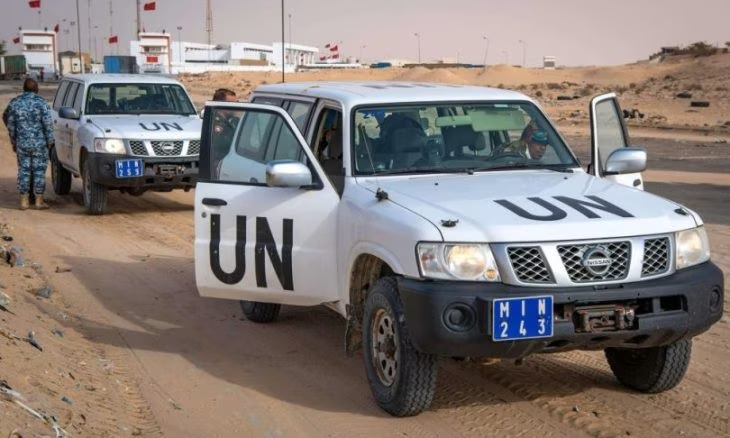
It is expected that the tasks of the United Nations Mission 'MINURSO' will undergo a radical transformation in the next phase, as the Security Council will discuss changing its original mandate related to the referendum. The mission may transform into a monitoring and support force for implementing the autonomy agreement, and ensuring all parties adhere to the new security and administrative arrangements that will be agreed upon.
Observers believe that the current US pressure reflects Washington's desire to close this chronic file that affects the stability of the North Africa and Sahel region. The US administration is betting that reaching an agreed-upon solution will enhance regional security cooperation and open new economic horizons in the Maghreb region.
Finally, the success of the February round remains contingent on the parties' ability to make mutual concessions on the precise technical details that follow the approval of the general principle. While Morocco expresses cautious optimism, the Polisario Front and Algeria await the nature of the international guarantees that Washington will provide to ensure the durability and stability of any future political solution.
The White House wants to sign a comprehensive framework agreement to resolve the conflict before the end of May to move to its actual implementation on the ground.


Share your opinion
Accelerated US Moves to Resolve Sahara Dispute: Anticipated Negotiation Round to Develop 'Autonomy'