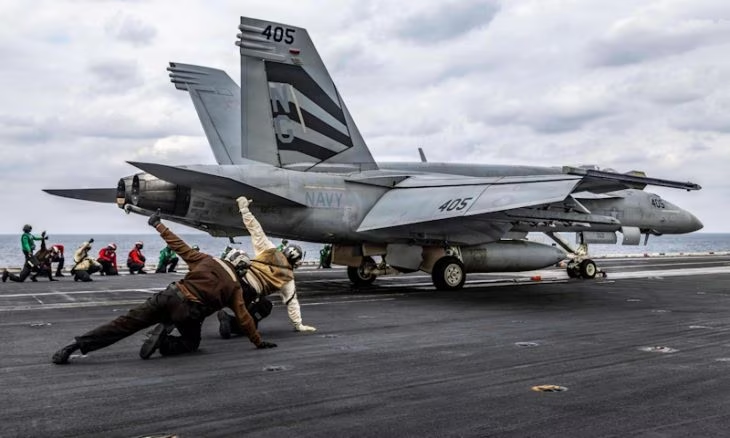







Amidst escalating tensions between Washington and Tehran and the faltering of traditional diplomatic channels, the question of a potential US military strike returns to the forefront of the international political scene. Observers believe that the military option is no longer just a bargaining chip, but has become a real possibility in light of recent field movements in the waters of the Arabian Gulf.
Omar Rahman, a researcher at the Middle East Council on Global Affairs, indicated that the wave of diplomatic activity witnessed in regional capitals recently was primarily aimed at avoiding an all-out war. These efforts culminated in indirect talks in the Sultanate of Oman in early February, which the American side described as positive, while Tehran considered them a step forward.
Despite these diplomatic signals, the movement of US naval assets, led by the aircraft carrier 'Abraham Lincoln', paints a completely different picture of the situation on the ground. This massive military buildup could be a prelude to an imminent military operation, or a calculated attempt to intimidate the Iranian leadership and push it to make fundamental concessions on the nuclear issue.
The foreign policy of the current US administration is characterized by improvisation and a lack of clear linear logic, making it difficult to predict the next step. A single decision may carry both a military threat and a negotiating card at the same time, which reinforces the state of strategic ambiguity favored by the White House.
In Washington, a strong and organized hawkish camp is pushing for direct confrontation and regime change in Tehran. This alliance includes neoconservatives and pro-Israel lobbies. They believe that Iran represents the last obstacle to establishing a new regional order dominated by a shared American-Israeli vision.
Israeli Prime Minister Benjamin Netanyahu plays a pivotal role in inciting the US administration, benefiting from his unrestricted access to the White House and his frequent official visits. Netanyahu consistently succeeds in portraying any Iranian move, however limited, as an existential threat requiring a decisive and immediate military response.
In contrast, a broad American current rejects involvement in new costly wars in the Middle East after decades of failed interventions in Iraq and Afghanistan. This popular current pressures the administration to focus on urgent domestic issues, warning that any military adventure could erode the president's popular base.
Trump appears to favor limited and spectacular military operations that do not require a long-term commitment on the ground, such as striking nuclear facilities or swift operations. This strategy allows him to appear strong to his constituents without sliding into the quagmire of chaotic occupation that he fears repeating.
Tehran is well aware that its previous cautious policy was interpreted as weakness, prompting its adversaries to escalate pressure more boldly. Therefore, Iranian leaders are now talking about a preemptive deterrence strategy, threatening uncontrolled responses targeting US interests and energy infrastructure in the region.
Iran's Supreme Leader clearly warned that any attack would lead to a comprehensive 'regional war', aimed at prolonging and internationalizing the conflict to force international powers to intervene. This threat puts the security of Gulf states and global oil markets at risk, which regional powers like Saudi Arabia and Turkey fear.
Iran suffers from suffocating internal pressures, ranging from deep-hitting economic sanctions to water crises and increasing social unrest. Some analysts believe that these crises may encourage Washington to test the regime's resilience through a limited military operation that accelerates the pace of its internal collapse.
In conclusion, war remains an uninevitable option as long as the US president's negotiating instincts seek deals that can be marketed as political victories. Arab mediations, especially Omani ones, continue to search for a formula that preserves Tehran's dignity and grants Washington the necessary appearance of success to avoid a major explosion.
Diplomacy is only useful for the hawkish camp in Washington if it leads to complete Iranian surrender.



Share your opinion
Between Military Threat and Diplomatic Maneuvers: Is Washington Heading for a New Strike Against Iran?