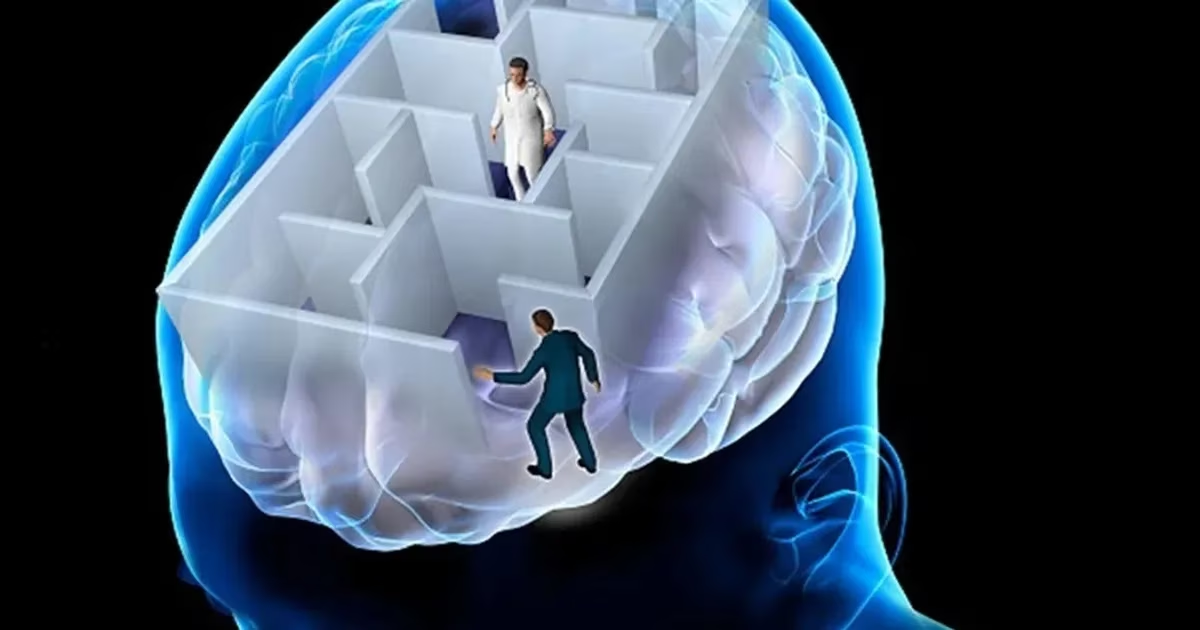







Political public opinion labs are the primary controllers in the process of unethical consciousness engineering, where the collective mind is directed without a value-based reference. Imagine the scene of the laborer who sacrifices his strength and wages to stand for hours under the sun, steadfast for a cause they made him believe was for the benefit of his children, while in reality, he is a tool in the hands of others. This behavior does not stem from free will, but from a systematic disabling of individual consciousness that makes a person see the sacrifice of their true interests as an offering for the triumph of an image carefully crafted for them.
Here, the deception of democracy in its contemporary form emerges, as a glittering facade for expressing popular will, while in reality, it is an arena for consciousness engineering. The modern state has harnessed its technical and media tools to transform democracy from a free choice between clear alternatives into a domestication process that produces an artificial majority. This majority is only achieved through political mobilization led by the public opinion engineer, who infiltrates through the loopholes of fear and need, transforming humans into caricatures that execute precisely drawn scenarios.
And if we look at the scene with a logical eye, we will find an impossible contradiction; where the worker and the factory owner, the conservative and the liberal, all unite in supporting the same person, and each believes that he is the savior of their conflicting interests. This impossible consensus only succeeds through the engineering of collective consciousness so that everyone becomes mere 'ultras' in herd politics. Nevertheless, the conscious individuals who take their stances based on a solid self-vision remain the exception that is difficult to subject to domestication tools.
Indeed, the modern democratic system operates through a long engineering accumulation that begins with changing terminology in educational curricula and pumping media narratives that create imaginary enemies. The public opinion engineer does not wait for election day, but rather prepares the psychological ground that makes his choice seem like the only way out. This system relies on the innate human fear of isolation, transforming natural diversity into a false sense of consensus through repetition and exaggeration, which pushes the individual to abandon their logical questions to join the crowd in search of false security.
To complete this control, the trick of 'demonizing the opponent' is resorted to, an old trick that the public opinion engineer has revived with modern techniques. The opponent is portrayed as a devil threatening existence, which pushes the supporter to adopt extreme positions to defend their image in front of themselves so as not to admit their naivety. Thus, logical questioning turns into a psychological burden, and the individual prefers subservience over the pain of confrontation with their conscious mind, where direct interest is replaced by the safe belonging to the herd.
Ultimately, economic helplessness and anxiety about the future are transformed into emotional loyalty, where no real solutions are offered, but rather a sedative for emotions and an illusion of personal victory. Emerging from this tunnel requires restoring an independent value system. Here, the genius of the Islamic model of 'Shura' (consultation) and 'Ahl al-Hall wal-Aqd' (people of binding and loosing) stands out, where the process relies on quality and a conscious elite that resists psychological manipulation, transforming the political process from mobilizing instincts to an exchange of opinions among the wise, and a restoration of true sovereignty away from engineered ballot boxes.
Democracy in its modern version does not begin with endorsement, but ends with it; it is a complete system for managing perception that begins years before an individual reaches the ballot box.
Share your opinion
The Deception of Democracy in the Modern State: How Majorities Are Manufactured in Public Opinion Labs?