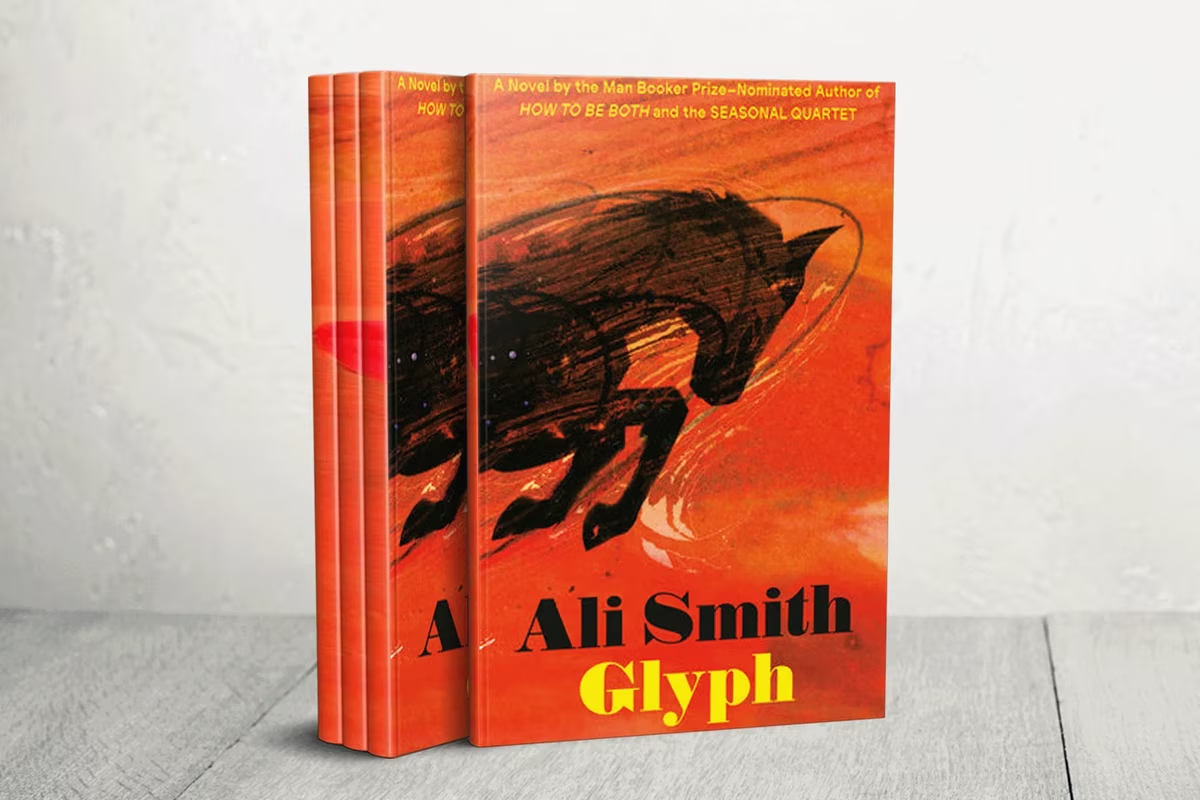







At the beginning of 'Glyph', the new work by Scottish novelist Ali Smith, a phone conversation takes place between two sisters; Patch asks her sister Petra if she has read the book she recently sent her? Petra replies cautiously: 'I thought it was well-written and everything, but it was a bit dark for me, and perhaps too clever and politically burdened for a novel.' For readers who have read Smith's previous novel 'Gliff' (2024), this dialogue will seem like an intentional 'literary joke'; the new novel is divided into three parts with evocative titles such as 'Wink' and 'Nod'. The reader quickly confirms that the book the sisters are discussing is 'Glyph' itself: a story about Prior and her younger sister Rose as they navigate life in a future world governed by 'surveillance capitalism', where the marginalized silently disappear.
While the previous novel looked to the future, 'Glyph' brings us back to our present time with its familiar pains. The text echoes the ongoing war in the Gaza Strip, the arrests of protesters in the United Kingdom, the rise of right-wing currents, the spread of fears about immigrants, and the concern about the dominance of artificial intelligence over jobs; all these events appear as fleeting threads in the narrative fabric. With this engagement with the present moment, 'Glyph' seems like an extension of Smith's 'Seasonal Quartet' (2016-2020), which she wrote and published in real-time, responding to ongoing events as they were still unfolding.
The publisher describes the relationship between the two novels as 'familial'; while there is no continuation of plot or characters, the two books clearly speak through recurring echoes: pairs of siblings, horses, and reflections on the art of storytelling. The term 'companionship' appears at the end of the novel during a discussion about how to comfort a blind horse, where an expert suggests providing a 'companion animal' (a donkey or goat) to care for it and keep it company. In a way, the relationship between Smith's novels seems similar to this dynamic; they support each other in a narrative language characterized by experimental innovation and wordplay.
The sisters Petra and Patch grew up with a mother suffering from psychological problems and a harsh father, which led Petra to play an overly protective role towards her 'sensitive' younger sister. Two war-inspired stories emerge in the novel, leaving a deep impact on the sisters: one about a blind horse and a young soldier in the trenches, and the other about a terrifying encounter with death at the end of World War II. These stories haunt the text and the sisters alike, blurring the lines between reality and fiction, and raising fundamental questions about the ethics of using 'reality' as raw material for creating 'imagination'.
The novel sometimes leans towards 'metafiction', meaning the novel talking about itself, a topic that has become common in contemporary literature. Although Smith does not offer fresh insights in this area, the true value of her work lies in 'testimony'; over seven novels published in the past decade, she has presented a dynamic and engaging picture of how we live now.
Smith excels at portraying the relationship between the sisters, especially in childhood scenes; her innovative language appears in its most beautiful form, revealing a bond that combines care, play, and love. The novel also confirms Smith's exceptional ability to write child characters with astonishing realism, adopting their curiosity and fresh perspective on the world. 'Glyph' is a novel that combines human depth and psychological analysis, affirming that literature in moments of great transformation is not a luxury, but a means of understanding the forces that reshape our world between the 'light' of creativity and the 'darkness' of reality.
Literature in moments of great transformation is not a luxury, but a means of understanding the forces that reshape our world between the light of creativity and the darkness of reality.


Share your opinion
'Glyph' novel traces the impact of the Gaza war and explains 'surveillance capitalism' through the eyes of children