





In the midst of one of the cruelest moments in contemporary Palestinian history, the idea of forming a national committee to administer the Gaza Strip was proposed, not as a preferred political option, but as an urgent attempt to deal with a deep political and administrative vacuum imposed by the war and its catastrophic humanitarian consequences. At the same time, it is a direct result of the inability of both the Palestinian National Authority and the Hamas movement, and with them the entire national movement, to resolve the most important national entitlement: the formation of a unified national consensus government, despite the declared consensus on this in the “Beijing Declaration.”
From here, the idea of the committee cannot be approached with a logic of preconceived rejection nor with a logic of excessive reliance, but rather as a potential transitional tool, whose success remains contingent on clear conditions, while its failure is linked to its slipping outside the comprehensive national framework. The committee was not proposed because Palestinians chose temporary solutions, but rather imposed on them because they have failed, until now, to achieve the fundamental solution represented by a consensus government that assumes its responsibilities in Gaza and the West Bank together.
The idea came about because both the Authority and Hamas failed, for different reasons, to move from managing the division to ending it. The Authority remained captive to political and security calculations and did not initiate a comprehensive formula that responds to the scale of the catastrophe in Gaza. In contrast, Hamas did not definitively state its position to mediators and public opinion in a way that would open the door for a real, not merely formal, consensus government.
An emergency committee, not a political project
The committee comes in an exceptionally harsh context, where an unprecedented destructive war has left a near-complete collapse in the administrative and service infrastructure, and created an actual vacuum in managing people's affairs. Therefore, it cannot be seen as an alternative political project or a final solution, but rather as a temporary arrangement whose success is measured by its ability to serve the people, prevent the entrenchment of separation, and prepare the ground for the return of the comprehensive national path.
The first opportunity for the committee lies in its direct function: organizing relief, managing basic services, and ensuring a minimum level of regularity in daily life. However, this humanitarian task is not separate from politics; any flaw in transparency, justice, or efficiency is enough to turn the committee from a tool for alleviating suffering into an additional burden. Therefore, the trust of the people and social forces becomes a foundational condition for its success, not a subsequent result.
The danger of turning the temporary into a permanent chapter
However, the committee's ability to function is not determined solely by its internal structure, but also by its surrounding political environment. Israel views Gaza as a separate file and seeks to manage its reality in a way that serves the goal of permanent separation between it and the West Bank. The danger here lies not in the committee's existence itself, but in its transformation into a long-term administrative framework that reproduces the division under a humanitarian title, or in its being trapped within a power struggle between Hamas, seeking hegemony, and the Authority, wishing to impose it as an extension of a non-consensual government. Therefore, the committee's success requires its explicit linkage to the single Palestinian entity, and a clear time limit that prevents the entrenchment of the status quo.
Risks of administration, funding, and the Israeli veto
A highly sensitive question arises here regarding dealing with the existing functional structure: employees of the former Hamas administration, and Authority employees working or suspended since the years of division. This is not just a technical question, but a political-social one par excellence. Gaza has tens of thousands of employees who have accumulated practical experience in harsh conditions, and they cannot be bypassed or excluded without enormous social and administrative costs.
Function: Justice and administrative professionalism, not loyalty
The realistic approach is to separate function from political choice. Any committee seeking success is required to deal with the functional staff as an administrative resource that should be organized, not an arena for settling scores. A transitional formula can be envisioned based on phased integration, professional assignment, and relative neutralization of public office from polarization, until institutions are reunified within a comprehensive national framework.
Related to this is the question of funding and salary payments, which is one of the most sensitive issues. The committee does not have financial sovereignty or self-resources, which makes it hostage to external funding or arrangements with the Authority. Here, funding becomes a double test of relative independence and transparency. Linking spending to clear mechanisms and professional oversight reduces the chances of politicization and enhances the trust of employees and society.
In contrast, the danger arises of Israel's attempt to impose a “veto right” on the administrative structure, whether by controlling the movement of individuals or interfering in the selection of employees, as happened in previous experiences. If this scenario materializes, it will undermine the essence of the committee's national idea. Therefore, rejecting its transformation into a tool for security selection is a fundamental condition for its success, despite the narrow margin of maneuver.
National risks and the meaning of entity
The reconstruction file is no less complex. The question is not only who funds, but who decides, who supervises, and how priorities are set. If this file is managed with a technical logic isolated from national authority, the danger of turning reconstruction into a tool for normalizing separation will remain. However, if it is subjected to a transparent national framework that links relief with institutional rebuilding, it can turn into a political-social lever.
As for the international position, it is governed by delicate balances. The United States shows pragmatism in supporting any arrangement that achieves “stability,” without actual readiness to engage in a path that restores the unity of the Palestinian entity or opens the horizon for self-determination. In contrast, Europeans and a number of active Arab countries, especially Saudi Arabia, along with Egypt, Qatar, and Turkey, can play an important role in ensuring that Gaza is not separated, by pressing for temporary arrangements linked to a comprehensive national path, not an isolated humanitarian administration.
From here, the importance of emphasizing that the committee is temporary and time-bound emerges, and that its existence must coincide with a parallel national path that returns the ball to the Palestinian court. The required path is organized popular pressure to generate a real political will that leads to the formation of a unified national consensus government as soon as possible, which assumes its responsibilities in Gaza and the West Bank together, and restores the unity of decision and institutions.
In conclusion, the people of Gaza should not be left captive to the feeling of betrayal accumulated by years of genocide and siege, nor should they be pushed into isolation as victims separated from their national context. What happened in Gaza is not a local fate, but a general Palestinian wound. Justice for its people is not achieved by managing their isolation, but by returning them politically and morally to the heart of the single Palestinian entity.
Gaza: A national issue, not a humanitarian file
From here, a direct responsibility falls on the living social forces in Gaza, from popular committees and civil society organizations to youth, women's, and trade union activities, to deal with this stage as a moment of pressure, not waiting. What is required is not to defend temporary arrangements for their own sake, but to use them as a tool to impose the entitlement of ending the division and building national unity.
This is what a truth dictates that should not be accepted to continue to be overlooked or ignored, namely that Gaza is not just a humanitarian matter or a temporary administrative file, but it is the heart of the Palestinian cause, and the dignity of its people and the meaning of their sacrifices will not be restored except through the unity of national decision and the unity of the political project, and steadily moving towards the entitlement of self-determination and the embodiment of an independent state.

OPINIONS
Tue 20 Jan 2026 12:00 pm - Jerusalem Time
The National Committee for the Administration of the Gaza Strip... A temporary rescue opportunity or a test of national identity?
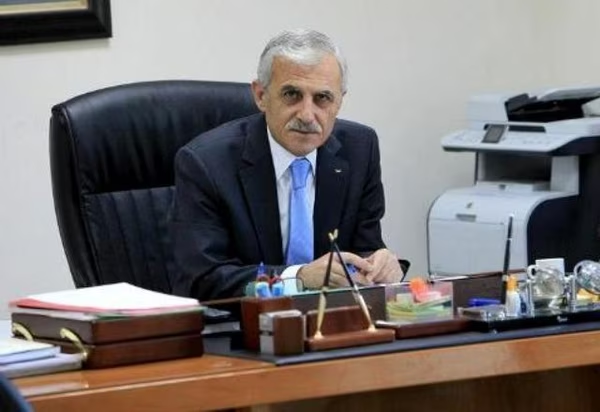
Jamal Zakout
Opinion Writer
Share your opinion
The National Committee for the Administration of the Gaza Strip... A temporary rescue opportunity or a test of national identity?