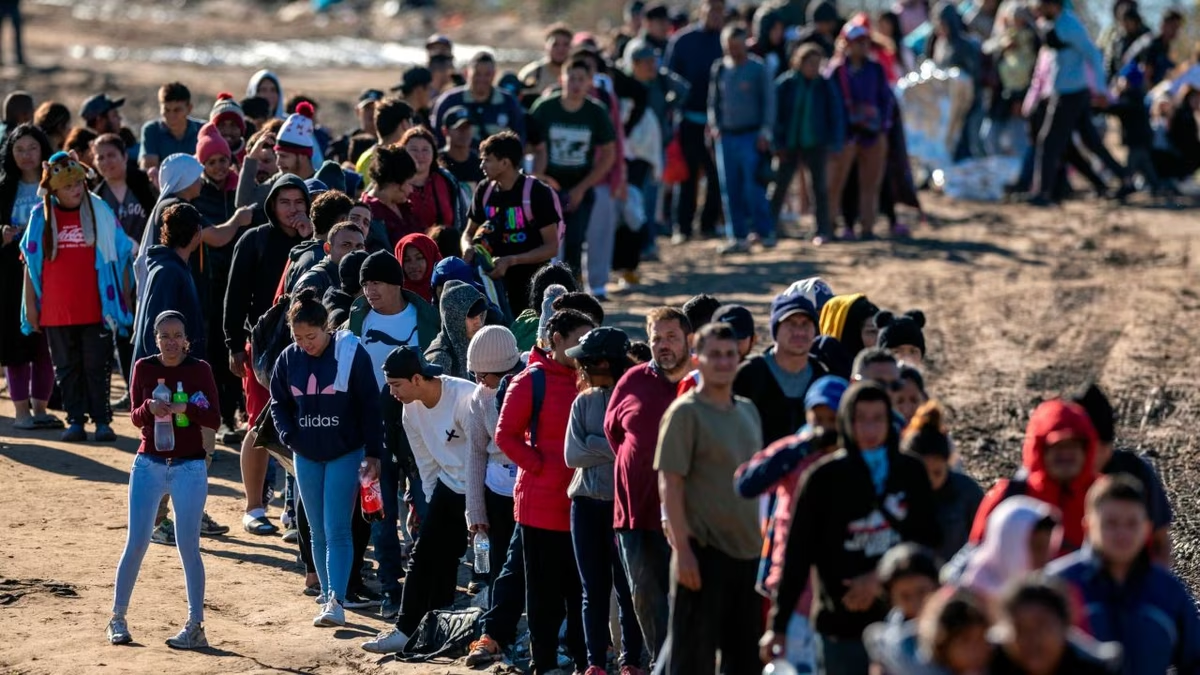







Remarks attributed to Sarah B. Rogers, US Under Secretary of State for Public Diplomacy, have sparked a massive wave of anger and criticism on social media, after she used language described as racist and anti-Islamic, which starkly contradicts the principles the United States claims to uphold in its official discourse on human rights and pluralism.
The media storm erupted after Rogers posted on Thursday on the "X" platform (formerly Twitter), where she re-shared an unverified screenshot of an alleged news article, before accompanying it with comments that evoked dangerous stereotypes about refugees and Muslim communities, and at the same time raised sensitive allusions related to Germany's history and its Jewish community.
The post, which quickly spread widely, included the expression that "Germany retains very few Jews, yet it imported barbarian hordes of rapists," a phrasing that human rights activists and campaigners saw as inflammatory language crossing red lines, especially when coming from a high-ranking American official tasked with managing discourse directed at global public opinion.
These statements came in the context of Rogers' response to a discussion about German laws to combat hate speech on social media. She had referred to what is known as the "Cologne attacks" that occurred on New Year's Eve 2015–2016, when hundreds of women reported being harassed and sexually assaulted near the city's main train station, incidents that at the time sparked widespread debate about asylum policy in Germany.
However, Rogers' critics emphasized that invoking those events does not justify generalizing the accusation to entire groups of refugees, nor using language that reduces religious or ethnic groups to being described as "hordes" or "invaders." The controversy was further intensified by the fact that the tweet was in response to a comment from another user who said that "Jews allowed black people in," in a clear attempt to fuel hate speech, which many considered a moral and professional failure in dealing with a racist provocation.
Across social media platforms, condemnations poured in from activists, journalists, and politicians who saw the statements as evidence of a worrying slide in the language of official American discourse. Some went as far as to say that the incident cannot be reduced to a "slip of the tongue," but rather reflects a broader trend towards adopting ideological and polarizing rhetoric in government officials' accounts, at the expense of balanced diplomatic language.
Critics pointed out that this shift has become more evident in recent months, especially in the context of discussions related to immigration and refugees within the United States, where some official statements tend towards cultural conflict rhetoric, and the repetition of internal political narratives instead of adhering to traditional diplomatic standards.
Observers believe that the seriousness of the incident is compounded by Rogers' own position. As Under Secretary of State for Public Diplomacy, she is responsible for presenting the image of the United States abroad, countering disinformation campaigns, and promoting values such as tolerance, freedom of religion, and human rights. However, her language, according to her critics, reflects the very discourse that Washington claims to fight when it comes from extremist groups or authoritarian governments.
Anti-racism activists warn that normalizing this type of discourse, even through officials' personal social media, legitimizes hatred and encourages extremist voices globally, and also undermines the moral credibility of the United States in sensitive issues such as combating anti-Semitism and Islamophobia.
This incident reveals a structural flaw in understanding public diplomacy as merely an extension of internal debate on social media. A diplomat, unlike a local politician, does not speak to a single audience, but to a world of multiple cultures and sensitivities. Using language charged with stereotypes not only offends the targeted groups but also empties the concept of "soft power" of its meaning, and transforms American discourse from a tool of persuasion into a factor of repulsion.
According to experts, the most dangerous aspect of this incident is that it comes within a broader context witnessing an erosion of the ethical constraints of official discourse, especially on issues of immigration and identity. When high-ranking figures adopt provocative language instead of responsibility, racist discourse becomes less shocking and more commonplace. This shift is not only reflected internally but also weakens the ability of the United States to present itself as a moral authority in a world experiencing a sharp rise in policies of hatred and exclusion.


Share your opinion
Widespread Anger After US Diplomat's Remarks Equate Refugees with "Barbarian Hordes of Rapists"