






Washington – Said Arikat
Official sources in Ankara and Cairo revealed that US President Donald Trump has extended invitations to both Egypt and Turkey to join what he called the "Peace Council," a new international framework announced by the White House to oversee the transitional phase in the Gaza Strip after the ongoing war.
According to the White House announcement on Friday, the "Peace Council" will be tasked with overseeing a temporary administration for the Gaza Strip, as part of a plan previously announced by Trump to end the Israeli war on the Strip, which international human rights organizations describe as a war of genocide against Palestinians in an area besieged for years. The announcement comes amid increasing international pressure to stop the fighting and growing criticism of US policies biased towards Israel.
In Ankara, the Turkish Presidential Communications Director, Burhanuddin Duran, confirmed via social media that President Recep Tayyip Erdogan received an official message from Trump on Friday, inviting him to be a "founding member" of the new council. The Turkish official did not disclose Ankara's final position on the invitation, merely indicating that the proposal is under consideration in light of regional developments and the sensitivity of the Palestinian issue.
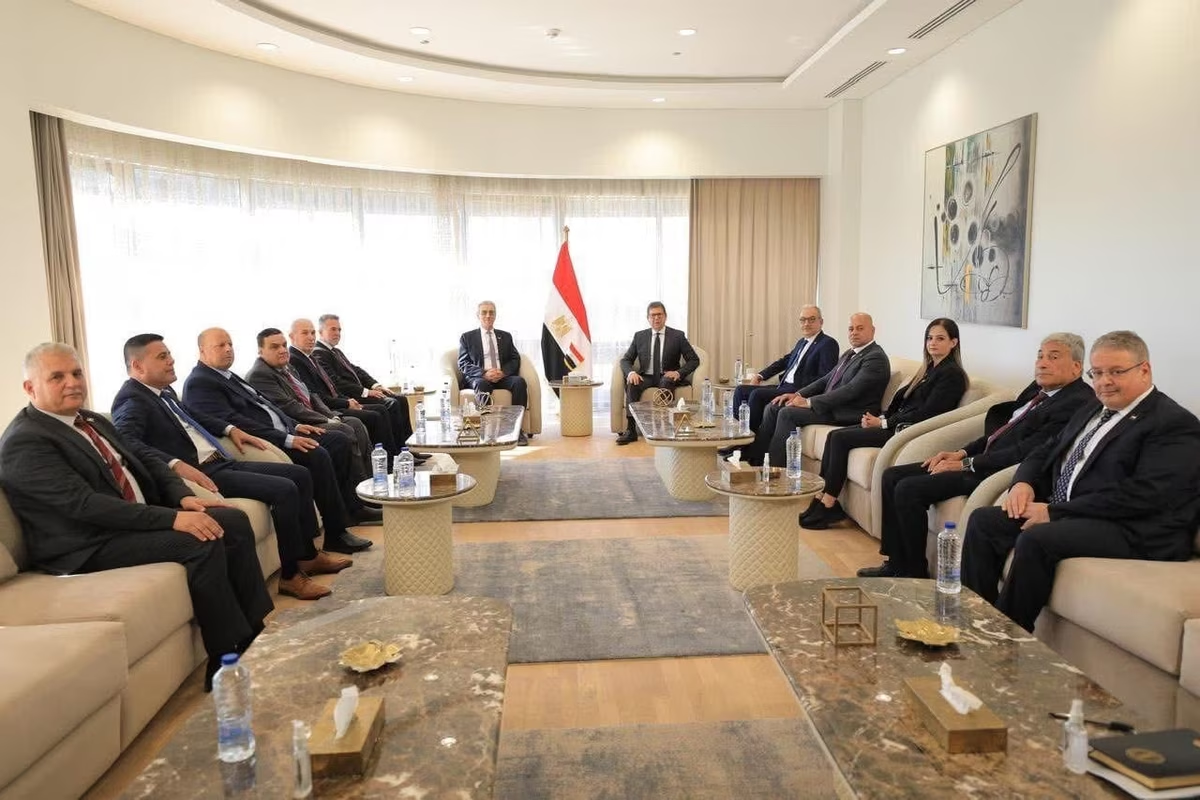
In Cairo, Egyptian Foreign Minister Badr Abdel Atty stated during a press conference on Saturday that his country had received a separate invitation from the US President addressed to President Abdel Fattah el-Sisi to join the council, explaining that Egypt is "carefully studying the invitation" in light of its historical role in the Palestinian issue and its regional responsibilities, particularly concerning the Gaza file, crossings, and political mediation.
The White House had previously announced the names of several members forming what it described as the "Founding Executive Council," led by President Trump himself as chairman of the council, alongside US Secretary of State Marco Rubio, the President's Special Envoy Steve Witkoff, former British Prime Minister Tony Blair, in addition to Jared Kushner, Trump's son-in-law and former advisor, known for his role in drafting the "Deal of the Century."
The establishment of the council dates back to a plan revealed by Trump last October, which stipulated the formation of a Palestinian technocratic body to manage Gaza's affairs during a transitional phase, with this body operating under direct international supervision from the Peace Council. The plan, according to the American narrative, aims to "restore stability" to the Strip and create conditions for a subsequent political settlement, without including clear commitments regarding ending the occupation or guaranteeing Palestinian national rights.
However, the announcement of the council was met with sharp criticism from international law experts and human rights activists, who considered that the supervision of a major head of state over the administration of a foreign territory, without the participation of representatives of its people, reflects a modernized colonial model that ignores the principle of self-determination. The inclusion of Tony Blair's name also sparked a new wave of objections, against the backdrop of his role in the Iraq War and the grave violations associated with it, as well as the British colonial legacy in the region.
The White House did not provide precise details about the powers of each member of the council or its decision-making mechanisms, merely indicating that additional names would be announced in the coming weeks. It also confirmed that the council would include prominent economic and international figures, including Mark Rowan, CEO in private equity, World Bank President Ajay Banga, in addition to Robert Gabriel, one of Trump's advisors. It clarified that Nikolay Mladenov, the former UN envoy to the Middle East, would serve as the "High Representative for Gaza."
What is striking about the council's composition, according to observers, is the complete absence of any Palestinian representation, whether from the Palestinian Authority, civil society organizations, or political factions, which raises fundamental questions about the council's legitimacy and its ability to manage a highly complex phase in Gaza's history.
The proposed "Peace Council" reflects a traditional American approach to crisis management in the Middle East, based on internationalizing supervision and marginalizing the original stakeholders. Instead of empowering Palestinians to determine their own destiny, Gaza's future is being reshaped behind closed doors, under the guise of stability and reconstruction. This approach does not address the roots of the conflict but postpones them, and may entrench a fragile political reality, prone to explosion at the first field or popular test.
Experts believe that the participation of regional countries like Turkey and Egypt in the council, if it happens, will place them in a difficult equation between maintaining their traditional role in supporting the Palestinian cause and engaging in an international framework led by Washington on its terms. Joining may provide a limited margin of influence, but it could also be interpreted as political cover for a plan that does not guarantee Palestinian rights. Rejection, on the other hand, carries the risks of marginalization from an international path that may be imposed as a fait accompli.
Ultimately, the "Peace Council" remains a controversial initiative, reflecting an American attempt to re-engineer the scene in Gaza after the war, amidst deep skepticism about its intentions and feasibility, and open questions about the future of a strip whose people were not consulted in determining their own destiny.

Share your opinion
Trump invites Sisi and Erdogan to participate in "Peace Council"