






News Analysis
In a striking analytical article published on the "Substack" platform on Thursday, January 15, 2026, Ilan Goldenberg, a senior fellow and director of the Middle East Security Program at the Center for a New American Security, revealed a fundamental and unprecedented shift in the trajectory of the security relationship between the United States and Israel. He described this shift as a "major earthquake" that went almost unnoticed, despite its profound strategic implications for the future of the alliance between the two countries.
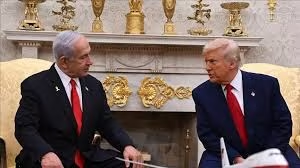
Goldenberg's analysis stems from two simultaneous events that together constituted a remarkable turning point. The first event was a statement made by Israeli Prime Minister Benjamin Netanyahu during an interview with The Economist magazine on Friday, January 9, 2026, in which he explicitly announced Israel's desire to end its reliance on American security assistance within the next decade. The second event was even more surprising, as it was followed by a public statement from Republican Senator Lindsey Graham, chairman of the Senate Appropriations Subcommittee on State, Foreign Operations, and Related Programs, who called for accelerating the termination of foreign military financing for Israel, perhaps at a pace even faster than what Netanyahu himself proposed.
According to Goldenberg, the seriousness of this development lies not only in its content but also in the context in which it occurred. Just a few years ago, merely questioning US military aid to Israel was considered a political taboo in Washington, met with ready accusations of "anti-Israel sentiment." Today, the explicit call to end this aid comes from one of the American politicians closest to Israel and to Donald Trump, and it passes in almost complete silence.
Practically, the author emphasizes that ending foreign military financing does not mean dismantling the security partnership between the two countries. Israel will continue to purchase advanced American weapons, from F-35 and F-15 fighters to smart munitions, and cooperation in missile defense programs, intelligence sharing, and research and development will continue. The fundamental difference, as he explains, is not about the nature of the relationship but about who pays for it: the American taxpayer or the Israeli treasury.
Goldenberg recalls the historical background of the Foreign Military Financing program, which was established in the late 1970s as part of the Camp David Accords, as a guarantee for the stability of the then-fragile peace treaties, especially between Egypt and Israel. However, this context has radically changed. Israel today is a country with an advanced economy, and its per capita GDP is comparable to that of major industrial countries such as Germany, France, and Japan, making its need for four billion dollars annually less urgent than it was in the past.
Indeed, according to the author's analysis, this aid has become a political burden on Israel itself. Being the largest recipient of US military aid in the world has made the relationship subject to constant scrutiny and placed it at the heart of American political polarization. From this perspective, treating Israel as a "naturally wealthy ally" might alleviate tensions rather than increase them.
As for the silence that accompanied Graham's and Netanyahu's statements, Goldenberg directly links it to the political context associated with Donald Trump. Netanyahu, as he conveys, was concerned that a potential Trump administration would not be willing to sign a new memorandum of understanding guaranteeing billions of dollars in long-term aid, so he chose proactive adaptation, abandoning one of the most sensitive elements of the US-Israeli relationship, rather than risking an embarrassing political confrontation.
Despite this shift, the author asserts that the discussion about accountability will not stop. American laws, including the Leahy Law, apply to arms sales as they do to aid. Questions regarding the use of American weapons in Gaza and the West Bank, and about potential violations and obstruction of humanitarian aid, will remain strongly posed, even if the discussion shifts from the framework of "grants" to the framework of "sales."
In conclusion, Goldenberg believes that this development reveals a truth that has long been ignored: American influence over Israel does not primarily stem from financial aid, but from broader political, diplomatic, and military weight, from Washington's position in international forums, and the nature of the relationship between the leaders of the two countries. Netanyahu and Graham indirectly acknowledged that aid was never the decisive factor in issues Israel considers existential.
What Goldenberg presents goes beyond describing a fleeting event, to reveal a gradual collapse of the "sanctity" of military aid to Israel within Washington. When ending financial support becomes an option proposed from within the pro-Israel camp, it means that the relationship has entered a phase of redefinition, where strategic partnership is separated from unconditional support, and reformulated in the language of interests and self-reliance, not in the language of permanent exception.
The political and media silence surrounding this shift exposes the double standards in the American debate about Israel. Accountability, when it comes from Democratic administrations, is met with accusations of betrayal, but when it comes from Republican right-wing allies, it is quietly absorbed. This confirms that the debate about aid is not a purely moral discussion, but a reflection of power struggles within American politics, where "constants" are reformulated according to the identity of those who propose them.




Share your opinion
A Silent Earthquake in the Security Relationship Between Washington and Tel Aviv