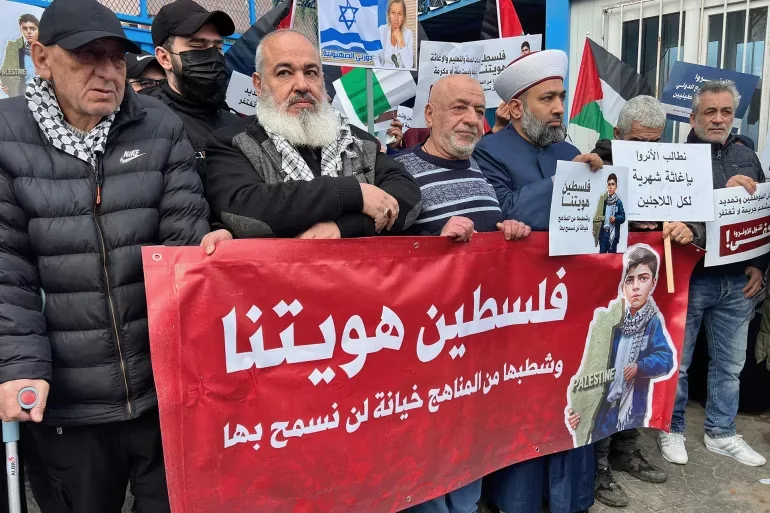







A modification in the geography textbook used in schools of the United Nations Relief and Works Agency for Palestine Refugees (UNRWA) sparked a wide wave of anger in Palestinian camps in Lebanon after the historical name Palestine was changed to "West Bank" and "Gaza Strip" on a map included in an "enrichment material" book designated for sixth-grade students for the academic year 2025-2026. The map quickly became the spark for popular protests yesterday, Wednesday, encompassing most Palestinian camps, where UNRWA schools witnessed a state of unrest, and students refrained from attending their classes, while angry parents and students tore up and burned the book, considering what happened an attempt to erase the Palestinian cause and a direct infringement on the right of return. Students and parents from 61 schools managed by UNRWA in various Lebanese regions participated in these movements, from Tripoli in the north, where the Nahr al-Bared and Beddawi camps are located, to Sidon in the south, where the Ain al-Hilweh camp is located. These schools include about 35,000 Palestinian students and constitute the primary pillar of official education for refugee children in the country.
The new version of the geography textbook also caused confusion within the agency's schools themselves, which are managed by Palestinian educational and administrative "cadres" who found themselves in direct confrontation with parents and students. Teachers confirmed that the book, classified as "enrichment," includes a clear change in the map, where the name Palestine was replaced by two arrows pointing to the West Bank and the Gaza Strip overlooking the Mediterranean Sea. In response to inquiries from sources, UNRWA in Beirut stated that it adopts the curricula of host countries and uses the official textbooks approved therein, and clarified that in Lebanon, it teaches the Lebanese national curriculum, including the geography textbook for the sixth grade, "Lights on the Geography of Lebanon and the Arab World," affirming that it had not made any modifications to the official textbooks. It mentioned that the "enrichment" geography textbook is an additional educational tool it produced to support the basic textbook, aiming to enhance critical thinking skills, map reading, and analysis among students, and indicated that some information was left open to encourage discussion and exploration within the classroom, affirming its deep respect for the national and historical identity of Palestinian refugees and its commitment to protecting their dignity and rights.
However, protesters view what happened as exceeding the educational framework and express accumulated concern about changes affecting the Palestinian national identity within educational curricula. Opponents directed direct accusations at UNRWA management of "conforming to Israeli and American policies," considering that deleting the name Palestine from the map is not a technical detail but a fundamental infringement on the national narrative and rights. For his part, the director of the "Thabet for the Right of Return" organization, Sami Hammoud, said that these protests are part of a series of movements carried out by Palestinians in the camps, through popular movements, activists, and institutions, to send a clear message to the Director-General of UNRWA that its policies "destroy what remains of our people's steadfastness, and undermine the essence of the agency's role." He added to sources that "previous administrations, despite all the cutbacks, did not take similar steps, while the current administration persists in policies that strike the last pillars of steadfastness, the latest of which was the attempt to erase the name Palestine from educational curricula, which practically means obliterating Palestinian consciousness and erasing national memory among generations." For his part, Muhammad Dib, a member of the Committee for the Defense of Refugee Rights, believed that UNRWA had gone beyond the issue of service cutbacks, and the targeting now affects the core of its role and the essence of the national cause and Palestinian identity, affirming to sources that the refugees' protests and sit-ins are an expression of their adherence to their identity and their cause for which they have struggled for long decades, and that the name Palestine cannot be erased or reduced in any educational curriculum.
In turn, sources – a spokesperson for the parents – stated that the movements are not limited to rejecting the policy of cutbacks in education, health, and social affairs, but go beyond that to what she describes as a direct infringement on the Palestinian national identity, and sees in her conversation with sources that targeting national symbols and attempting to erase the name Palestine from curricula constitutes a transgression of all red lines and a direct threat to the consciousness of Palestinian generations. From the Burj al-Shamali camp in southern Lebanon, Rosaline Mansour tells sources that the protests aim to pressure UNRWA management to retract the deletion of the name Palestine from the geography textbook, adding that this step goes beyond the educational framework to affect national identity and the right of return. She clarified that the demands are not limited to curricula but also include improving students' conditions and addressing the legal and educational problems faced by refugees. In turn, Amna Ibrahim questioned the basis that allows the deletion of the name of an entire homeland from students' memory, affirming that the name Palestine must remain present in curricula without deletion or dilution. She stressed to sources that infringing upon it is not a symbolic matter but a matter of existence and dignity, adding that the protesters' demands also include settling the residency status of Palestinian refugees coming from Syria – especially students – and reinstating the aid they were deprived of this year. Participants in the movements affirmed that Palestine will remain present in memory and conscience, no matter how many attempts there are to obliterate or redefine it.
Protesters view what happened as exceeding the educational framework and express accumulated concern about changes affecting the Palestinian national identity within educational curricula.

Share your opinion
Reasons for UNRWA in Lebanon to remove the name Palestine from its curricula