






News Analysis
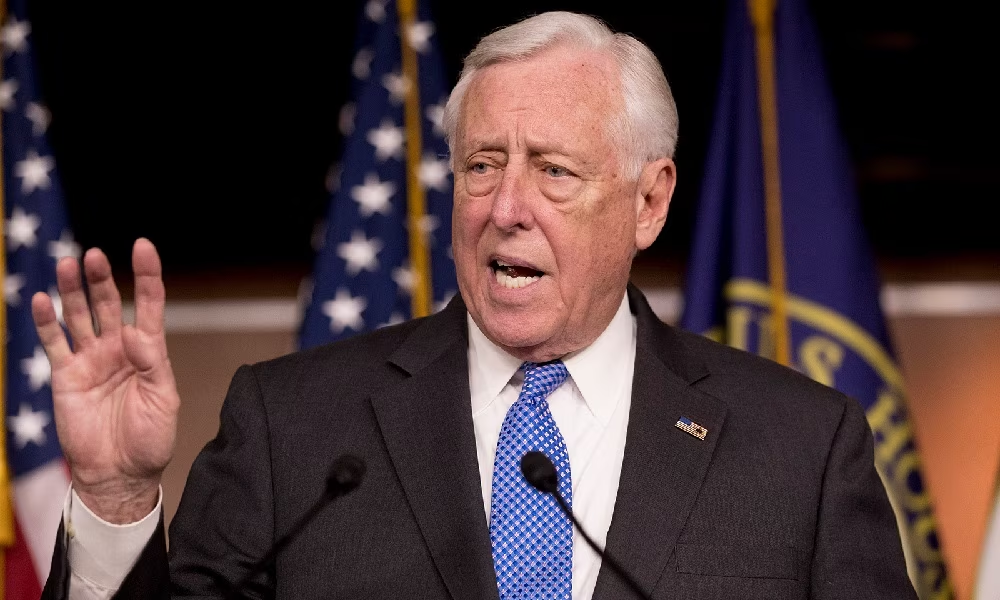
Veteran Democratic Congressman from Maryland, Steny Hoyer, announced on Thursday his intention to retire after more than four decades in the U.S. Congress. Hoyer's retirement from the House of Representatives not only marks the end of a long political career but also opens a wide door for a re-evaluation of the role of one of the most prominent architects of the special relationship between the United States and Israel within the American legislative institution. Hoyer, who held high leadership positions in the House of Representatives and was known as AIPAC's primary man, was for many years a symbol of what is known as the "pro-Israel consensus" within the Democratic Party, and a central link between the party leadership and pro-Tel Aviv lobbying groups, foremost among them AIPAC.
Since his election in 1981, Hoyer established himself as a pragmatic, centrist politician, but on the issue of Israel, he adopted a firm and unequivocal stance: unconditional support for military aid, and providing political and diplomatic cover for Israeli policies, even when they clearly contradicted international law or the stated American discourse on the two-state solution. This steadfastness was not merely an ideological position, but part of an integrated structure of influence, in which Hoyer used his leadership position to guide internal party debate and contain critical voices, especially with the rise of the progressive wing.
One of the most significant manifestations of this influence was his repeated leadership of congressional delegations to Israel, trips that were organized and funded through the "American Israel Education Foundation" (AIEF), an arm associated with the AIPAC lobby. These trips, often held every two years during parliamentary recesses, became a semi-institutional political ritual, involving a large number of newly elected representatives in each election cycle (usually in August of every other year).
These trips were not merely protocol visits; they were carefully designed to shape the mindset of new representatives regarding "Israel's security" and "regional threats," through field tours and meetings with military leaders and Israeli officials, in contrast to a limited – or symbolic – presence of the Palestinian narrative. Under Hoyer's leadership, these delegations acquired an organized partisan character, as they were seen as part of the process of integrating new representatives into the "traditional parliamentary consensus" on supporting everything Israel does, including the Israeli war of annihilation.
Here lies the fundamental problem: while these trips are presented as legitimate educational activities, observers see them as a form of effective soft influence exercised by lobbying groups, especially when targeting legislators early in their political careers, before their independent positions are solidified. In this context, Hoyer played the role of "political guarantor" of this process, leveraging his organizational weight and his close ties with pro-Israel campaign donors.
However, recent years have witnessed a clear crack in this model. With the escalation of criticism within the Democratic Party of Israeli policies in Gaza and the West Bank, and with increasing talk about settlements and human rights, the number of new representatives participating in these trips has begun to decline. Some Democrats have also openly declared their refusal to accept AIPAC support, indicating a gradual shift in party sentiment, especially among young people and progressive voters.
Hoyer's departure, at this particular time, carries deep symbolic significance. It not only means the exit of an influential figure but also indicates the decline of an entire political generation that viewed supporting Israel as a matter beyond partisan debate. With his absence, the debate within the Democratic Party is expected to intensify regarding the conditions of military aid, the limits of the relationship with the Israeli government, and the role of lobbying groups in shaping American foreign policy.
The model of funded trips (for new representatives and their families) to Israel demonstrates how political influence can be exercised without direct legislation or pressure. Personal experience, when carefully crafted and presented at an early political moment, becomes an effective tool for reproducing long-term political positions. Hoyer's role here was not only organizational but also educational in its political sense, as he contributed to "forming" generations of legislators with a single vision of the conflict.
It should be noted that the shift within the Democratic Party does not necessarily mean a break with Israel, but rather reflects a growing desire to redefine the relationship away from blind alignment. Resistance to this shift by traditional leaders like Hoyer delayed the debate, but did not stop it. With his exit from the scene, critical voices may find more space to link American support to human rights values and international law.
The most important aspect of Hoyer's retirement is not what has ended, but what may begin. The question now is: will new leaders fill the void and reproduce the same model, or does the political moment allow for a genuine review of the role of lobbies in guiding foreign policy? The answer will determine the future of the American debate on Israel, and perhaps redraw the boundaries of the "consensus" that governed Washington for decades.



Share your opinion
Steny Hoyer Retires from Congress After Decades of Pro-Israel Influence and Loyalty to AIPAC