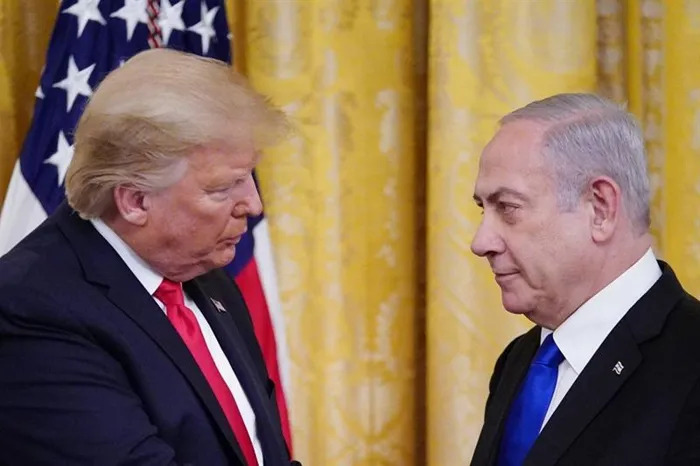







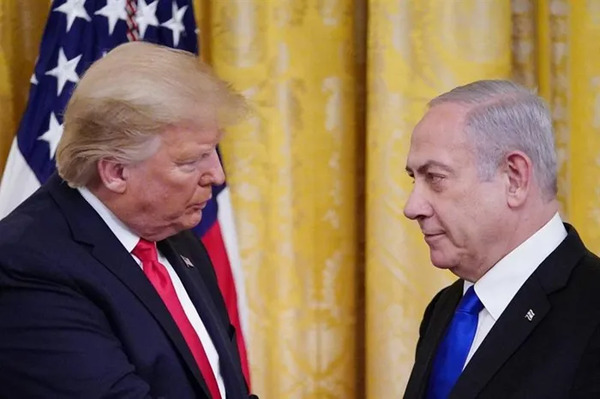
The meetings that brought together U.S. President Donald Trump and Israeli Prime Minister Benjamin Netanyahu in Mar-a-Lago, Florida, revealed clear differences between the two sides regarding Israeli policies in the occupied West Bank, despite mutual efforts to maintain the relationship within its overall strategic framework. According to an American official, Trump and his senior aides expressed growing concern over undisciplined settler violence, the accelerating settlement expansion, and Israel's continued withholding of billions of dollars in Palestinian tax revenues, policies that have pushed the Palestinian Authority to the brink of financial and political collapse, according to the American website "Axios".
A source confirmed to the site that the discussions were characterized by a friendly tone, but Washington warned that the deteriorating situation in the West Bank could negatively impact efforts to stabilize Gaza, and could undermine the U.S. administration's efforts to regionally expand the Abraham Accords. When asked whether Trump had raised the issue of settler violence during his meeting with Netanyahu, he acknowledged the existence of disagreements, saying that the two sides do not agree "100 percent" on the West Bank, but expressed confidence in reaching a "result" regarding it.
At the same time, the United States is pressuring Israel to release the withheld funds that it collects on behalf of the Palestinian Authority, which it has repeatedly refused to transfer since the October 7, 2023 attack. Finance Minister Bezalel Smotrich is leading this approach, considering these funds "support terrorism," and openly declaring his aim to weaken the Palestinian Authority through what he described as "economic strangulation" to prevent the establishment of a Palestinian state, a position that reflects the growing weight of the far-right within the ruling coalition.
Netanyahu, for his part, faces significant pressure from his right-wing partners who are pushing for the expansion of settlements and the annexation of the occupied West Bank, alongside undermining the role of the Palestinian Authority. The West Bank has witnessed a notable escalation over the past year in attacks by extremist settlers on Palestinians and their property, with the Israeli occupation army documenting more than 752 incidents of violence and hate crimes since the beginning of the year, compared to 675 incidents during 2024, amid almost complete absence of judicial accountability, where indictments are rarely filed, and convictions remain exceptional.
Alongside settler violence, the Israeli government has proceeded to consolidate its civilian presence in the occupied West Bank, announcing the establishment of 11 new settlements and the legalization of eight additional settlement outposts. The United Nations had confirmed earlier this month that the pace of settlement expansion has reached its highest levels since at least 2017, considering these activities illegal under international law, a characterization rejected by the Israeli occupation authorities.
Despite the disagreements over the occupied West Bank file, a senior Israeli official described the meeting between Trump and Netanyahu as "the best" among the meetings held by the two leaders since Trump's return to office. He noted that the meeting addressed major regional issues, including how to deal with the Iranian threat, the future of Hamas and Hezbollah, in addition to other security issues, according to "Axios". During the joint press conference, both Trump and Netanyahu took care to exchange compliments, with Trump praising Netanyahu, describing him as "a prime minister in time of war" who "did a great job," indicating the continued strength of the alliance despite tactical differences.
The U.S.-Israeli disagreements over the West Bank reflect the widening gap between political warnings and the actual ability to influence. Washington recognizes that the continuation of settlements and settler violence threaten the stability of the Palestinian Authority and undermine any future political path, but it has so far limited itself to signals of concern without translating them into real pressure tools. It seems that the U.S. administration is betting on containing the repercussions rather than confronting the roots of the crisis, fearing damage to an alliance it considers a cornerstone in its regional strategy.
The Trump administration also recognizes that what is happening in the West Bank points to a structural shift in Israeli policy, where the land is no longer a subject of negotiation but a field for imposing permanent facts. In this context, weakening the Palestinian Authority becomes a strategic choice, not a side effect. The continuation of this approach not only threatens what remains of the two-state solution, but also portends the reproduction of chronic tension spots that could explode at any moment, putting the U.S. bets on regional stability to a tough test.


Share your opinion
Trump Faces Netanyahu with Disputes over the West Bank Amid Escalating Settlements and Settler Violence