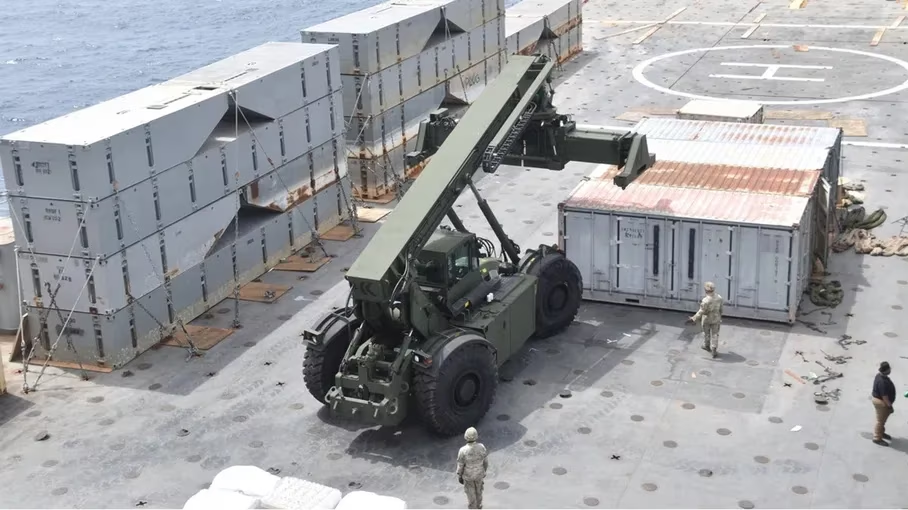







Reports have revealed progress in consultations related to forming an international stabilization force intended to be deployed in the Gaza Strip, as part of what is known as the second phase of the political and security arrangements discussed by the Israeli occupation and the United States in the context of the post-war period.
Members of the Political and Security Cabinet (the Cabinet) were informed during a meeting that three countries have agreed to an American request to participate in the international stabilization force in Gaza, without disclosing their names, except for noting Indonesia as a country that has expressed readiness to send troops.
Names of other countries that were previously circulated as potential "contributors" to this force include Italy, Pakistan, and Bangladesh, as part of American efforts to form a multinational force that will undertake security tasks in the sector.
The report quoted a senior Israeli official as saying, following the Cabinet meeting, that "the basic plan that the American President Donald Trump and Israeli Prime Minister Benjamin Netanyahu worked on was based on expanding the Abraham Accords after the end of the war and the return of the prisoners," but this path "currently faces major challenges."
The official explained that the focus has now shifted to the second phase of the understandings, primarily the issue of forming a multinational force, emphasizing that "Turkey will not be part of this force," adding: "We will not be forced to include any country we do not want to participate, and we do not want Turkey."
The official acknowledged the existence of serious doubts within the Israeli occupation regarding the ability of the anticipated international force to disarm Hamas, but considered that "it should be given a chance," according to his expression.
According to the briefings presented to the Cabinet, the transition to the second phase, even if officially announced by the United States, will require additional logistical preparations, noting that "at least several additional weeks" will be necessary to finalize the plan's format, assemble the international force, and ensure its readiness before deploying it in the Gaza Strip.
The Israeli official indicated that the transition to this phase "would have taken time even under the best circumstances," explaining that the United States is seeking to complete all arrangements before introducing any forces into the sector.
In a related context, the official addressed the possibility of Russia's participation in the international stabilization force, amid its increasing involvement in the Syrian file, considering that "Russian participation is not necessarily a negative thing," and could form "a balancing factor for Turkey."
He also noted that Syrian President Ahmed al-Sharaa faces major internal challenges, pointing out that Israel believed that signing an initial security framework with Syria could happen faster, "but Syria is unstable," in his words.
The Israeli official also addressed the escalating tensions with Lebanon, following the recent strikes carried out by the Israeli army, saying that "the Lebanese government strongly desires to dismantle Hezbollah, but it faces major difficulties."
He added that less than a week remains until the end of the "internal Lebanese deadline" for the first phase of disarming the party, confirming that the orientation within the occupation is to "continue holding the lands and executing operations," while being prepared to move "if and when all options are exhausted."
According to the security briefings, Hamas is still active, continues to rearm and restore part of its capabilities, although it has not returned to its previous level. Officials also pointed to the accelerating pace of Iran's production of ballistic missiles, a development described by Israeli security circles as concerning.
This comes at a time when discussions are intensifying within the Israeli occupation and Washington about the future of Gaza, amid regional political and security complexities, indicating that the next phase may be more sensitive and complex than previous ones.
The basic plan that the American President and the Israeli Prime Minister worked on was based on expanding the Abraham Accords after the end of the war and the return of the prisoners.

Share your opinion
Progress in consultations to form an international stabilization force in the Gaza Strip