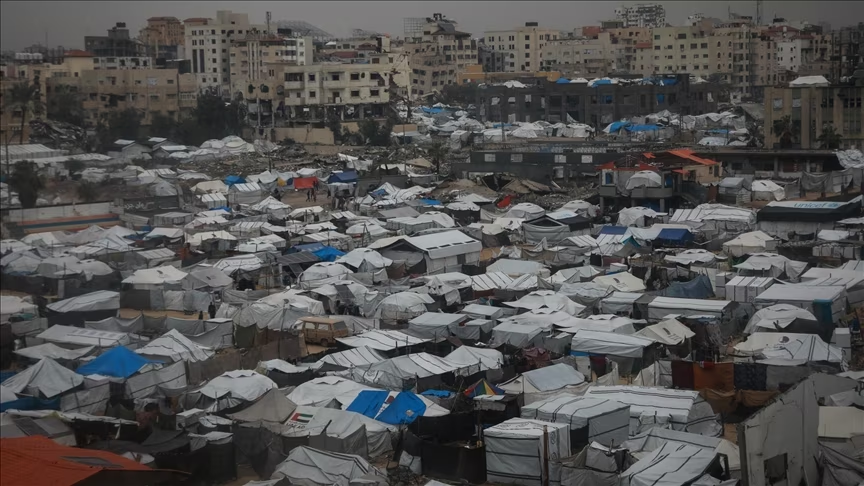







Two political experts believe that the Palestinian National Authority will face harsh and complex conditions if offered participation in what is known as the "Peace Council" for managing the Gaza Strip.
On November 18, 2025, the UN Security Council adopted by majority an American draft resolution on ending the Israeli genocide war in the Gaza Strip, authorizing the creation of a temporary international force until the end of 2027.
According to the resolution, Gaza is managed through a transitional Palestinian technocratic government, operating under the supervision of an executive "Peace Council" led by US President Donald Trump according to his plan launched to stop the ceasefire between the "Hamas" movement and Israel on September 29 last year, consisting of 20 points and entered into force on October 10 last month.
The Israeli genocide war in Gaza, which began on October 8, 2023, with American support and lasted two years, left more than 70,000 dead and over 171,000 injured, mostly children and women, and destruction affecting 90% of the civilian infrastructure.
The Security Council resolution presented by Washington received approval from 13 countries, while Russia and China abstained from voting, and both Israel and the "Hamas" movement expressed opposition to some aspects of the plan.
On November 23 last month, Palestinian Vice President Hussein Al-Sheikh and former British Prime Minister Tony Blair discussed in Ramallah developments in the Palestinian situation in the Gaza Strip and the occupied West Bank after the Security Council adopted a resolution on ending the war.
In an interview, Hani Al-Masri, director of the Palestinian Center for Policy Research and Strategic Studies "Masarat", says that Blair's visit to Ramallah came in the context of exerting pressure on the Authority to agree to the American-Israeli conditions regarding the Peace Council in Gaza.
Al-Masri points out that there is regional welcome for the Council, and that there are countries ready to participate in the peace force in Gaza.
He adds: "But this does not mean that all views are equal, the American administration has the upper hand, and the American president is the one who decides in the end."
He adds: "The Peace Council, despite its existence being approved by the Security Council, its reference and control over its work is not from the Security Council, to the extent that it does not send reports to it about its work."
Al-Masri warns that "as long as there is no trusted international reference in the Security Council, there will remain the risk of extending the Council's term, and the text clearly indicates the possibility of renewal, and thus Palestinians outside self-rule for a period that may be long, and this weakens them more and serves American and Israeli plans."
Regarding the nature of the conditions imposed on the Palestinian Authority, Al-Masri explains: "There are those who want the technocratic committee that will manage the Gaza Strip under the Peace Council to be the (Palestinian) government, there are those who want the Peace Council to be the direct rule, and there are those who want to merge the two, and this disagreement is not between equal forces, the American administration has the upper hand, and decides what serves Israel's interests."
He notes that "the decision to form the Peace Council does not contain any commitment to a real political horizon or a Palestinian state, but may obligate the Authority to the conditions set for participation, and this may be just throwing dust in the eyes, and if clear agreements are not implemented, how about if they are unclear?"
Al-Masri indicates that among the conditions that may be placed before the Palestinian Authority if it wants to have a role in the Gaza Strip "stopping prisoners' salaries, changing curricula, stopping media incitement against Israel, recognizing Israel as a state for the Jewish people, stopping pursuing Tel Aviv in the United Nations and international courts, and stopping unilateral recognitions of the Palestinian state."
He continues: "The issue of the Peace Council is very complex, and it is not certain that it will succeed, and the danger is great, but there are opportunities as well, and the solution is to agree on one vision and one program and a unified Palestinian partnership, because there is a shared danger that one Palestinian side accepts and the other opposes."
Al-Masri concludes: "If the Peace Council succeeds in Gaza, its influence can later extend to the West Bank, so the risks are great, but the Palestinian cause is just and has broad international support, as 160 countries have recognized the Palestinian state, and there is a global popular uprising against Israel, which provides an opportunity to bet on international resistance."
For his part, Suleiman Bisharat, director of the "Yabus" Center for Studies, says that the Palestinian Authority "may be the weakest party in the equation of managing the Gaza Strip", noting that several unnamed parties "are trying to practice political blackmail in exchange for involving it (the Authority) in managing the sector in the future."
Bisharat explains in his speech that "the weakness of the Palestinian Authority's position stems from its absence from the Gaza Strip in recent years (since Hamas took control in 2007), which made any future role for it conditional on a series of political bargains, represented by a set of preconditions."
He clarifies that the first of these preconditions "relates to the nature of the Palestinian Authority's presence in Gaza, so that it is not a clear political presence, but is limited to an administrative and executive role related to managing service and logistical aspects, without possessing the political decision related to the sector's future."
Bisharat adds that "another precondition may be linked to attempts to retreat from some Palestinian demands, especially those related to recognition of the Palestinian state, in light of the recent recognitions made by several European countries."
He considers that Israel "seeks to keep the political designation of the Palestinian Authority within the framework of local administration, without transforming into a state designation."
Bisharat indicates that "the reference of any administrative committee or potential government for managing the Gaza Strip will not be, according to these proposals, subject to the Palestinian Authority's decision, but may be subordinate to what is known as the Peace Council, which deprives the Authority of decision-making independence."
He adds: "These preconditions intersect with previous demands related to reforming the Palestinian Authority, including files on elections, financial and administrative corruption, the structure of the Authority, and perhaps going towards comprehensive Palestinian elections within a specified timeline."
Bisharat addresses other preconditions "related to Israeli behavior in the West Bank, especially in the northern camps, where the demand is raised to hand over the administration of the camps to the Palestinian Authority, which includes removing the refugee status from their inhabitants."
He indicates that this "may be accompanied by changes in dealing with the file of Palestinian refugees or with the United Nations Relief and Works Agency for Palestine Refugees (UNRWA), which affects the essence of the right of return."
Bisharat concludes by warning that "these paths collectively herald an attempt to transform the Palestinian issue in the Gaza Strip into a primarily political-security equation, with the removal of the political cover and content, which poses a real danger to the political status of the Palestinian Authority and to the future of the Palestinian state."
The American administration has the upper hand in the Gaza Peace Council despite gaining its legitimacy from the Security Council.




Share your opinion
Experts: Palestinian Authority will face harsh conditions for participation in 'Gaza Peace Council'