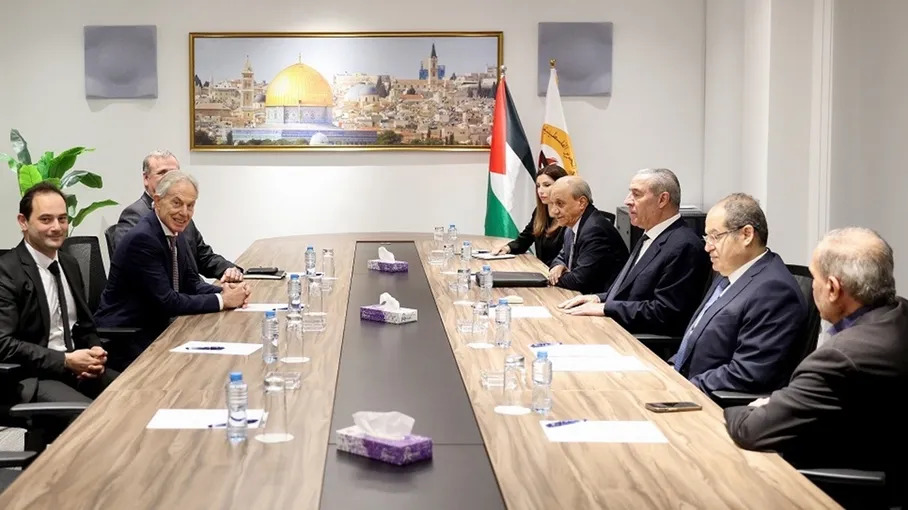







In recent days, attention has turned to the movements of former British Prime Minister Tony Blair, who visited Ramallah. Analysts confirmed that this is linked to the UN decision establishing an international force in the Gaza Strip and the implementation of an American plan for the future of the sector alongside reform pathways within the Palestinian Authority.
During a meeting in Ramallah in the central West Bank, Palestinian Vice President Hussein Sheikh and Blair discussed the developments in the Palestinian situation in Gaza and the occupied West Bank after the Security Council adopted a resolution regarding the establishment of an international force in Gaza, as part of the second phase of the ceasefire.
Sheikh mentioned in a post on the "X" platform that he met with Blair and a representative from the U.S. government (whose name he did not disclose) and discussed with them "the latest developments related to the next phase (in Gaza) following the issuance of the Security Council resolution, in addition to discussing issues related to Gaza and the West Bank, and the basic requirements for achieving the right to self-determination and statehood."
Last week, the UN Security Council adopted by majority a U.S. draft resolution regarding the end of the Israeli war in the Gaza Strip (number 2803), which authorizes the establishment of a temporary international force until the end of 2027.
This decision comes as a prelude to the second phase of the ceasefire agreement in Gaza, which has been in effect since October 10, and includes, according to President Donald Trump's plan, a temporary transitional governance managed by an independent Palestinian committee under the supervision of an international body headed by Trump, with the participation of other leaders to be announced later, including Tony Blair.
Ahmad Rafiq Awad, director of the Jerusalem Center affiliated with Al-Quds University, stated that Blair's discussions in Ramallah "are directly related to what is called the next day in the Gaza Strip, based on the UN resolution regarding Gaza," explaining that the Palestinian Authority is required to play a clear role in the sector that necessitates essential reforms that may take three years.
Awad added in his remarks to Anadolu Agency that the Authority "has already begun steps in this direction, such as forming a committee of experts specifically for the Gaza Strip; this indicates its readiness for the expected tasks in the upcoming phase," believing that the Palestinian meetings with Blair "come to establish this role and clarify its nature and limits."
He noted that Blair "raises questions regarding the extent of the Palestinian Authority's ability to contribute to any future arrangements, and how it can be a building factor rather than a destructive one."
Awad pointed to indications that Blair is likely to be "the influential figure in the UN Security Council if the proposed international force is formed in Gaza, and thus he is concerned with knowing the extent to which the Authority can participate and what needs to be developed within it."
He highlighted the Israeli rejection of any return of the Palestinian Authority's role in Gaza, saying: "This makes the meeting an attempt to explore the possible, rather than presenting a ready-made plan."
He warned that "any arrangements that do not have the approval of the Palestinians may collapse," adding: "Without the approval of the Palestinians or at least one of their levels, no plan will advance; because the international parties involved in stability or financially supporting may refuse if they see the Palestinians rejecting the decision."
He concluded that Blair's visit "carries a message that the international community is concerned about the Palestinians, but the nature of this interest and its size are subject to the reality of pressures and the ability to implement the required changes within the Authority."
For his part, Suleiman Basharat, director of the Yabous Center for Studies, spoke about Blair's visit as "confirmation of an American economic-political plan related to Gaza that preceded President Donald Trump's plan."
Basharat explained to Anadolu Agency: "There are two parallel American plans, the public plan that came out in Trump's name and includes 20 items related to ending the war, exchanging prisoners, disarming resistance, and turning the plan into a resolution in the Security Council."
The other is "a shadow plan that Washington has been working on quietly," according to Basharat, who considered that Blair "represents the most prominent figure working on it," pointing out that the presence of Jared Kushner, Trump's son-in-law and U.S. envoy, in the details of the plan "reinforces this perception."
He continued: "Kushner's successive visits to Tel Aviv and the settlements adjacent to Gaza are part of direct supervision that paves the way for transforming Gaza into what is called the Gaza Riviera, which is a very clear economic investment vision."
Basharat clarified that

Share your opinion
What is behind the "Blair" meeting in Ramallah and its relation to the plan to end the Gaza war?