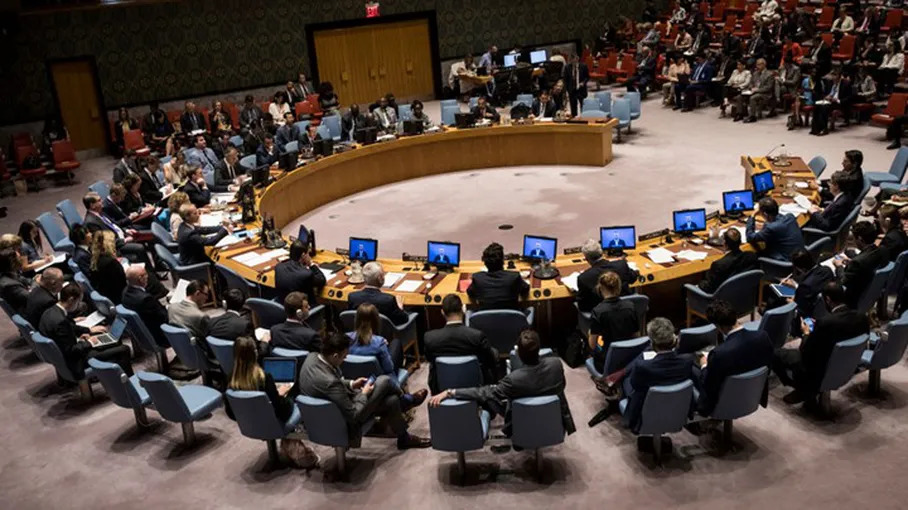







The UN Security Council voted with a majority of 13 votes in favor, while Russia and China abstained, on Resolution 2803, which imposes a new transitional framework on the Gaza Strip under the name 'Peace Council' led personally by US President Donald Trump.
Trump announced via social media: 'Congratulations to the world on the amazing vote by the UN Security Council, which recognizes and supports the Peace Council that I will lead, consisting of the strongest and most respected leaders around the world.'
For his part, Russian Ambassador to the UN Vasily Nebenzya stated during the voting session that the resolution 'recalls colonial practices and the League of Nations and the British mandate over Palestine, when the opinions of the Palestinians themselves were not taken into account.'
Nebenzya added: 'The resolution lacks any clarity regarding the timelines for transferring control of Gaza to the Palestinian Authority, and any certainty surrounding the Peace Council and the international force, which according to the text of the resolution, can operate completely independently, without any regard for the position or opinion of Ramallah.'
Resolution 2803 essentially establishes a clear military mechanism based on creating an international stabilization force tasked with disarming the Islamic Resistance Movement Hamas and other armed Palestinian factions.
US Ambassador to the UN Mike Waltz clarified in his speech following the vote that this force will work alongside Israeli security forces to stabilize the security situation in Gaza, support the disarmament process, dismantle Hamas's infrastructure, and halt the operation of weapons, while ensuring the safety of Palestinian civilians.
The mission assigned to the international force clearly indicates its actual objectives, as a research document issued by the Israeli National Security Studies Institute (INSS) earlier this month revealed the nature of the expected role of this force, stating that 'from Israel's perspective, the international force should be granted executive powers that allow it to ensure the disarmament of Hamas and other armed factions, in line with Trump's disarmament plan for the sector.'
The document added that 'Israel's strategic objectives, which include ending Hamas's rule in Gaza and destroying its military capabilities and those of other factions, remain in place even after the war ends, and thus Israel considers disarming these organizations and preventing their rearmament as central objectives.'
The resolution states that it is a step towards 'more sustainable peace,' but in reality, it conditions the disarmament of Palestinian resistance as a prerequisite for any progress, which is the primary Israeli goal that Tel Aviv has failed to achieve militarily despite a war lasting over two years.
The Washington Post reported in its analysis that 'the US-sponsored resolution enshrines the complete plan in international law and establishes a vaguely defined Peace Council, headed by Trump.'
In contrast, Hamas and the Palestinian factions categorically rejected the resolution, with Anadolu Agency reporting a joint statement from the Palestinian factions rejecting it, stating, 'Any clause that includes disarmament in Gaza or any infringement on the internationally recognized right of the Palestinian people to resist the Israeli occupation.'
The statement added that 'any discussion related to weapons must remain a purely national issue linked to a political process that leads to ending the Israeli occupation and establishing a Palestinian state.'
Reuters reported Hamas stating that the resolution imposes 'international guardianship' over Gaza, warning that 'any foreign military presence or guardianship or international bases inside Gaza' represents 'a direct assault on Palestinian sovereignty.'
Following his recognition of Jerusalem as the capital of Israel, President Donald Trump's assumption of the presidency of the 'Peace Council' is one of the most controversial topics related to the resolution, given his previous role in sensitive issues such as recognizing Jerusalem as the capital of Israel, moving the US embassy there, and proposing the 'Deal of the Century,' which was completely rejected by the Palestinians.
US Ambassador Mike Waltz confirmed this direction, stating that 'the Peace Council, which will be led by President Trump, remains the cornerstone of our efforts.'
For his part, Chinese Ambassador to the UN Fu Cong described the resolution as 'vague and unclear in many critical elements,' saying: 'The draft resolution outlines post-war governance arrangements for Gaza, but Palestine seems barely visible in it, and Palestinian sovereignty and ownership are not fully reflected.'
Politician Osama Rushdi posted on X platform, considering the US resolution in the Security Council regarding Gaza as 'a new trap' aimed at rearranging the course of the war to serve Washington and Tel Aviv.
He stated that the resolution is written in a 'Zionist-American' spirit, leaving the occupation to interpret its clauses, reproducing a freeze of the war without ending it, and paving the way for imposing post-war arrangements at the expense of the Palestinians, including entrenching the division of Gaza and controlling
Share your opinion
Does the Security Council's decision pave the way for international oversight over Gaza?