







Washington – "Jerusalem" dot com - Said Arikat
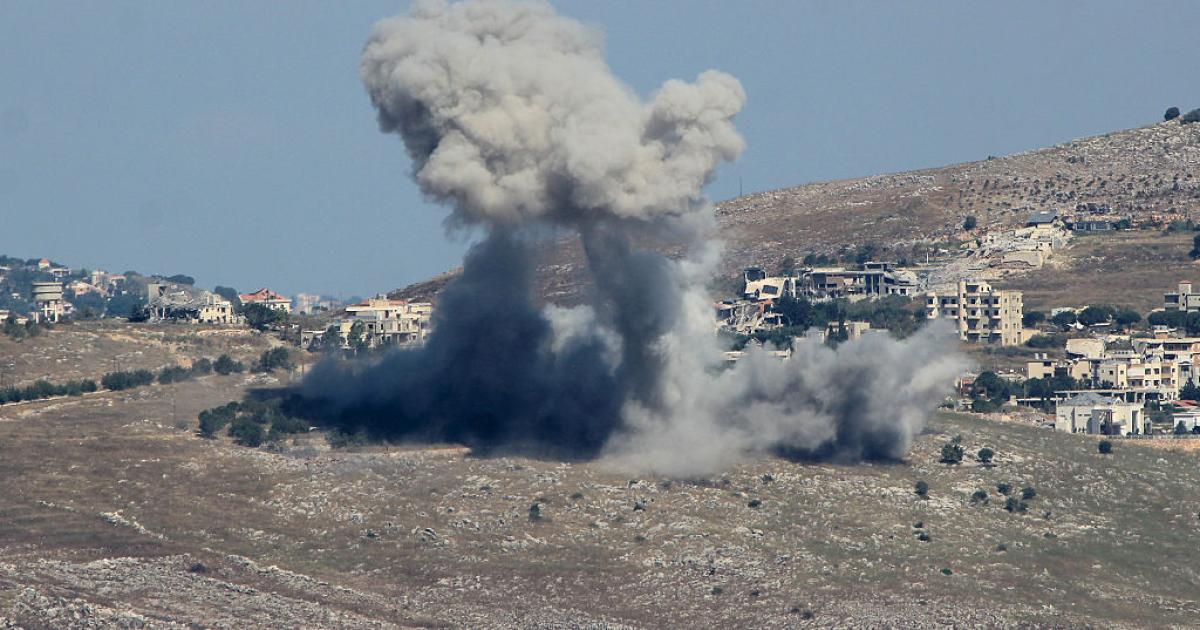
The atmosphere of war looms once again over the Lebanese-Israeli border, amid increasing indications of Israel's readiness to launch a ground military operation that could extend as far as the Litani River, a move that threatens to redraw the security landscape in northern Israel and southern Lebanon in a highly dangerous manner.
Media reports and intersecting military analyses indicate that Israel is seriously considering the option of launching a wide-ranging ground operation in southern Lebanon, under the pretext of "preventing Hezbollah's expansion" and enhancing deterrence along its northern borders. Informed sources in Washington confirm that these plans are being seriously discussed within Israeli security circles, amid growing concerns about the military capabilities of the party, particularly its missile capabilities. However, behind this stated concern, observers believe that Tel Aviv is once again leaning towards the logic of force in an attempt to restore the deterrence balance that has eroded due to its recent failures in Gaza.
Reuters reported, citing Israeli security sources, that Tel Aviv has sent direct and indirect messages (believed to be through the American mediator) to Beirut warning that the continuation of Hezbollah's activities south of the Litani will make confrontation "a matter of time." Israel also held the Lebanese government responsible for what is happening there, demanding that the Lebanese army take action to disarm the party or limit its military presence. In contrast, Lebanese analysts consider these threats to be nothing new, but they acquire additional seriousness today in light of unprecedented regional tension, making any limited friction likely to escalate into a full-scale war.
The significance of the Litani River lies in the fact that it is not just a geographical line but a strategic symbol in Israeli-Lebanese consciousness. For more than half a century, the Litani has represented the maximum limit of Israel's security ambitions in the south, and it has often been associated with ceasefire agreements and UN attempts to establish buffer zones. Therefore, the return of Israeli discourse about "reaching the Litani" practically means paving the way for the establishment of a new security zone north of the border, reminiscent of the previous Israeli occupation phase. Military experts point out that any incursion of this kind would mean controlling populated areas that include hundreds of villages and tens of thousands of residents, which threatens a wide-scale humanitarian disaster.
Analyses from American and Israeli research centers, such as the "Institute for the Study of War" in Washington, which is close to the Israeli Likud, and the "Israeli National Security Institute," present multiple scenarios starting with limited operations targeting missile sites or weapon depots of Hezbollah, which could escalate into a full-scale ground invasion if the strikes do not achieve their objectives. Some experts believe that Israel is using this escalation to send deterrent messages and compel the Lebanese government to act, but the danger of slipping into an actual confrontation remains, especially if international mediations fail or border clashes exceed the unannounced red lines.
On the other hand, Lebanon suffers from institutional weakness and a suffocating economic crisis that limits its ability to impose sovereignty in the south. The Lebanese army lacks sufficient resources to deploy in the border area, while state institutions are experiencing near-total paralysis. This reality provides Israel with an additional excuse to claim that "the Lebanese state is unable to implement Resolution 1701," which ended the 2006 war and stipulated the absence of any non-governmental armed presence in the area between the blue line and the Litani. However, Israel believes that Hezbollah has not adhered to the resolution, but rather has strengthened its military structure in that area in recent years.
Analysts warn that any Israeli aggression of this magnitude will overturn the equations, making the talk of disarming Hezbollah impossible and granting it renewed legitimacy for resistance within Lebanon. In this context, Washington is closely monitoring developments, as its envoys Tom Barak and Morgan Ortagus move between Beirut and Tel Aviv in an attempt to "contain the escalation," while reaffirming full American support for Israel under the pretext of "its right to self-defense."
Military experts believe that any ground operation extending to the Litani would be extremely costly. The terrain there is difficult, the population is hostile, and Hezbollah possesses high combat experience and advanced missile capabilities. Any incursion of this kind would open the door to a broader regional confrontation, potentially involving other fronts in Syria, Iraq, and perhaps the Mediterranean Sea.
Although talk of an invasion remains within the realm of possibility, the increasing discourse around it in Israeli political and military circles reflects a clear tendency towards "rebuilding lost deterrence" and attempting to compensate for failure in Gaza through a new adventure to the north. However, historical experience shows that Lebanon has never been an easy arena for Israel, and any new invasion could turn into a costly quagmire that deepens its security and political predicament.
The rising rhetoric about "returning




Share your opinion
Israel is preparing for a ground invasion up to the Litani River and a return to the policy of open aggression against Lebanon.