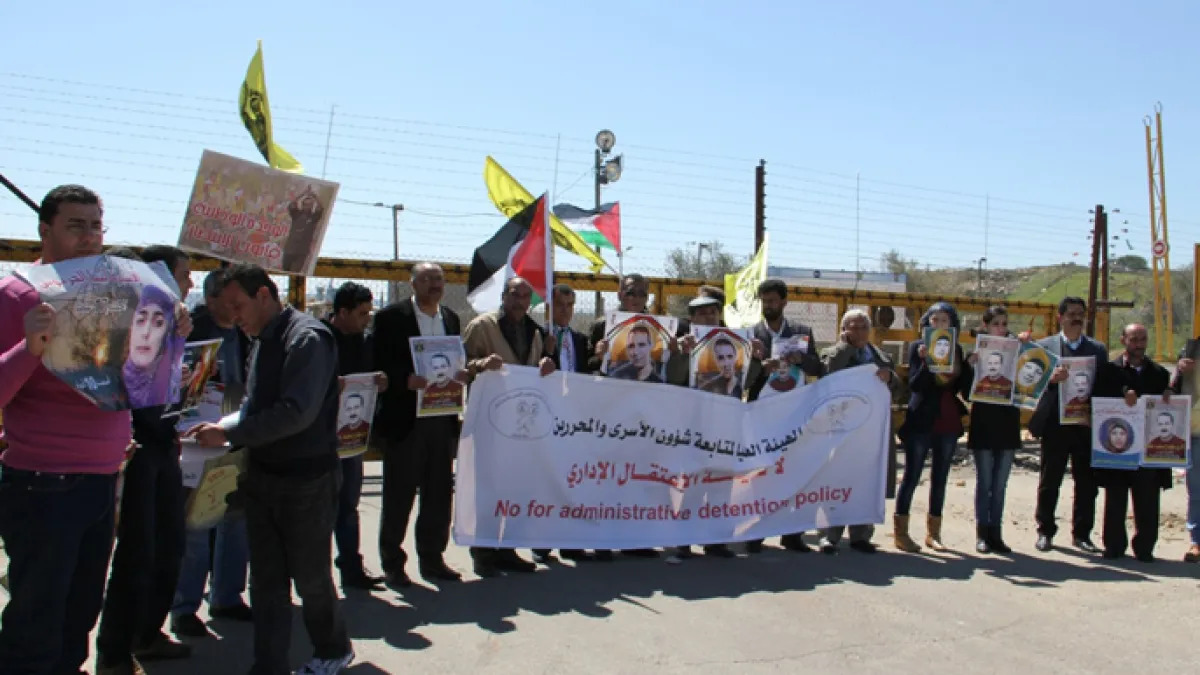







Since the occupation of the West Bank in 1967, hundreds of thousands of Palestinians have undergone military trials, far from justice, and many have received unjust sentences based on Israeli military orders and laws inherited from the British Mandate era.
According to the Israeli human rights organization "B'Tselem," the jurisdiction of military courts covers "security" offenses related to resisting the occupation, as well as offenses related to issues that "threaten public order," including traffic violations.
The organization states in its reports that detention until the judicial procedures are completed, meaning until the trial is concluded and a verdict is issued, is considered one of the most problematic procedures in the performance of military courts.
It adds that the performance of these courts "appears - superficially - to be judicial like in regular courts, as there is a prosecutor and a defense lawyer, there are legal procedures and laws and regulations, and there are judges who write decisions and rulings in embellished legal terms.
However, behind these respectable appearances operates one of the fiercest instruments of occupation.
It adds, "The judges and military prosecutors are always Israelis, soldiers in military uniforms, and Palestinians in all cases stand there in the category of suspicion or accusation and in most cases in the category of conviction."
How many Palestinian prisoners are in the occupation's prisons? By the end of October 2025, the number of prisoners and detainees in Israeli prisons exceeded 9,250, the majority of whom are held as administrative detainees, according to the Palestinian Prisoners' Club.
Of the total number, only 1,242 prisoners (about 13%) have received sentences, 3,368 are administrative detainees (36%), and 1,205 are classified by the occupation as "illegal combatants."
Where are the prisoners tried and what is the structure of those courts? There are two primary military courts in the West Bank: Ofer Court located in Ofer Prison west of Ramallah, and Salem Court near Jenin.
There is also a military appeals court located in Ofer Camp, which oversees the primary courts.
The military courts that decide on detention procedures during the investigation phase are located in the interrogation centers of the Israeli General Security Service (Shabak), which are: Jalameh, Petah Tikva, Ashkelon, and the Moscow facility in Jerusalem.
The two military courts that decide on administrative detention are located, one in Ofer Camp and the other in Negev Prison.
Since 2009, there has been a military court for minors operating in "Ofer" Camp.
The courts hold sessions either in person with the presence of the prisoner, which imposes great hardship on the prisoners, as some may take days to be transferred to West Bank courts, or there are sessions held in absentia, and others via closed-circuit television.
Are there real hearings for Palestinian prisoners? The proceedings of the trial vary depending on the accused, as they may either be administrative detainees under a secret file, or under a file registered as a case in court, each with its own procedures.
Administrative detention: According to the Prisoners' Club, the order for administrative detention is issued by the occupation's intelligence and the Minister of Defense under the pretext of having materials or a secret file claiming that the detainee poses a threat to "security."
The duration of the administrative detention order can reach 6 months and can be extended for years, either continuously or non-continuously.
According to the club, military trials in administrative detention are "formal and sham courts, as deliberations take place far from the principles of fair trials, even though all court appearances are present, including a judge, a lawyer, a prosecutor, and a detainee."
In the case of administrative detainees, no indictment is presented, and there is not enough space for defense and cross-examination of witnesses.
The prisoner or their lawyers are also prohibited from accessing the secret file, and the decision to extend or cancel the detention order in the future remains the prerogative of the intelligence services.
Trials with indictments: This includes prisoners who are accused and convicted and those who have cases opened against them, and they undergo litigation procedures.
In this classification, the prisoner has the right to appoint a lawyer to represent them, and family members of the prisoners may be allowed to attend their trial sessions, and in most cases, lawyers resort to plea bargains to save time and due to the futility of litigation, alleviating the burden on prisoners who face mistreatment when brought to court sessions.
What is the role of lawyers? In administrative detention


Share your opinion
Question and Answer.. How are Palestinian prisoners tried in the occupation's prisons?