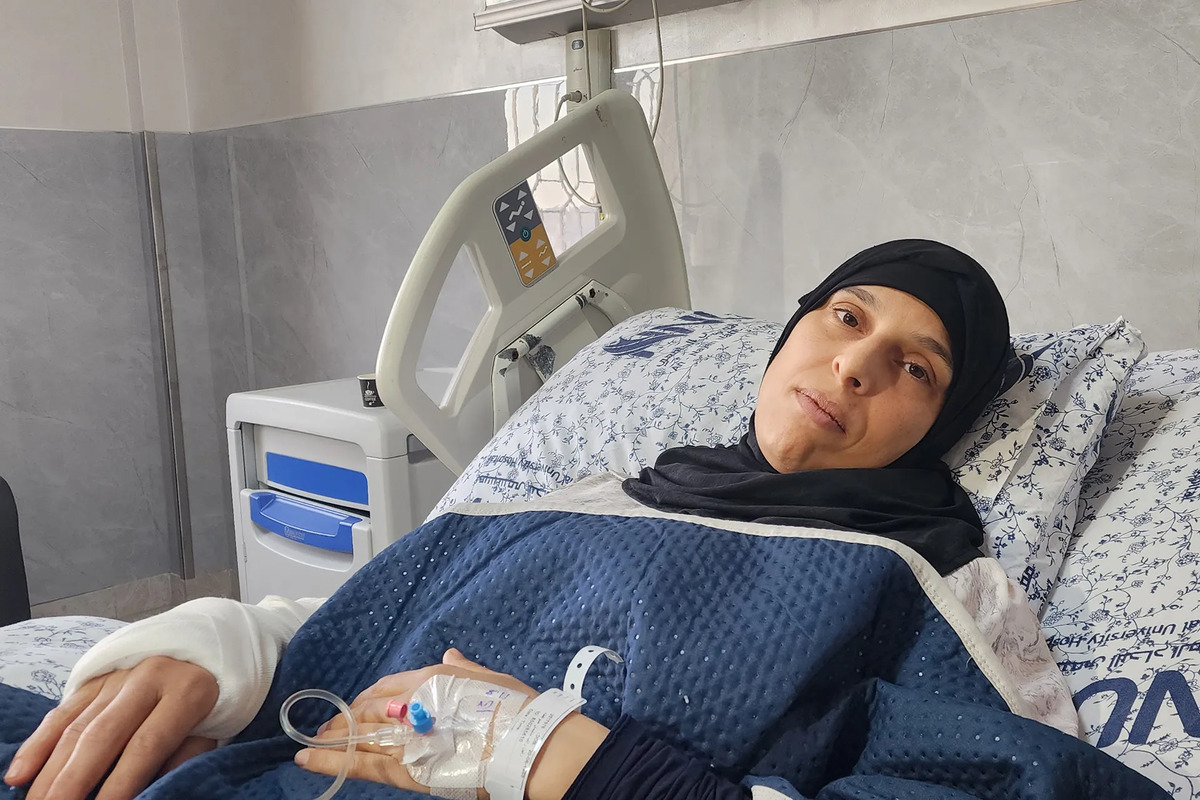







I was screaming: For God's sake, stop hitting me and I will leave the place, but to no avail; he only became more brutal each time. With these words, journalist Ranin Suwafta described what happened to her during her reception at the emergency department of Rafidia Government Hospital in Nablus after she was subjected to a horrific assault by settlers while covering the olive harvest season in the town of Beita in the northern West Bank.
Suwafta explains that the journalists present for the coverage were direct targets for the settlers, and that the assault on her was "with the intent to kill." The residents of Beita village south of Nablus went to pick their olives in the Al-Qamas mountain area accompanied by foreign activists, before being attacked by a group of settlers with sticks and stones, primarily targeting the press crews, including Suwafta.
Suwafta says she could not withdraw quickly due to the weight of her journalistic equipment and protective gear and the difficult terrain of the area, so she fell to the ground, surrounded by more than five settlers who began to beat her violently on the exposed parts of her body, especially her right hand that was holding the camera.
She adds, "The more I hurt, the harder they hit, focusing on my head and hands," as shown in the video that circulated of her inside the emergency department.
Suwafta was taken to the hospital with direct injuries to her right hand and side, while doctors confirmed her need for a long treatment journey after diagnosing three fractures in her elbow, in addition to being hit by a stone in her head that shattered her helmet.
She remarks, "The protective press gear is what saved my life from death."
Throughout her years working as a news photographer, Suwafta has faced multiple assaults from Israeli forces, including injuries from live and rubber bullets, beatings, choking, detention, and obstruction of coverage, but the recent assault by settlers was "the harshest ever" for her and her colleagues who were with her.
Photographer Nasser Ishtiyeh was also among the injured. He says, like Suwafta, that the settlers targeted the unprotected areas, where he was hit by a large stone in his neck while documenting the assault on his colleague, causing damage to a major nerve, in addition to bruises on his right hand from repeated falls while trying to withdraw.
Ishtiyeh recounts that he arrived in the area around 11 AM to cover the support of foreign activists for the residents of Beita in picking olives, before being attacked by dozens of settlers (between 30 and 40 settlers) in less than half an hour, all of whom were armed with sticks and stones and directly targeting journalists and activists.
Ishtiyeh agrees with his colleague Suwafta that this assault is one of the most difficult during his 33 years spent in fieldwork and covering events from the first intifada to today, during which he has been injured dozens of times by occupation forces.
He points out that he was subjected to a similar assault just two months ago in the Jordan Valley, where settlers stole his lens, smashed his vehicle, and assaulted him directly, prompting him to avoid coverage in areas where settlers are prevalent.
He adds, "Settler assaults are the most dangerous... They are groups not governed by law and cannot be pursued or punished."
Alongside Suwafta and Ishtiyeh, Al Jazeera correspondent Mohammed Al-Atrash and photographer Louay Al-Saeed were injured, in addition to Xinhua Agency photographer Nabil Bouitel.
Journalist Ayman Al-Noubani, a member of the Palestinian Journalists' Syndicate, states that assaults by settlers on journalists have escalated dangerously over the past year, threatening their lives and hindering their work, especially in areas where settler assaults on Palestinians are recurrent.
He adds in his remarks, "We have witnessed attempts to kill journalists... Unfortunately, no one can today protect the Palestinian journalist during their coverage, movement, or daily work."
According to the syndicate's monitoring, around 100 assaults on journalists by settlers occurred over the past three years, most of which concentrated in recent months, including the fatal assault on Anadolu Agency photographer Issam Al-Rimawi and the burning of photographer Jaafar Ishtiyeh's vehicle to prevent him from covering.
Al-Noubani points to the syndicate's efforts through its partnerships with the International Federation of Journalists, the Arab Journalists' Union, and international institutions to expose these assaults and pressure to stop them, but "the assaults continue and are becoming more violent, and no one is able to protect the Palestinian journalist on


Share your opinion
Field testimonies about settlers' attempts to kill journalists in the West Bank.