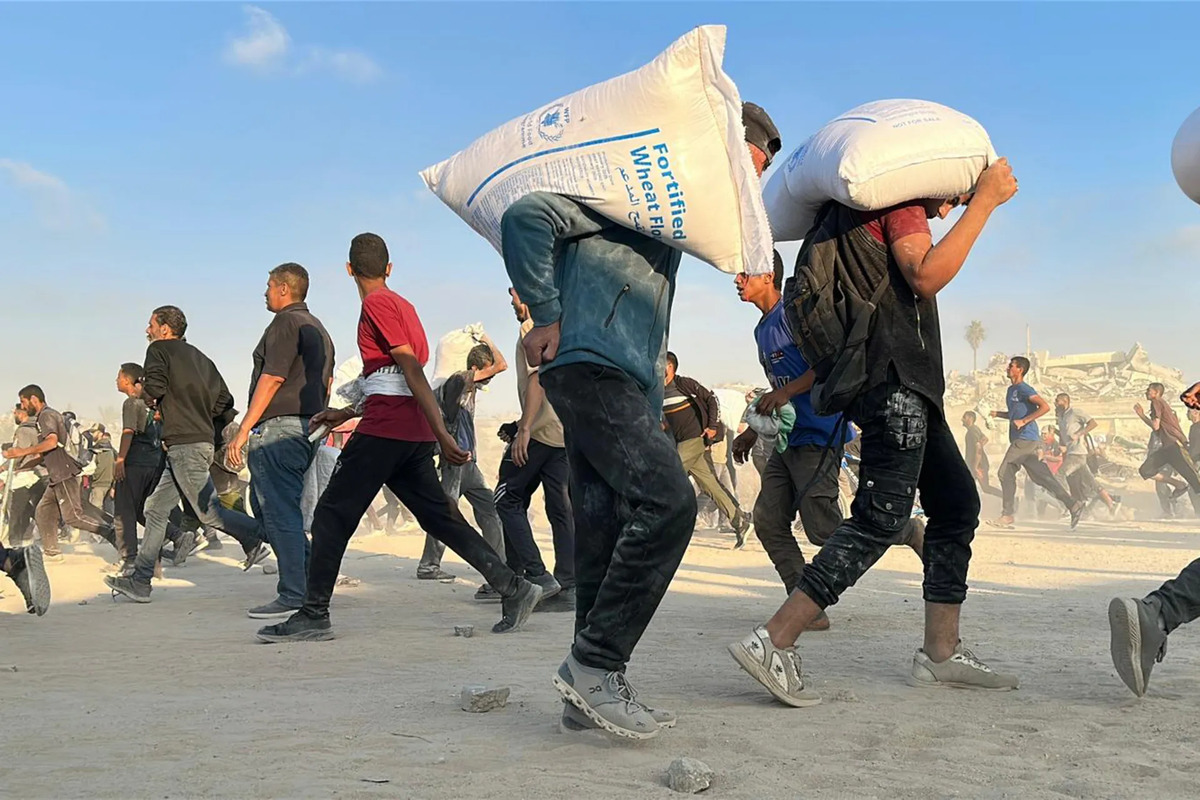







While the Israeli occupation allows the passage of aid and goods to the Gaza Strip, it continues to adhere to the equation of 'keeping the head above water' with more than two million Palestinians, resembling a state of leaving them in a spiral of starvation without recovering from its effects.
This policy is evident through Israel's control over the types of goods entering, their quantities, and prices, aiming to make their availability difficult for consumers who are still suffering from the repercussions of a devastating war that has left its marks on their bodies.
The occupation has accurate statistics on the monthly consumption of basic food items by the residents of the Strip, as the occupation forces allowed the entry of a total of 4,453 trucks, including all that has entered the Strip in terms of aid, commercial goods, and fuel derivatives.
The number of trucks entering the commercial sector reached 1,110 trucks, of which 354 were food trucks, accounting for 32% of the total incoming to traders.
The number of meat trucks was limited to only 10 trucks, while the number of vegetable and fruit trucks reached 62 trucks.
The Director General of the Government Media Office, Ismail Al-Thawabteh, states that the average number of trucks entering daily is only 171 trucks out of 600 trucks that are supposed to enter according to humanitarian protocols.
The occupation forces still prevent 350 types of essential foods needed by children, patients, the injured, and vulnerable groups, most notably eggs, red meat, poultry, fish, and dairy products.
The occupation has accurate statistics on the monthly consumption of basic food items by the residents of the Strip due to its control over the commercial crossings.
The Acting Director General of Studies at the Ministry of Economy, Muhammad Barbak, states that the occupation relies on a policy of 'keeping the head above water' and controls the incoming goods in a way that ensures the population lives in a state of hunger without reaching complete mass death.
The occupation's procedures control the triad of quantities, prices, and types, redistributing goods at rising prices, making the market fragile and quick to be affected by any escalation.
The Gaza Strip is currently suffering from a lack of the necessary infrastructure to store goods after warehouses and storage facilities were destroyed during the war.
The Director General of Studies at the Ministry of Economy confirms that the Israeli occupation deliberately controls the quantity of essential goods entering to ensure its continued control over the market.
It seems that the occupation has set a limit on the number of calories each person in the Gaza Strip consumes, so that they do not reach a level of recovery from starvation.
Nutritionist Ahmad Al-Fara states that malnutrition in Gaza has shifted from a stage of severe calorie deficiency to a stage of protein deficiency.
The lack of protein causes swelling of the face, abdomen, and limbs, as well as destroying immunity, making the body unable to resist diseases.
The diet in Gaza has become dangerously imbalanced, as the population relies solely on carbohydrates, while essential natural fats are scarce.
Al-Fara confirms that the situation is becoming harsher for the most vulnerable groups such as the injured, pregnant women, and newborns.
New birth cases clearly reflect the disaster, as the weights of newborns do not exceed one and a half kilograms.
Malnutrition has become a constant partner of chronic diseases, and we lose cases in intensive care every day.
Malnutrition has become a constant partner of chronic diseases, and we lose cases in intensive care every day.



Share your opinion
Israel tightens its grip on food in Gaza