







Washington – "Al-Quds" dot com - Said Arikat
The state of confusion surrounding the U.S. stance on the ceasefire in Gaza is increasing as U.S. President Donald Trump continues to send contradictory messages regarding the agreement and its second phase, which is supposed to include humanitarian arrangements and the reconstruction of the sector after a devastating war that lasted more than two years. While Trump seeks to portray himself as a peacemaker, his conflicting statements seem to confuse both his allies and adversaries alike, raising questions about the seriousness of Washington in leading a coherent political process in the Middle East.
Trump wants the credit without the involvement
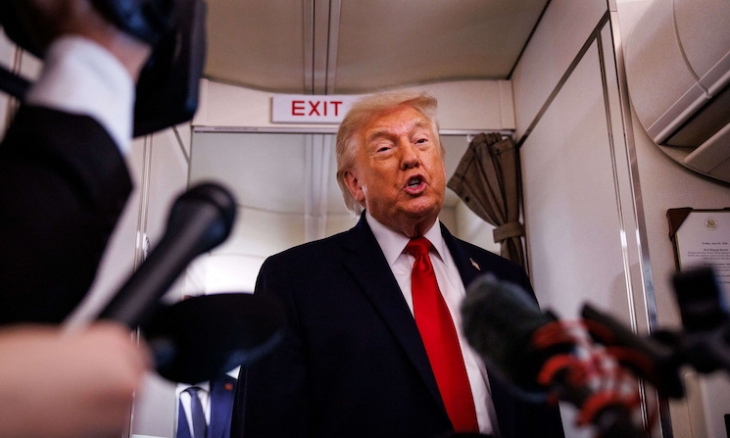
Since the announcement of the ceasefire, Trump has not stopped praising his personal role in achieving the truce, describing the agreement as a “historic deal that no one but me could accomplish.” But just hours later, he returned to question the intentions of Hamas, saying it “cannot be trusted,” hinting that Israel would be “free to respond” if fighting resumed.
This duality, as observers see it, is not coincidental. Trump seeks to reap political gains without bearing the consequences of direct U.S. intervention. He wants to appear to the American public as a decisive peacemaker, without making financial or military commitments that might anger his conservative base or increase Washington's foreign burdens.
One expert on Middle Eastern affairs in Washington told a correspondent for Al-Quds newspaper that “the president wants to own the victory, but he does not want to own the responsibility. He wants the success attributed to him, not to bear its consequences.”
The second phase: Ambiguity in vision and conflicting messages
While regional mediators talk about a “second phase” that includes reconstruction and stabilizing the ceasefire through international mechanisms, it seems that the Trump administration does not have a clear or unified plan. While some of his advisors promote the idea of an international coalition overseeing the reconstruction of Gaza, the president himself rejects it, describing it as “wasting American money.”
This contradiction reveals a division within the U.S. administration between the State Department, which leans towards coordinating with international partners, and the political team at the White House that prefers to minimize any long-term U.S. involvement in the region. One U.S. diplomat described the scene, saying: “Every time we get close to a coherent policy, the president tweets something that turns everything upside down.”
Regional confusion and Arab caution
Israel, which openly claims to coordinate everything with Washington, including its violation of the ceasefire last weekend, does not hide its concern over the contradictions in U.S. positions. Some Israeli officials have expressed their dissatisfaction in closed sessions about the lack of clarity regarding whether Washington supports continued pressure on Hamas or prefers to stabilize the truce.
As for Hamas and the mediators in Doha and Cairo, they see the U.S. position's turmoil as an opportunity to push for easing restrictions on the sector and increasing humanitarian aid. In Cairo and Amman, officials are exercising extreme caution, aware that a single tweet from Trump could reignite the situation.
An Arab diplomatic source in Washington told a correspondent for Al-Quds that “moderate Arab countries are dealing with the U.S. position as they would with unpredictable weather — no one knows when the storm will hit.”
Electoral calculations behind foreign policy
Domestically, Trump's fluctuations reflect a mix of political and electoral calculations. He seeks to reassure his evangelical and pro-Israel conservative base without alienating war-weary voters. Therefore, he adopts a dual rhetoric: publicly declaring peace while simultaneously making hardline statements to satisfy two opposing sides within the American scene.
A former U.S. National Security Council official said, “Trump deliberately maintains ambiguity because he believes that contradiction gives him negotiating power and keeps everyone on edge. It’s a governing style based on surprise rather than planning.”
The risks of a confused approach
However, this approach is fraught with risks. The contradiction in the U.S. position may encourage hardliners on both sides — within Hamas who doubt Washington's commitment, and in Israel who see that U.S. confusion allows them freedom of action. It may also undermine what remains of the United States' credibility as an honest broker in the region.
A European diplomat involved in mediation efforts warns that “peace is not built on tweets and conflicting statements, but on a stable and clear policy.”
In the end, the ceasefire may succeed in holding temporarily, but unless Washington lays out a clear vision for the next phase, what Trump describes as the “greatest diplomatic achievement” may
Share your opinion
Trump's contradictory messages about the ceasefire in Gaza reveal a deeper confusion in his strategy.