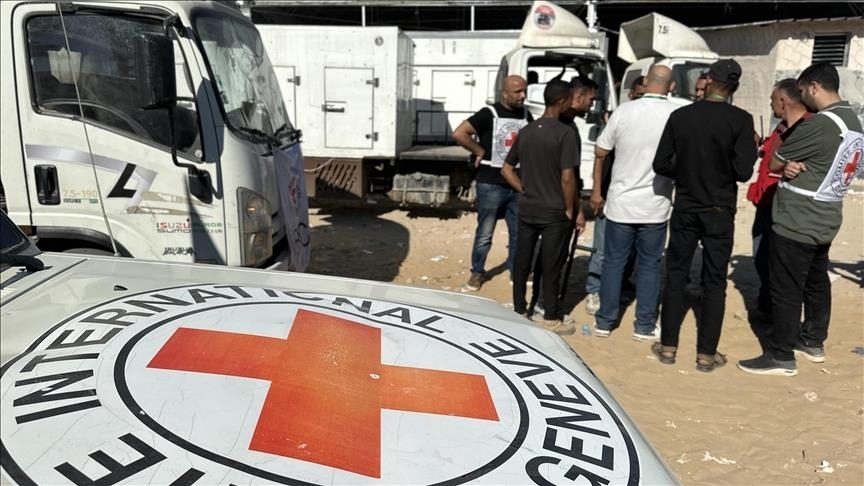







The Israeli Broadcasting Authority reported on Saturday that the government is considering imposing additional sanctions on the Gaza Strip if it does not continue to deliver the bodies of the deceased captives. This comes hours after Prime Minister Benjamin Netanyahu's office announced that the Rafah crossing would not be opened until further notice, a crossing that has been controlled by Tel Aviv from the Palestinian side since May 2024.
Since last Monday, Hamas has released 20 living Israeli prisoners and handed over the bodies of 13 out of 28, most of whom are Israelis. It stated that it seeks to 'close the file' and needs time, advanced equipment, and heavy machinery to retrieve the remaining bodies.
Meanwhile, Israel claims that the remaining number is 16, asserting on Wednesday that one of the received bodies does not match any of its captives, and it also claims that among the returned bodies is one of a Nepali citizen.
The official channel 'Kan' quoted an unnamed Israeli official stating that Netanyahu is considering repositioning army forces within the Gaza Strip and adjusting their withdrawal lines if Hamas does not deliver the bodies by the specified deadline (without additional details).
On October 10, the Israeli army partially withdrew to areas within the Gaza Strip known as the 'yellow line,' coinciding with the implementation of a ceasefire agreement, while keeping its forces deployed in about 50 percent of the area of the strip.
The 'yellow line' is the first withdrawal line stipulated in U.S. President Donald Trump's ceasefire plan between Hamas and Israel.
The channel added that the Prime Minister's office statement confirmed that the opening of the Rafah crossing would only be discussed based on how Hamas fulfills its commitments to return the bodies of the captives and implement the agreed-upon terms of the agreement.
In contrast, the headquarters of the families of Israeli prisoners welcomed Netanyahu's decision to keep the crossing closed, but emphasized in a statement that the Israeli government must adopt a strict approach towards Hamas and demand the return of all 18 captives without exception, according to the official channel.
Kan also noted that U.S. envoy Steve Witkoff, representing Trump, will arrive in Israel on Monday accompanied by Vice President JD Vance to follow up on the implementation of the U.S. initiative to end the war in Gaza.
Earlier on Saturday, Netanyahu's office announced that the Rafah crossing 'will not be opened until further notice,' in violation of the ceasefire agreement in the Gaza Strip.
The Rafah crossing was scheduled to open last Wednesday as part of the first phase of the ceasefire agreement.
Earlier on Saturday, the Palestinian embassy in Cairo announced that the crossing would be reopened next Monday to allow Palestinians wishing to return to the strip.
Netanyahu's decision contradicts what Israeli Foreign Minister Gideon Sa'ar suggested on Thursday, that the Rafah crossing would open at the beginning of this week.
On October 9, Hamas and Israel reached an agreement for a ceasefire and prisoner exchange, according to Trump's plan, and the next day the first phase of the agreement came into effect.
This agreement ended a genocide committed by Israel since October 8, 2023, over two years, with U.S. support, resulting in the deaths of 68,116 Palestinians and injuring 170,200 others, and the destruction of 90 percent of the infrastructure in the strip.
Israel is considering imposing additional sanctions on the Gaza Strip if it does not continue to deliver the bodies of the deceased captives.


Share your opinion
Despite receiving the living prisoners and 13 bodies, Israel is considering imposing sanctions on Gaza.