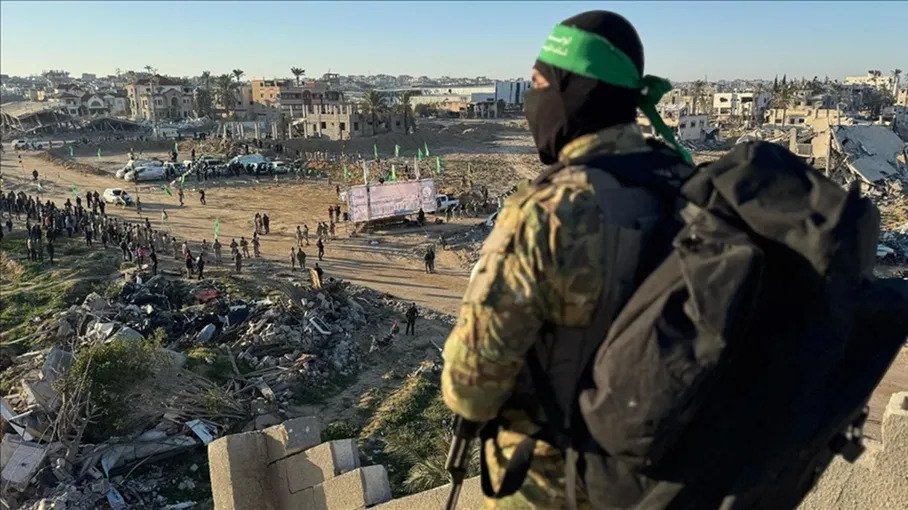







The ceasefire agreement in the Gaza Strip contains many ambiguous clauses, not only for the Palestinians but also for the Israelis. Among these is the deployment of a multinational force in the sector, which, although it seems like a promising idea, could turn into a "dangerous trap" for the occupation, particularly regarding the promises to disarm Hamas.
The Israeli expert on Hamas affairs, Ayal Ofer, mentioned that "the precise version of Tony Blair's plan for the day after in Gaza includes the establishment of a new entity called GITA (the International Temporary Authority for Gaza), whose tasks will include providing stability in Gaza during its reconstruction period. It will not act as a substitute for the local police but will assist and coordinate with it, and its role will be to protect infrastructure construction sites, humanitarian corridors, and public sites, as well as to provide services and rehabilitation for the Palestinians, in addition to combating 'terrorism' and preventing smuggling."
Ofer added, in an article published by "Channel 12" and translated by "Arabi21," that "a European force will be at the Rafah crossing, which will be managed by 150 to 200 members of the presidential guard loyal to Abu Mazen, called EUBAM, short for the European Union Border Assistance Mission. It was supposed to prevent smuggling at the crossing, but it fled in July 2007 when Hamas took control of the sector, most of them being Spanish, French, and Italian, residing in their air-conditioned offices in Tel Aviv, receiving their salaries, and finally being allowed to return to the crossing."
He pointed out that "the three main tasks of the international force will be to oversee what is called 'disarming the sector,' meaning the surrender of heavy weapons capable of injuring five or more people. The number of heavy rockets remaining in Hamas's hands is unknown, but it is expected that they will be forced to surrender them. However, the more important question is the disarmament of Hamas, meaning its personal weapons, as it still possesses thousands of assault rifles and RPG launchers, including the Gaza-produced version: Yassin 105, because President Trump's clear demand is for the complete disarmament of the movement."
He clarified that "many have speculated that the movement will not agree to this step, as it may find itself losing in its battles against its opponents in Gaza, while others believe it is interested in a Hezbollah model, where a 'government of 15 technocrats' managing the daily affairs of the sector is supposed to exist above it. Hamas has never aspired to be responsible for repairing the sewage network in Shuja'iyya or placing traffic lights in Khan Younis while retaining its weapons and forming a force that compels the technocrat government to operate under its influence and protection."
He confirmed that "there is another surprising possibility that Hamas will not choose the Hezbollah model but rather the Syrian model, where it will take a step similar to the opposition there, ready to surrender all its weapons, yes all of them, to the multinational force in exchange for guaranteeing its soldiers' access to the last frontline in the coming years, where they will be re-equipped with powerful weapons. To understand why this surprising possibility could theoretically materialize, the important third role of the multinational force, as stated in Blair's document, must be discussed, which is the security of Gaza's borders."
He added that "Hamas has previously demanded in negotiations the deployment of Arab forces along the eastern and northern borders of the sector, which will have only one purpose: to act as a barrier preventing entry into Gaza after the war ends until the movement regains its ranks and military capabilities. In this way, the multinational force, which will primarily consist of Islamic and Arab countries, will be a force that will compel the Israeli army to withdraw from almost all areas of the sector, and it will be deployed in a way that prevents it from resuming its operations in the sector."
He explained that "Egypt has submitted a request that specifies the mandate of this force by a binding resolution from the Security Council, which will significantly limit Israel's ability to operate within Gaza, including airstrikes. This will require a coordination mechanism with this force, which will reduce the army's ability to operate there, leading to the integration of Gaza with the Palestinian Authority through its security forces, from the presidential guard and five battalions trained by American General Dayton and his successor General Chapland, which will enter Gaza with the multinational force or a few months after it."
He clarified that "Hamas always thinks long-term; the return of the Authority to Gaza serves it in the short term, as it allows the flow of tens of billions for its reconstruction, and funds that will mostly be allocated as salaries for the residents of Gaza participating in the reconstruction process, and it


Share your opinion
Israeli concerns about Hamas benefiting from the deployment of a multinational force in Gaza