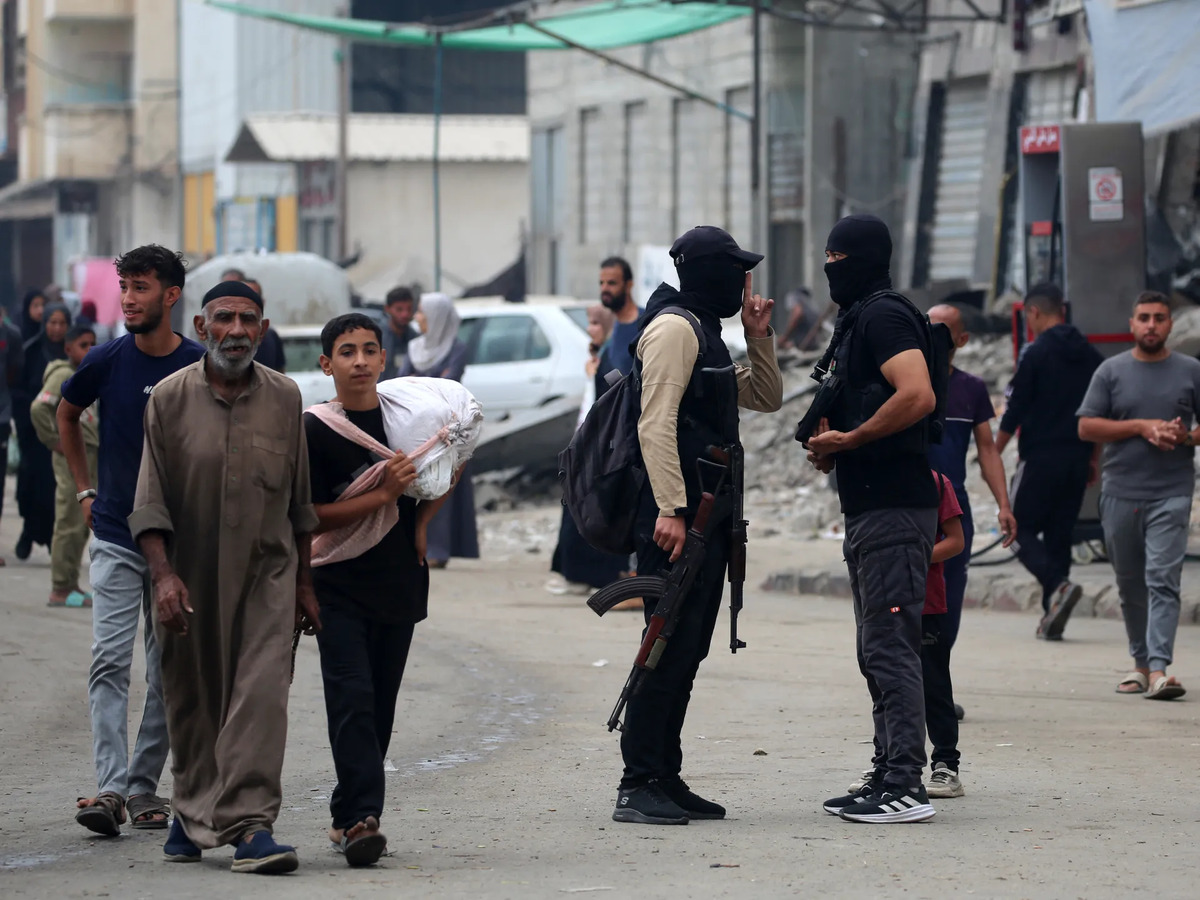







Le Monde reported that the Islamic Resistance Movement (Hamas), after organizing a prisoner exchange with Israel, has begun to redeploy its security apparatus in the Gaza Strip amid rising tensions with local militias suspected of receiving Israeli support.
The French newspaper explained—in a report by Louis Imbert and Marie-Jo Sader—that Hamas has returned to the forefront of events in Gaza after months of absence from the public scene and a decline in its influence due to bombardments, war, and divisions.
In a symbolic scene in Khan Younis city in the southern Gaza Strip, Hamas organized—a wide reception without slogans—for nearly two thousand prisoners released by Israel as part of the first phase of the ceasefire, sending a clear message that the movement is acting in a calculated and studied manner.
About 7,000 employees from government institutions affiliated with Hamas participated in the organization—according to the government media office—in a scene reflecting the restoration of the movement's administrative structures after a near-total collapse of the civil infrastructure due to the prolonged Israeli aggression.
The newspaper noted that strict instructions were issued from the "Resistance Security" to citizens and journalists, calling for discretion and not circulating any information about the exchange operations, under the threat of prosecution and penalties, according to official statements.
The prisoner exchange coincided with an extensive security campaign carried out by Hamas against local armed groups, most notably the Dagmash clan, which exploited the security chaos and took control of civilian facilities, turning them into a military stronghold, according to the newspaper.
According to eyewitnesses, clashes occurred around the clan's base in the Sabra area, and Hamas was able to regain control of the building, at a time when members of the clan were accused of committing murder crimes, including the assassination of photographer Saleh Al-Jaafari.
In an official statement, the Dagmash faction expressed "regret for the transgressions," but accused Hamas of "indiscriminate strikes," denying any connection to the assassination of the journalist.
Hamas and some local sources—according to Le Monde—accuse armed groups, including two factions led by Ashraf Al-Mansi and Yasser Abu Shabab, of receiving direct support from Israeli intelligence, aiming to create chaos and undermine the movement's control.
One of these groups had published advertisements on Facebook seeking volunteers, offering salaries of up to 3,000 shekels (about 800 euros), the newspaper said, but these groups withdrew, with the start of the ceasefire, to border areas known as "the yellow line," which are still under Israeli military control.
Despite the announced U.S. position of not involving Hamas in Gaza's future, U.S. President Donald Trump surprised observers with statements confirming that the movement "is acting within the standards" of the ceasefire, saying, "They expressed their desire to solve problems, and we agreed to give them a temporary opportunity."
In the absence of acceptable political alternatives internally capable of imposing order—as Le Monde states—it seems that Hamas maintains its position as the de facto ruler of the Strip, even outside any international or regional agreements.
Abu Mohammed, a university professor from southern Gaza who refused to disclose his real name, said, "No one but Hamas can govern Gaza today. Simply because it provides security and stability. Even if I politically wish for an alternative authority."
The newspaper concluded that Hamas is repositioning itself as a de facto power in Gaza, despite international political exclusion and regional and local pressures, remaining the most present player, while the Palestinian Authority is preoccupied with developments in the West Bank, and international initiatives remain stagnant.
Hamas is repositioning itself as a de facto power in Gaza, despite international political exclusion.



Share your opinion
Le Monde: Hamas reasserts its control over Gaza