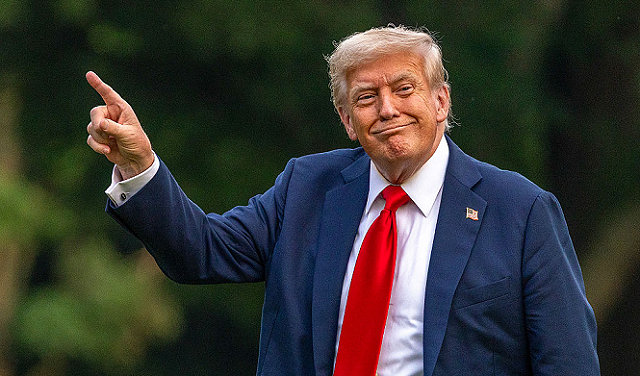







In an unexpected development, U.S. President Donald Trump welcomed on Friday what he described as "partial acceptance" from Hamas of his initiative aimed at ending the ongoing war in the Gaza Strip that has lasted for two years. This surprising stance, announced by Trump on October 3, 2025, reshaped the political landscape in the region and prompted the Israeli government to reassess its positions in the face of unprecedented (potential) American pressures.
It is noted that the peace plan announced by Trump, during a press conference with Israeli Prime Minister Benjamin Netanyahu, included provisions described as bold and ambitious. The most prominent of these provisions included mutual release of Palestinian and Israeli prisoners, withdrawal of Israeli forces from the Gaza Strip, and the establishment of a temporary international body to manage the area until a permanent political settlement is reached. However, the most significant disagreement remained centered around the issue of disarming Hamas, a fundamental Israeli demand that the movement did not agree to, merely indicating its desire to continue internal Palestinian dialogue regarding the governance structure in Gaza.
Hamas's response was a conditional acceptance of the initiative, as the movement expressed its readiness to enter into detailed negotiations through mediators, while emphasizing that Gaza should be managed by an independent Palestinian body comprising technocratic figures, according to a national consensus. Regarding broader issues, such as the rights of the Palestinian people and the political fate of the sector, the movement linked this to a comprehensive national stance based on international legitimacy decisions, implicitly rejecting the idea of handing over the sector to a foreign ruler, as Tony Blair's name was mentioned in some American proposals.
Trump, for his part, did not delay in expressing his welcome, publishing a statement on his platform "Truth Social" in which he said: "Based on Hamas's statement, I believe they are ready for lasting peace. Israel must stop bombing Gaza immediately so we can safely and quickly bring out the hostages. This is the long-awaited peace in the Middle East." With this statement, it seemed that Trump was trying to present himself as a peacemaker capable of achieving a historic breakthrough in a file considered one of the most complex in international politics.
The American statement confused the Israeli leadership, as Axios reported that Israeli officials said Netanyahu was surprised by Trump's remarks, considering that Hamas had not provided a genuine acceptance of the plan but had exploited the ambiguity to circumvent the disarmament condition. The source clarified that Netanyahu emphasized, during security consultations, the necessity of coordinating positions with Washington to avoid implications that Hamas had made tangible concessions.
Despite this Israeli hesitation, an official statement from Netanyahu's office confirmed that Israel "is preparing for the immediate implementation of the first phase of Trump's plan," adding that Tel Aviv will continue to coordinate with the U.S. administration to ensure its security objectives are met. The Israeli Broadcasting Authority also reported that instructions were issued to the military level to limit operations in Gaza to defensive targets, a clear indication of the beginning of a de-escalation in preparation for entering into actual negotiations.
At the same time, opposition leader Yair Lapid expressed his support for Trump's statements, considering that there is an "unprecedented opportunity" to release the prisoners and end the war, according to Axios. Lapid's support comes amid a clear internal division within Israel between those who see the American plan as an entry point for a solution and those who view it as an uncertain concession.
Trump's reaction, despite welcoming the partial acceptance, raises questions about the extent to which he can pressure Israel, especially since his public call for a halt to the bombing could be understood as direct pressure on Netanyahu. At the same time, his initiative is seen as an attempt to achieve a diplomatic achievement in a complex file, even if not all elements of the settlement have matured yet.
Alongside the political dimension, there is a pressing humanitarian aspect. The potential agreement on the exchange of hostages and prisoners is looming on the horizon, especially with Hamas's readiness to negotiate through international mediators. If this occurs, the release of the hostages will be the first fruits of this initiative, and it may pave the way for a permanent ceasefire.
Nevertheless, the major questions remain suspended: Will American pressures succeed in pushing Israel to make additional concessions? Will Hamas actually commit to disarming or even accept international oversight of its weapons? And what is the long-term fate of the Gaza Strip? Will it be under independent Palestinian management, or subject to complex international settlements that may deprive Palestinians of decision-making power?
The scene in Gaza today stands at a crossroads. Between Trump's optimism, Netanyahu's discontent, and Hamas's conditional openness, what seems like the beginning of a breakthrough could quickly turn into a new crisis if the outstanding issues are not resolved clearly and transparently. As for the hostages, they remain – for now – the most pressing leverage, which may determine the direction of the next phase: either a conditional calm or a new collapse

Share your opinion
Trump's welcome of Hamas's conditional acceptance of his plan confuses Israel and opens the door to negotiations.