






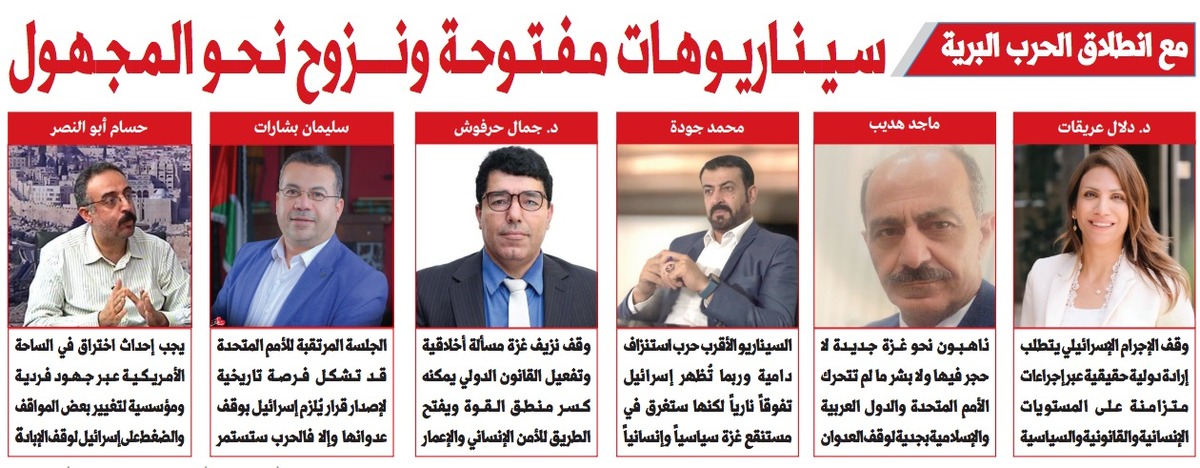
Dr. Dalia Arikat: Stopping Israeli crimes requires genuine international will through simultaneous actions on humanitarian, legal, and political levels
Majid Hdeib: We are heading towards a new Gaza with no stones or people unless the United Nations and Arab and Islamic countries act seriously to stop the aggression
Mohammed Joudeh: The most likely scenario is a bloody war of attrition, and while Israel may show fire superiority, it will drown politically and humanely in the Gaza quagmire
Dr. Jamal Harfoush: Stopping the bleeding in Gaza is a moral issue, and activating international law can break the logic of power and open the way for human security and reconstruction
Suleiman Basharat: The upcoming UN session may represent a historic opportunity to issue a resolution obligating Israel to stop its aggression; otherwise, the war will continue
Hossam Abu Nasr: A breakthrough must be made in the American arena through individual and institutional efforts to change some positions and pressure Israel to stop the genocide
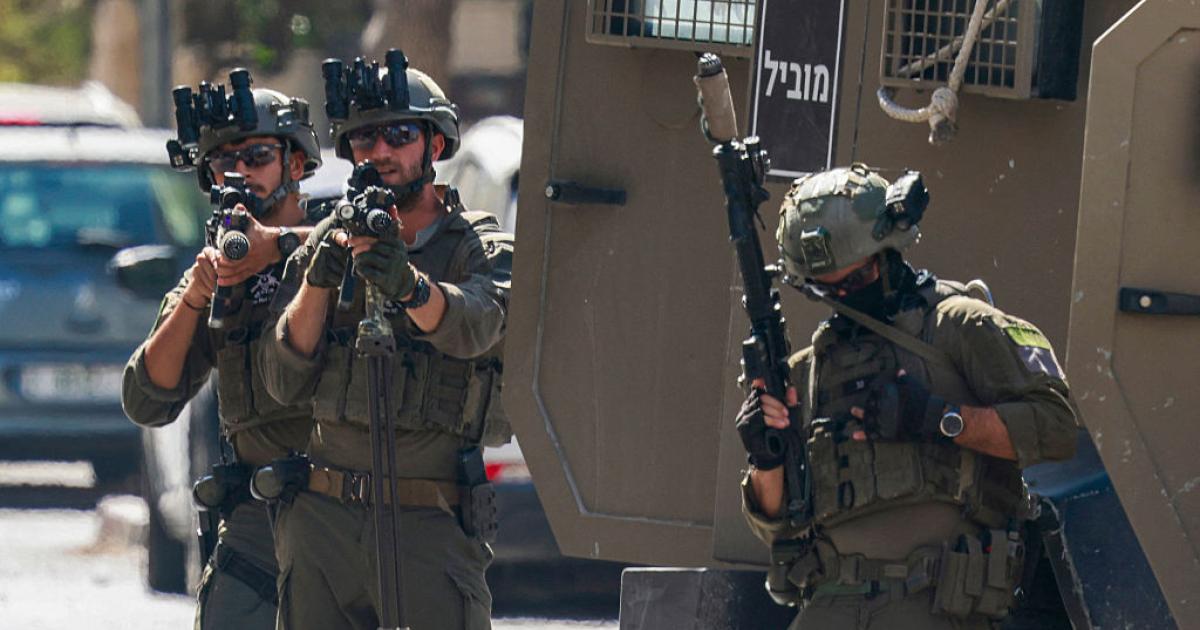
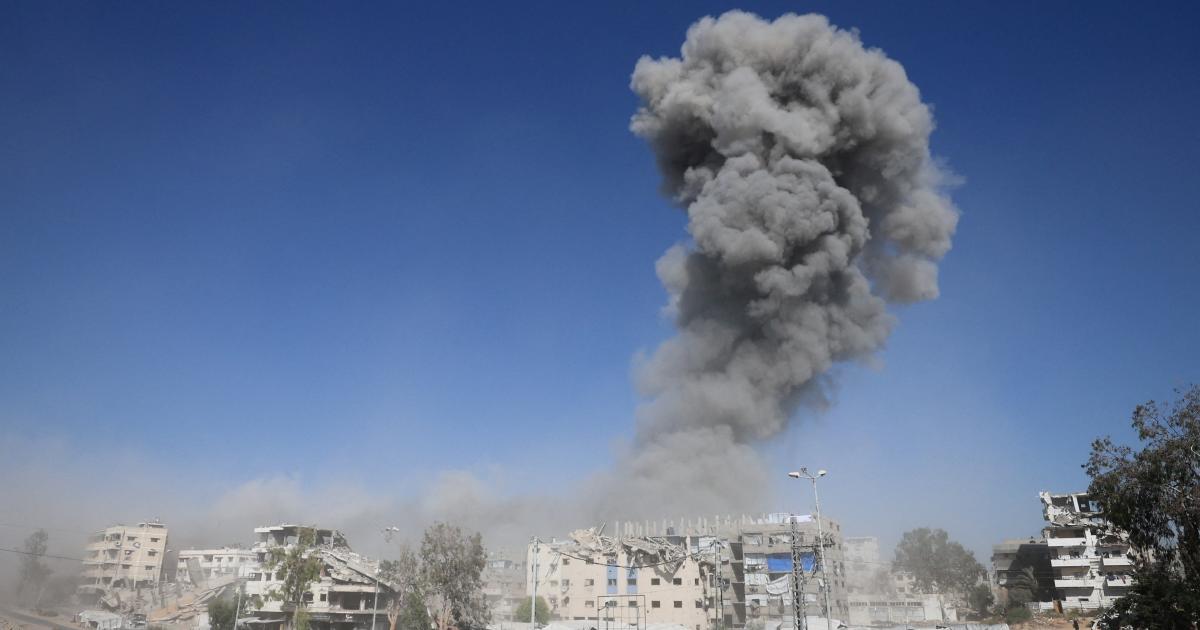
The Israeli genocide war on the Gaza Strip has entered a more dangerous phase with the launch of the ground military operation, where Palestinians face a bloody escalation that threatens a new wave of mass displacement reminiscent of the Nakba, while possibilities lean towards open scenarios amid international silence.
This escalation, according to writers, analysts, specialists, and university professors in separate conversations with "Al-Quds," is inseparable from political and ideological dimensions through which Israel seeks to impose a new reality on the ground that serves its expansionist settlement project, in the absence of serious international and Arab pressure to stop the aggression. They point out that the expected scenarios range from a long war of attrition, to imposing a conditional humanitarian ceasefire, or even the expansion of the conflict regionally, threatening the stability of the entire region.
Writers, analysts, specialists, and university professors believe that stopping the genocide against Palestinians will not be achieved through statements of condemnation, but through real legal, diplomatic, and economic pressures, including imposing sanctions, activating international accountability tools, and launching a political track that places the life and rights of the Palestinian people at the heart of any future settlement.
The danger of mass displacement and the reproduction of the Nakba
Dr. Dalia Arikat, a professor of diplomacy and conflict resolution at the Arab American University, confirms that the ground operation launched by Israel in the Gaza Strip has opened the door to multiple scenarios, the most dangerous of which is mass displacement and the reproduction of the Nakba.
Arikat explains that the Israeli incursion translates into enormous human and material costs, causing massive destruction and demolition of buildings, internal displacement, and loss of basic services, without achieving a real military resolution for Israel.
She points out that the continuation of operations and intense bombardment may push tens of thousands, and perhaps hundreds of thousands, of Palestinians to forced displacement southward or towards the Egyptian border, which poses an existential threat to Palestinian national identity.
Arikat warns of the dangers of the conflict expanding regionally if confrontations extend to Lebanon, Syria, or the Red Sea, which threatens to destabilize the security and economic stability of the region.
She clarifies that there is a possibility of imposing a relatively long humanitarian ceasefire that turns into a conditional ceasefire, involving the exchange of prisoners and detainees and opening crossings for aid under international supervision, but without addressing the roots of the conflict or launching a serious political track.
A negotiating path with multilateral guarantees to gradually end the occupation
Arikat sees that the best strategic scenario is to open a negotiating path with multilateral guarantees to gradually end the occupation; however, this option remains the most difficult under the current balance of power.
She emphasizes that ground wars in Gaza do not lead to resolution but to "painful stagnation," asserting that stopping Israeli crimes requires genuine international will through simultaneous actions on humanitarian, legal, and political levels.
On the humanitarian front, Arikat calls for stopping the use of weapons of mass destruction in populated areas, opening crossings without restrictions to deliver aid, restoring basic services, in addition to exchanging prisoners and patients through a reliable mediation, and deploying an independent field monitoring mechanism to document violations.
On the legal front, Arikat stresses the need to activate accountability tools in the International Criminal Court and the International Court of Justice, impose targeted sanctions on those responsible for war crimes, and suspend arms exports to Israel, linking it
Share your opinion
With the onset of the ground war... open scenarios and displacement towards the unknown.