






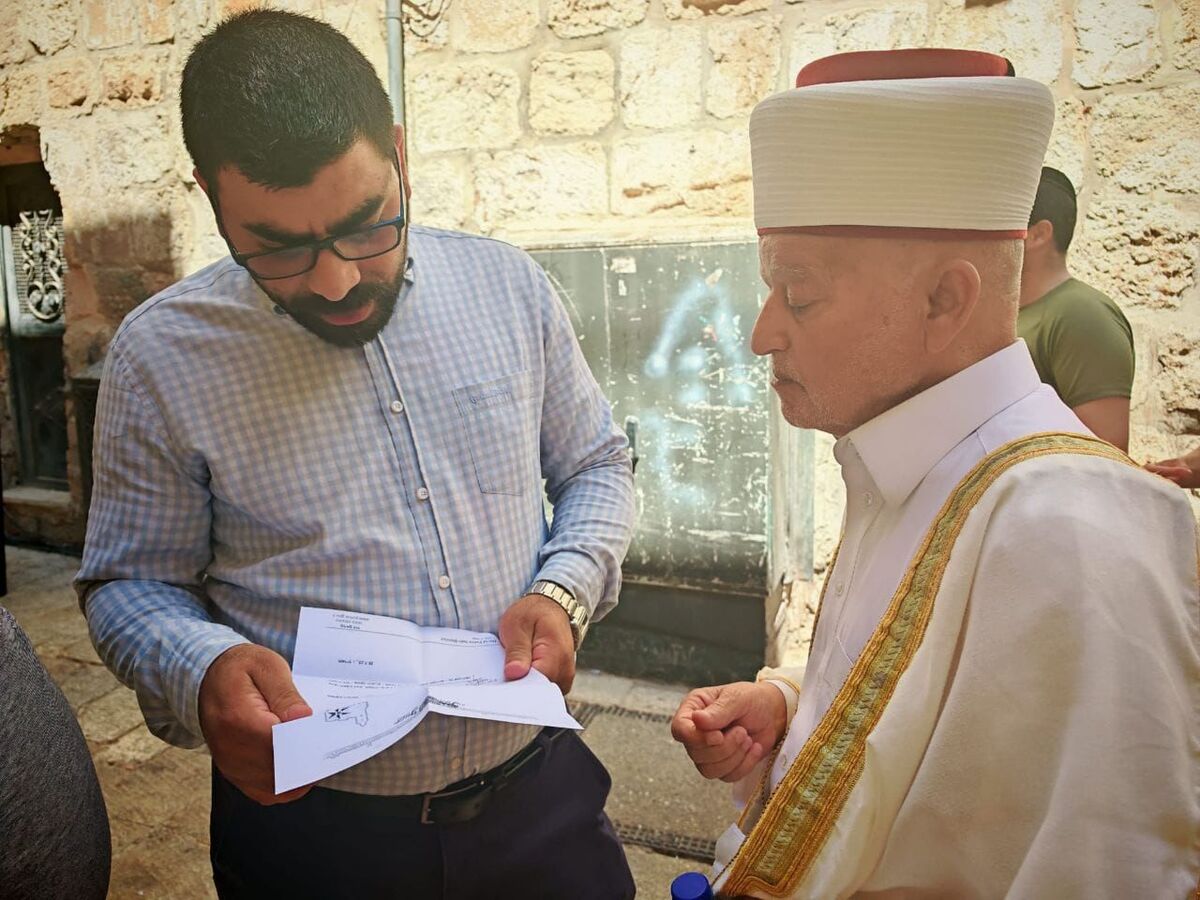
Major General Bilal al-Natsheh: Islamic and Christian clerics are no longer immune from the oppression of the occupation authorities, which pursue a policy of gagging.
Archbishop Atallah Hanna: The Mufti's arrest is a message of threat and intimidation to the spiritual and national authorities in Jerusalem, to force them to remain silent.
Dr. Hassan Khater: Several messages and dangerous implications of the Mufti's arrest indicate that the situation has reached unprecedented levels of oppression of Palestinians.
Jawdat Manna: A blatant violation of the sanctity of Al-Aqsa Mosque and a flagrant assault on a widely respected religious figure.
Mazen al-Jabari: An additional link in the chain of Israeli measures aimed at emptying Al-Aqsa of its national and religious content.
Ismail Muslimmani: The Al-Aqsa pulpit has become a new arena for confrontation, and the Mufti's voice, which expressed pain and suffering, has become a security target.
As part of its open criminal war against all Palestinians, whether in the Gaza Strip or the West Bank, including Jerusalem, the occupation police arrested the Mufti of Jerusalem and the Palestinian territories and preacher of the blessed Al-Aqsa Mosque, Sheikh Muhammad Hussein, last Friday from within the Al-Aqsa Mosque courtyards.
According to the Islamic Endowments Department, Israeli police arrested Sheikh Hussein after he delivered his Friday sermon, during which he denounced the occupation's starvation policy against the Palestinian people in the Gaza Strip.
Jerusalemite activists, clerics, and analysts spoke to "I" and condemned the arrest of the Mufti of Jerusalem and the Palestinian territories, Sheikh Muhammad Hussein, the preacher of the blessed Al-Aqsa Mosque. They considered this arbitrary measure a message of threat and intimidation to the spiritual and national authorities in Jerusalem, to force them to remain silent.
They said the Mufti's arrest carries several dangerous messages and implications, indicating that the situation has reached unprecedented levels of oppression of Palestinians. They emphasized that the arrest of Sheikh Hussein from within the Al-Aqsa Mosque compound is a flagrant violation of the sanctity of the mosque and a blatant assault on a widely respected religious figure.
They explained that the Al-Aqsa pulpit, which is supposed to remain free and protected, has become a new arena for confrontation, and the Mufti's voice, which expressed pain and suffering, has become a security target. They emphasized that the arrest of Sheikh Hussein is yet another link in a series of Israeli measures aimed at emptying Al-Aqsa Mosque of its national and religious significance.
A blatant assault on a religious and high stature
The Secretary-General of the Popular National Conference for Jerusalem, Major General Bilal al-Natsheh, condemned the treatment of His Eminence, the Grand Mufti, Sheikh Muhammad Hussein, by Israeli police after delivering the Friday sermon and prayers at the blessed Al-Aqsa Mosque.
Al-Natsheh considered this interference unjustified and a blatant assault on a prominent religious figure in Palestine and Jerusalem.
He said: "The Mufti spoke only the truth and accurately described the conditions of the Palestinian people, who are being killed and displaced in the Gaza Strip and the West Bank, and are being besieged and abused in Jerusalem."
He stressed that Muslim and Christian clerics are no longer immune from the oppression of the occupation authorities, who pursue a policy of silencing voices and consider any description of the deadly situation in Palestine to be incitement.
Al-Natsheh called on the free world, Arabs and Muslims to take immediate action to put an end to Israel's rampant corruption.
Targeting the thought, message and authentic belonging
In turn, the Greek Orthodox Archbishop of Sebastia, Archbishop Atallah Hanna, condemned the arrest of the Mufti of Jerusalem and the Palestinian territories, Sheikh Muhammad Hussein, considering this move a threatening message to the spiritual and national authorities in the Holy City.
He said: "This arrest is part of a systematic policy aimed at silencing free voices and forcing religious and national leaders in Jerusalem to remain silent about the ongoing targeting of the Palestinian people, whether in the Gaza Strip, where a war of genocide is being perpetrated, or in the West Bank and Jerusalem, where the city's identity, history, heritage, and holy sites are being targeted.
He added, "We stand in solidarity with Sheikh Mohammed Hussein and express our strong rejection of his arrest, as he is a religious and national symbol in the Holy City. Targeting him is not just targeting him personally, but rather targeting his thought, message, and authentic affiliation to this Holy Land."
Bishop Hanna concluded by emphasizing that this escalation will not deter spiritual and national leaders from fulfilling their role in defending Jerusalem, its people, and its Islamic and Christian holy sites.
Israeli oppression has reached the pulpit of Al-Aqsa Mosque.
For his part, Dr. Hassan Khater, head of the Jerusalem International Center for Studies, said that the Mufti's arrest carries several dangerous messages and implications, indicating that the situation has reached unprecedented levels of oppression of Palestinians and the targeting of even symbolic figures:
First: It is clear that Israeli oppression has reached the pulpit of the blessed Al-Aqsa Mosque, this pulpit that has always represented the voice of truth, and it is the free pulpit from which everything that preachers fail to say on other pulpits in the region in general is said. Therefore, it is clear that the occupation wants to silence this pulpit, weaken its influence, and obliterate its presence.
Second: The occupation is also sending a message that there is no longer any immunity for symbolic Palestinian figures such as the Mufti and others, and this may be the beginning of a broader targeting that will affect a greater number of official religious, political and economic figures.
Dr. Khater said: "Everything Palestinian has become a target, and we had already witnessed the arrest of Sheikh Ekrima Sabri before this incident."
Third: There is another message, which is that the images of Israeli oppression have reached unprecedented levels. The arrest of the Mufti based on the Friday sermon reflects a great harmony with what is happening in the West Bank, Jerusalem, and even the territories occupied in 1948, in terms of the suppression of opinion and expression of opinion, even through social media, by liking a post, sharing a specific post, or publishing a specific opinion criticizing the occupation and its crimes.
He stressed that what happened was a clear and explicit expression that things were heading in the direction of more repression and further confiscation of what remained of marginal freedoms.
Dr. Khater pointed out that by arresting the Mufti, a prominent religious figure, the occupation is sending a message to numerous parties regarding its indifference to any Arab, Islamic, or even international stances or reactions.
He added: "The occupation's crimes and violations against these symbols, and even against holy sites and the Palestinian people, are no longer met with fear of any reaction, whatever its nature or from any quarter. This reflects the height of Zionist arrogance and rebellion against all international norms, values, and laws."
Preparing for an atmosphere of tension in Al-Aqsa Mosque
For his part, the coordinator of the International Campaign to Defend Jerusalem, Jawdat Manna, considered the Israeli occupation forces' arrest of the Grand Mufti of Jerusalem and the Palestinian territories, Sheikh Muhammad Hussein, from within the courtyards of Al-Aqsa Mosque in occupied Jerusalem, last Friday, a blatant violation of the sanctity of the mosque, the place of the Prophet Muhammad's Night Journey (peace be upon him), and a deliberate assault on a religious figure who is respected officially, popularly, and within Islamic circles as a whole.
He stressed that the International Campaign to Defend Jerusalem reiterates its strong condemnation of His Eminence's arrest without justification, but rather as part of the ongoing attacks on Islamic and Christian holy sites in occupied Jerusalem, the provocation of worshippers, and the creation of an atmosphere of tension in the blessed Al-Aqsa Mosque.
Manaa pointed out that the reason given by the occupation authorities for the arrest of His Eminence the Mufti does not justify this illegal and immoral measure simply because His Eminence condemned Israel's policy of starving Palestinian citizens in the Gaza Strip, a war crime that has been widely condemned internationally.
He said: "We understand that His Eminence's arrest, simply for condemning the starvation policy, is an Israeli endorsement of this policy and an admission of its responsibility for it, as well as other measures that include the severe restrictions it imposes on access to the blessed Al-Aqsa Mosque and logistical support for settler incursions into the mosque."
Mana' asserted that this practice amounts to madness, demonstrating support for the starvation of more than two million Palestinians in the Gaza Strip and hundreds of thousands more in the West Bank, caused by Finance Minister Smotrich's imposition of restrictions on the transfer of funds due to the Palestinian Authority's treasury. Therefore, the humanitarian duty of condemning the starvation of the Palestinian people separates a world that condemns it from an entity that rejoices in it through the mouths of ministers in Netanyahu's fascist government.
Violation of the Jordanian-Israeli peace agreement
Manaa believes that the Mufti's arrest reaffirms Israel's violation of the Jordanian-Israeli agreement and its blatant breach of its provisions, which stipulate respect for the Jordanian role and the Hashemite custodianship of Islamic and Christian holy sites, and which clearly indicate the preservation of the historical and legal status of the Noble Sanctuary.
He added: "This blatant action took place in a place sacred to all Muslims, located in an occupied city over which Israel has no sovereignty, but rather the State of Palestine, in accordance with United Nations laws and international resolutions that do not recognize the annexation of East Jerusalem nor US President Donald Trump's recognition of it as the alleged capital of the Israeli occupation entity."
Manaa explained that Israeli practices in this holy place, such as raids and arrests, such as the one that resulted in the arrest of approximately 400 worshippers from inside the mosque, are considered a blatant violation of the sanctity of the holy sites and the powers of the Palestinian and Jordanian Ministries of Endowments in the blessed Al-Aqsa Mosque, as they stormed the audio and security rooms in the mosque, a matter that has occurred repeatedly and has been followed by tension and violent confrontations between the invading Israeli forces on one side and the Palestinian worshippers on the other.
He reminded Israel and those behind it that Jerusalem, where Islamic and Christian holy sites are located, is occupied Palestinian land, and that its practices, including Judaization operations inside the mosque, such as raids, and its surroundings in the city with settlements and military checkpoints, are all illegal measures that deserve Palestinian, Arab and international condemnation and denunciation.
An escalating campaign of intimidation and repression
For his part, researcher and writer specializing in Jerusalem affairs, Mazen al-Jabari, stressed that the arrest by Israeli occupation forces of the Mufti of Jerusalem and the Palestinian territories, Sheikh Muhammad Hussein, as he was leaving the blessed Al-Aqsa Mosque. The arrest came after his sermon, in which he addressed the tragedy of hunger suffered by the people of the besieged Gaza Strip, comes in the context of an escalating campaign of intimidation and repression practiced by the occupation authorities against anyone who expresses their rejection of the war crimes and systematic starvation affecting more than two million people in the Strip.
Al-Ja'bari pointed out that this arrest constitutes yet another link in a series of Israeli measures aimed at emptying Al-Aqsa Mosque of its Palestinian national and religious significance, limiting it to its role as a place for prayer only, without any significance related to Palestinian identity or struggle.
He said: "Under Netanyahu's government, the most extremist in Israel's history, Israel is transforming into a fascist and racist entity implementing a systematic program of starvation, displacement, and war crimes, with direct American and Western support."
Al-Ja'bari added that the Israeli government has intensified its policies in Jerusalem, particularly over the past two years, to advance the Judaization and settlement project, at the heart of which is an attempt to impose new realities on Al-Aqsa Mosque and transform it into a shared religious site for Muslims and Jews, in a way that serves the Israeli biblical narrative.
A violation with profound political, religious and media implications
In turn, writer and political analyst Ismail Muslimmani said, "In a dangerous precedent that reflects the extent of Israeli targeting of Islamic holy sites, occupation forces stormed the audiovisual room at Al-Aqsa Mosque and arrested Sheikh Mohammed Hussein following his Friday sermon, in which he criticized the starvation policy imposed on the Palestinian people."
He emphasized that this scene is not merely a passing event, but rather carries profound political, religious, and media implications, revealing the nature of the confrontation imposed by the occupation on all forms of Palestinian expression, even from the pulpit of Al-Aqsa Mosque.
Muslimani said that this raid was not directed solely at the "audio room," but rather at the voice itself, at the word emanating from the heart of the holy city, exposing a reality that Israel is trying to obscure. When Israeli forces move to silence a preacher and confiscate the equipment used to broadcast the sermon, they are attempting to impose their control not only over the space but also over consciousness and conscience, in an attempt to subject the mosque to security surveillance that undermines the essence of its religious and national message.
Muslimani believes that the arrest of Sheikh Mohammed Hussein, one of the most prominent religious and national figures in Jerusalem, comes within a broader context of attempts to undermine any resistance or even critical discourse, especially when it comes from a platform as symbolic as Al-Aqsa.
He pointed out that the content of the sermon, which described the occupation's policy as a systematic starvation of Palestinians, crossed the "red line" drawn by the occupation, necessitating a punitive response that conveyed a message of intimidation to other preachers and religious institutions.
He added: "The irony is that the mosque's pulpit, which is supposed to remain free and protected, has become a new arena of confrontation, and Sheikh Mohammed Hussein's voice, which expressed his pain and suffering, has become a security target."
A siege on bodies, minds and consciences
Muslimani explained that the Mufti's arrest after his sermon cannot be isolated from this policy, which views every word of resistance as a danger that must be contained or suppressed. Thus, the occupation not only imposes a siege on bodies but also extends to besiege minds and consciences.
He said that what happened was not merely a violation of the sanctity of a mosque, but rather an assault on the dignity of a people and a pathetic attempt to silence the truth. However, he emphasized that the voices emanating from Al-Aqsa Mosque are still capable of disturbing the occupation, and that when words emerge from the heart of suffering, they become a weapon no less effective than stones, if not more so.
Muslimmani touched on the political implications of the arrest, which are:
1. Suppression of dissenting voices:
The sermon delivered by the sheikh included a clear denunciation of the "starvation policy," which upset the occupation, and the response was security-related, not political, in an attempt to intimidate other preachers.
2. The policy of strangling the word before strangling the body:
Arrests and summonses indicate the occupation's efforts to suppress the Palestinian narrative, even within mosques, especially when it addresses sensitive topics such as the siege and hunger.
3. A warning message to the Palestinian street:
"Whoever criticizes in public will be held accountable," especially if the pulpit is Al-Aqsa Mosque and the preacher is a public figure.
Regarding the timing and context, Muslimani noted that it coincides with a major escalation in Gaza, the West Bank, and Jerusalem, and timid international criticism of the blockade and starvation policies.
He added, "Therefore, targeting the sheikh and the Friday sermon is part of an authoritarian response to attempts to break the global silence, especially if mosques begin to turn into platforms for exposure and exposure."
Regarding the symbolic messages drawn, Muslimmani said: "Al-Aqsa Mosque is not just a place of worship, but also an arena for confrontation and a clash of narratives. Sheikh Mohammed Hussein represents the connection between religion and national dignity, and targeting him is a threatening message to every similar voice. Israel treats free speech as a security threat, not just an opinion."
Powered by Froala Editor

Share your opinion
The Mufti's arrest: a message of threat and intimidation