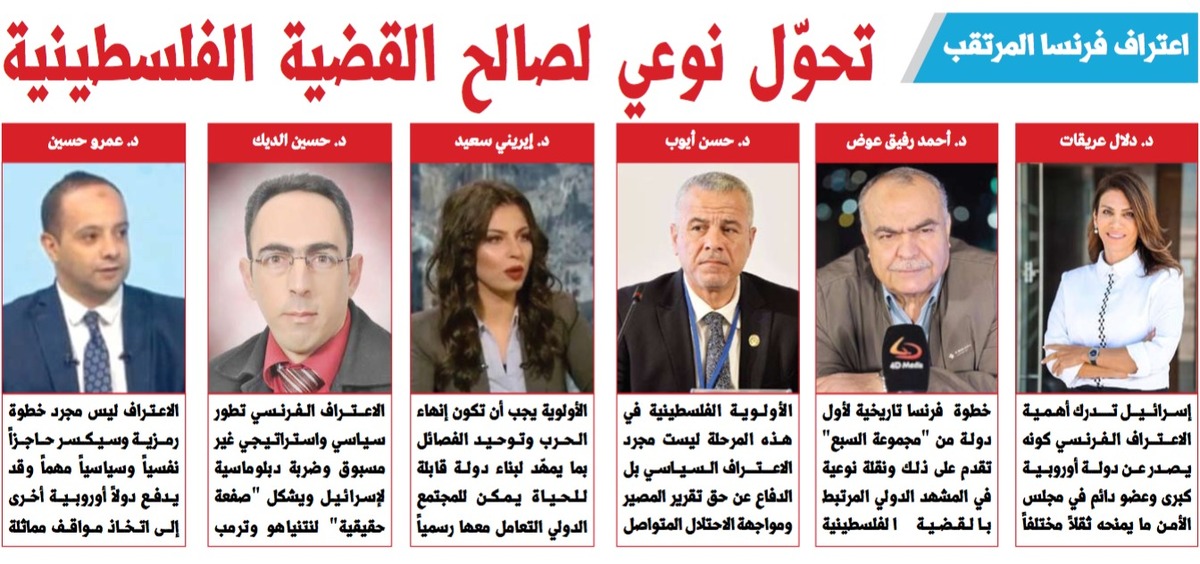







Dr. Dalal Erekat: Israel recognizes the importance of French recognition, as it comes from a major European country and a permanent member of the Security Council, which gives it a distinct weight.
Dr. Ahmed Rafiq Awad: France's move is historic, as the first G7 country to do so, and represents a qualitative shift in the international landscape related to the Palestinian issue.
Dr. Hassan Ayoub: The Palestinian priority at this stage is not merely political recognition, but rather defending the right to self-determination and confronting the ongoing occupation.
Dr. Irene Said: The priority must be to end the war and unify the factions, paving the way for the building of a viable state with which the international community can formally engage.
Dr. Hussein Al-Deek: French recognition is an unprecedented political and strategic development, a diplomatic blow to Israel, and a "real slap in the face" for Netanyahu and Trump.
Dr. Amr Hussein: Recognition is not merely a symbolic step. It will break a significant psychological and political barrier and may prompt other European countries to adopt similar positions.
In a move widely viewed as a qualitative shift in European positions on the Palestinian issue, French President Emmanuel Macron announced his country's intention to formally recognize the State of Palestine during the UN General Assembly meetings next September. This would represent a significant turning point in favor of the Palestinian cause.
In separate interviews with Al-Quds, writers, political analysts, experts, and university professors believe this announcement represents a pivotal political moment, given that France is a major European country and a permanent member of the Security Council. This gives this step unprecedented diplomatic weight and pushes toward reshaping the international approach to the Palestinian-Israeli conflict.
Writers, analysts, specialists, and university professors point out that the French announcement comes at a time when the credibility of the two-state solution is eroding due to Israeli expansionist policies. This gives French recognition a sovereign and moral dimension in light of the escalating crimes of the Israeli occupation in Gaza.
They point out that this French trend is viewed as part of broader shifts in the European mood, which may open the door for other countries, most notably Britain and Germany, to join the recognition bandwagon, constituting a growing international trend that cannot be ignored.
Writers, analysts, specialists, and university professors explain that Israel is seeking to obstruct this step through intense political and diplomatic pressure. However, Palestinian and international circles view the anticipated recognition as a strategic opportunity to revive the political process, break the United States' monopoly on mediation, and advance the Palestinian statehood process based on international law and international legitimacy resolutions.
A very important political and diplomatic step
Dr. Dalal Erekat, professor of diplomacy and conflict resolution at the Arab American University, says that French President Emmanuel Macron's announcement of his country's intention to recognize the State of Palestine next September is a momentous political and diplomatic step, with profound implications at the European and international levels.
Erekat explains that this announcement comes at a time when the remaining credibility of the two-state solution is eroding as a result of unilateral Israeli policies, the continued occupation, and settlement expansion.
Erekat points out that the French move reflects a genuine desire—which may later expand to include other European positions—to rebalance the international approach to the Palestinian issue and revive the references to international law and UN resolutions as the basis for a solution.
Erekat emphasizes that what gives the French-Saudi initiative both a political and moral character is its timing, which coincides with the escalation of Israeli crimes in Gaza and the international division over the aggression. This makes it a sovereign step to correct the historical flaw in the treatment of Palestinian rights and restore Palestine's standing on the international agenda.
Israel realizes the importance of French recognition
Erekat explains that the Israeli response is expected and has already begun, with condemnatory statements and diplomatic pressure aimed at dissuading France from its decision. The announcement is even being exploited as a pretext for confiscating more land and expanding settlements.
Erekat asserts that Israel recognizes the importance of the French recognition, given that it comes from a major European country and a permanent member of the Security Council, giving it political weight distinct from previous recognitions.
Erekat believes this step could serve as an incentive for other countries, most notably the United Kingdom, to follow the same path.
Erekat emphasizes that the success of this diplomatic dynamic hinges on unifying the Palestinian position and activating more professional and coordinated political and diplomatic tools at the international level, transcending the monopoly of the American mediator and restoring respect for international legitimacy.
International recognition of the patience and sacrifices of the Palestinian people
For his part, writer and political analyst Dr. Ahmed Rafiq Awad says that France's announcement of its intention to recognize the State of Palestine represents a pivotal and historic step, not only because of France's political and international weight, but also because it is the first G7 country to take this step, marking a qualitative shift in the international landscape related to the Palestinian cause.
Awad explains that this recognition represents a decisive response to all that Israel has sought to achieve over the past decades, including attempts to dismantle Palestinian national identity and deny the right to statehood. He points out that the Paris move confirms the collapse of these Israeli policies and represents international recognition of the patience, sacrifices, bloodshed, and prolonged suffering of the Palestinian people.
Awad emphasizes that France is not an ordinary country, but rather a nuclear power, a permanent member of the Security Council, and a former colonial power, which makes its recognition have profound emotional, legal, and political dimensions.
Awad believes this step gives the Palestinians a tremendous boost in international visibility and constitutes a guarantee that the birth of a Palestinian state has become irreversible, regardless of the length or complexity of the process.
Introduction to broader international recognition
Awad points out that French recognition could become a prelude to broader international recognition from major powers such as Britain, Germany, and Canada, signifying the birth of a global political movement in support of Palestine that neither Israel nor even the United States can stop.
Awad emphasizes that Israeli and American anger at the French statements reflects their awareness of the seriousness of this shift, asserting that France is not taking this step solely out of solidarity, but also for domestic reasons related to the presence of a large Arab and Muslim community, which Paris seeks to appease and integrate politically and socially.
Awad believes that French recognition is not only consistent with the values embraced by Paris as a country of freedom and human rights, but also a step that opens the door wide for other countries to recognize the State of Palestine, thus strengthening international action to break the monopoly of the Israeli narrative.
French advertising should not be given more importance than it deserves.
For his part, writer, political analyst, and political science professor Dr. Hassan Ayoub explains that French President Emmanuel Macron's announcement of his country's intention to recognize the State of Palestine, despite its apparent symbolic and political significance, should not be given more importance than it deserves and cannot be considered a fundamental or practical shift in the French position on the Palestinian issue.
Ayoub explains that this announcement reflects, to some extent, shifts in the international mood, but it does not emanate from a genuine principled position. He points out that France maintains close and strategic relations with Israel, while simultaneously displaying contradictory positions regarding solidarity with the Palestinian people, particularly at the domestic level, which raises questions about the seriousness of this approach.
Ayoub believes that the Palestinian priority at this sensitive stage is not merely political recognition, but rather defending the right to self-determination and confronting the ongoing colonial occupation. He called for a focus on effective deterrent tools against Israel, most notably imposing international sanctions to halt war crimes in Gaza and forced displacement and settlement activity in the West Bank.
Ayoub criticizes the French position, saying that Paris, along with Germany and other European countries, is avoiding taking real positions by hiding behind European Union institutions, despite its prior awareness that the EU's unanimity law obstructs any serious action against Israel.
French contradiction and political hesitation
Ayyoub addresses what he calls the "French contradiction," noting that France had previously proposed holding an international peace conference led by itself and Saudi Arabia, but withdrew from the initiative, reflecting political hesitation and a lack of will to confront the situation.
Ayoub asserts that Macron's statements regarding a "demilitarized" Palestinian state constitute a historic injustice to the Palestinian people and undermine their legitimate right to self-defense.
Ayoub believes that Israel does not seek any form of Palestinian state at all, but rather seeks to erase the Palestinian entity entirely. This is evident in the recent preliminary vote in the Israeli Knesset in preparation for a bill to impose sovereignty over the West Bank, and the years prior to that in the "Nation-State Law," which limits the right to self-determination to the Jewish people alone.
Ayoub emphasizes that promoting French recognition as a major achievement deviates from national priorities and serves the Israeli discourse, which seeks to strip Palestinians of their basic rights. This discourse contradicts actual official policies and lacks a clear recognition of the Palestinian state.
According to Ayoub, the official Palestinian welcome and other statements welcoming this declaration clearly confuse what is symbolic with what is practical, and it undermines the essence of the Palestinian struggle, which is based on reclaiming rights, not accepting political crumbs.
Ayoub asserts that Israel, despite its awareness of the weak practical impact of this French recognition of a Palestinian state, stands fiercely against it to prevent any transformation—even a symbolic one—that could be built upon later.
Ayoub emphasizes that the real response must be to intensify political and popular pressure on the major powers to take concrete steps to guarantee Palestinian rights, rather than simply issuing declarations that change nothing in the reality under occupation.
European transformations and a step paving the way for similar moves
For her part, Egyptian academic and political analyst Dr. Irene Said believes that European shifts toward the Palestinian issue have become more evident, especially with the escalating talk of France's move to recognize a Palestinian state. This move, announced by French President Emmanuel Macron, could pave the way for similar moves by other European countries and influential international alliances.
Saeed wonders whether the expected French recognition will be explicit, leading to the establishment of diplomatic relations and political, economic, and possibly military support, or whether it will merely be a symbolic recognition aimed at exerting political pressure on Israel to push it toward a settlement of the conflict.
Saeed points out that "recognition of a state does not simply occur through a political declaration. Rather, it requires the completion of the components of a state, including land, sea, and air borders, and a stable and representative population. This is followed by international recognition, the establishment of political and diplomatic relations, and the signing of agreements, including joint defense agreements, if they exist."
Saeed believes that the current priority for Palestinians should be to end the war on the Gaza Strip and work to unify Palestinian factions under a stable political umbrella, paving the way for the establishment of a viable Palestinian state with which the international community can formally engage.
Preparing to establish a new political reality
Saeed believes that the French move comes within this preliminary context towards establishing a new political reality.
Saeed asserts that this move is not acceptable to either the US or Israel, and has been met with disregard and disdain, given the continued close military alliance between Washington and Tel Aviv on the one hand, and Paris on the other.
However, Saeed believes that this French position represents a significant development in the international perception of Israel, particularly after it lost its ability to manipulate the discourse of self-defense in the face of escalating crimes and violations, which has contributed to exposing its practices to global public opinion.
"The French move, even if it is symbolic so far, is a positive indicator toward preparing the ground for the establishment of a Palestinian state along the 1967 borders with East Jerusalem as its capital," Saeed says.
Unprecedented political and strategic development
Writer, political analyst, and expert on American affairs and international relations, Dr. Hussein Al-Deek, says that French President Emmanuel Macron's announcement of his country's intention to recognize the State of Palestine during the UN General Assembly meeting next September represents an unprecedented political and strategic development that alters the international balance of power regarding the Palestinian issue.
Al-Deek explains that France will be the first G7 country to officially recognize the State of Palestine, a move of significant political weight given France's permanent membership in the Security Council and its economic and political importance on the international stage.
Al-Deek points out that this resolution paves the way for the formation of a majority within the Security Council consisting of permanent member states that recognize the State of Palestine, alongside Russia and China, which constitutes a diplomatic pressure force that cannot be ignored.
Al-Deek points out that this French announcement also signals an internal shift, as Paris faces pressure from its Arab and Muslim communities and seeks to appease these groups and integrate them politically and socially. He explains that its recognition of a Palestinian state reflects a desire to restore its moral and international balance after years of decline in Middle East affairs.
A serious French will supported by the people and parliament
Al-Deek warns of an angry Israeli reaction, noting that Tel Aviv, along with Washington, will seek to exert significant pressure on the French government to dissuade it from implementing the recognition.
However, Al-Deek affirms the existence of a serious French political will, supported by the people and parliament, from the French National Assembly, the government, and the presidency. These factors make the French position cohesive.
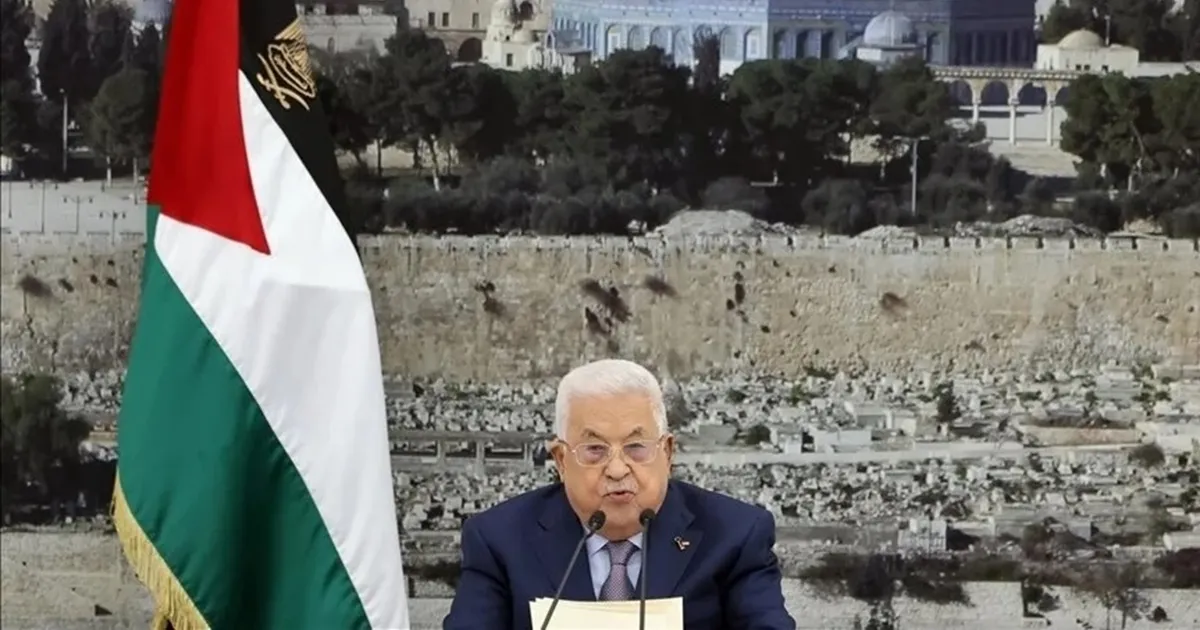
Al-Deek explains that President Mahmoud Abbas's recent letter from the Palestinian leadership to the French president and the Saudi crown prince, which included a commitment to hold presidential and legislative elections before the end of the year, played a role in coordinating this French position, which also came as a moral response to Palestinian pledges affirming seriousness and political responsibility.
Al-Deek explains that France's recognition will encourage other major Western countries to follow suit, most notably Britain, which faces similar internal pressures, as well as countries such as Portugal, Belgium, the Netherlands, Luxembourg, and Denmark.
Israel will respond with unilateral steps.
As for Central European countries, such as Germany, Austria, and Italy, Al-Deek believes they are unlikely to join this movement at present due to the dominance of the populist right and the historical sensitivity of the Palestinian issue.
Al-Deek emphasizes that this French shift represents a diplomatic blow to Israel, which considers France to be one of the most prominent enablers of its nuclear weapons program after the Nakba. This recognition also represents a "real slap in the face" for Israeli Prime Minister Benjamin Netanyahu and his American ally, Donald Trump.
Al-Deek expects Israel to respond to this announcement with unilateral steps, including accelerating settlement activity, land confiscation, and annexing areas of the West Bank, particularly Area C, based on support within the Israeli Knesset, where 71 members voted in favor of annexing the West Bank.
Al-Deek expects Israel to resort to imposing new sanctions on the Palestinian Authority, including withholding clearance revenues and tightening the blockade and checkpoints in the West Bank.
Al-Deek considers the French recognition a new compass for the international community regarding Palestinian rights, and could lead to fundamental shifts in European and global politics toward recognizing the State of Palestine on the June 4, 1967, borders with East Jerusalem as its capital.
The occupation's massacres are a moral and political burden on European capitals.
For his part, Egyptian writer, political analyst, and researcher in international relations and strategies, Dr. Amr Hussein, believes that French President Emmanuel Macron's announcement of his intention to recognize the State of Palestine next September is not merely a symbolic or protocolary step, but rather represents a profound political and strategic move that reflects a shift in European sentiment toward the ongoing Israeli aggression, especially following the escalation of massacres committed in the Gaza Strip.
Hussein says that the massacres of Palestinian civilians have placed an increasing moral and political burden on European capitals, prompting a number of countries to reconsider their traditional positions. This comes as the US role has been exposed, and its rhetoric as an "honest broker" no longer convinces many, as its bias toward Israeli policies has become clear and blatant.
Hussein explains that through this recognition, Paris seeks to restore its international influence, especially after its declining role in regional issues in the Middle East and Africa.
Hussein asserts that recognizing the State of Palestine restores France's status as a state that upholds international law and is active in humanitarian issues.
Hussein believes the anticipated move sends a firm political message to Israel that continued occupation, settlements, and aggression will not be without cost, and that Europe has begun to evade the political blackmail practiced by Tel Aviv for years.
Tel Aviv is very angry about the French approach
Regarding the Israeli response, Hussein explained that Tel Aviv expressed its extreme anger, viewing any recognition of Palestine as a "reward for terrorism," in an attempt to delegitimize Palestinian rights. It is expected to exert intense diplomatic pressure to prevent the implementation of the French resolution.
Hussein points out that implementing the recognition will break a significant psychological and political barrier and may prompt other European countries to adopt similar positions, particularly those that had previously been hesitant but now view support for Palestinian rights as a strengthening of their moral and diplomatic standing.
Hussein believes that France's recognition, if achieved, would be a qualitative development with significant impact within the European Union and could mark the beginning of a shift in the conflict equation. He calls for the need to capitalize on this moment politically and diplomatically on both the Arab and international arenas.
Powered by Froala Editor




Share your opinion
France's expected recognition: a qualitative shift in favor of the Palestinian cause