






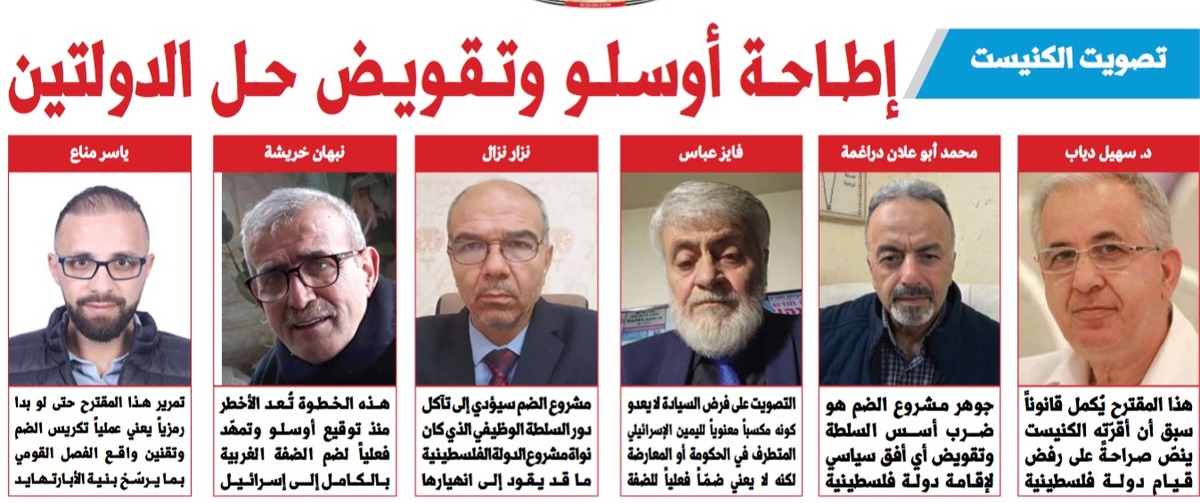
Dr. Suhail Diab: This proposal complements a law previously passed by the Knesset that explicitly rejects the establishment of a Palestinian state.
Muhammad Abu Allan Daraghmeh: The essence of the annexation project is to undermine the foundations of the Authority and any political horizon for establishing a Palestinian state.
Fayez Abbas: The vote to impose sovereignty is nothing more than a moral gain for the extreme right in the government or the opposition, but it does not mean actual annexation of the West Bank.
Nizar Nazzal: The annexation project will erode the functional role of the Palestinian Authority, which was the core of the Palestinian state project, which could lead to its collapse.
Nabhan Khreisha: This step is the most dangerous since the signing of the Oslo Accords and effectively paves the way for the complete annexation of the West Bank to Israel.
Yasser Manna: Passing this proposal, even if it seems symbolic, practically means consecrating annexation and legalizing the reality of national separation, thus entrenching the structure of apartheid.
Moves are accelerating within the Israeli Knesset to impose so-called full "Israeli sovereignty" over the West Bank. The latest move was a majority vote on a resolution paving the way for the annexation law and the imposition of sovereignty over the West Bank, a move that effectively paves the way for the liquidation of the idea of a Palestinian state and undermines the Palestinian National Authority.
In separate interviews with "I," Israeli affairs experts and writers assert that this approach is not merely symbolic, but rather an extension of previous laws rejecting the establishment of a Palestinian state. It reflects a growing trend toward exploiting the regional situation and employing political and security pressure to prevent the establishment of a Palestinian state and the annexation of the West Bank.
They believe the timing is linked to the Gaza deal arrangements and the appeasement of the extreme right to ensure the cohesion of the Israeli government, while the annexation plans are being used as a bargaining chip with the United States to end any prospect of a two-state solution.
They believe these steps will likely have a profound impact on the overall Palestinian situation, both internally and externally, amid warnings of the collapse of the PA's functional role and its transformation into a service-oriented administration under occupation.
In light of the expansion of legislation and the rhetoric of annexation, calls are mounting to re-examine the entire landscape and unify Palestinian ranks to confront the most dangerous phase since the signing of the Oslo Accords three decades ago, and even since the occupation of the West Bank in 1967.
A clear vision is being arranged at the level of legislation and laws.
Dr. Suhail Diab, a political science professor and expert on Israeli affairs, warns of the danger of the proposed vote on the law currently being debated in the Israeli Knesset, which aims to impose full Israeli sovereignty over the West Bank. He emphasizes that this proposal is not merely symbolic, as it is being promoted, but rather represents an advanced step in a series of steps that have preceded and will follow, within the context of a systematic plan to completely liquidate the Palestinian cause.
Diab explains that this proposal does not come out of nowhere, but rather complements a law previously passed by the Knesset by a large majority of both the ruling coalition and the opposition, which explicitly rejects the establishment of a Palestinian state.
Diab points out that the new annexation plan bears the signatures of 14 ministers from the Likud Party and other coalition parties. It calls for immediate annexation and the extension of Israeli sovereignty over the entire West Bank, revealing a clear vision being formulated at the legislative and legal level.
Diab explained that these legislative steps coincide with ongoing practices on the ground, including raids on Al-Aqsa Mosque and the holding of Talmudic prayers there, repeated and illegal raids on Joseph's Tomb in Nablus and attempts to impose sovereignty over it, as well as advanced steps to Judaize the Ibrahimi Mosque in Hebron, in addition to the widespread and unprecedented settlement expansion throughout the West Bank.
Diab points to the preparation of a new draft law, more dangerous than its predecessors, which aims to restrict the right of self-determination in historic Palestine to Jews alone, effectively ending any prospect of a two-state solution and liquidating Palestinian national rights.
In Diab's opinion, the danger of the current plan to annex the West Bank and impose sovereignty over it lies in the fact that it reflects an escalating political trajectory that exploits the current historical context, even if it is not currently feasible for direct implementation because implementation is in the hands of the Israeli government, which has not yet made an official decision to do so.
Timing of the law's introduction before the Knesset's summer recess
Diab stresses that the mere fact of introducing the law at this time, just before the Knesset enters its summer recess, is linked to two key factors: the nearing of new understandings regarding a deal in Gaza, and the second, the introduction of a step that satisfies the extreme right and ensures the cohesion of the ruling coalition headed by Netanyahu after the announcement of the Gaza deal.
Diab believes that this step will deepen the narrative in the Israeli collective consciousness that the West Bank will remain part of Israel, and will be used as a bargaining chip with the United States to either annex large parts of the West Bank or end the two-state solution with American approval, given the current circumstances in the region.
Diab explains that the continued violation of the Oslo Accords over the years clearly reveals that what is happening is not a coincidence or a symbolic decision, but rather a systematic process.
Diab calls on Palestinian political forces, particularly in the West Bank, to recognize that the imminent danger is not limited to Gaza alone, but rather encompasses the entire Palestinian territory. He believes that whoever decides the battle in the West Bank will decide the essence of the entire Israeli-Palestinian conflict, whether in favor of or against the Palestinian cause. This requires a new vision that places the unity of the land and the people at the heart of any future action.
The movement within the Knesset was preceded by political pressures and demands.
For his part, writer and Israeli affairs expert Muhammad Abu Allan Daraghmeh said that the ongoing Knesset efforts to impose "Israeli sovereignty" over the West Bank—which garnered 71 votes in favor of annexing the West Bank and 13 against—considered a historic move by Israel to impose its sovereignty over the West Bank and prevent the establishment of a Palestinian state.
Draghmeh points out that this movement within the Knesset was preceded by ongoing political pressures and demands, the most recent of which occurred prior to Prime Minister Benjamin Netanyahu's recent visit to Washington, where members of the Settlements Council and Minister Roni Dermer demanded that he seriously work toward annexing the West Bank and imposing Israeli sovereignty over it.
Draghmeh explains that what is happening is still symbolic and informal, but the proposed bill assumes significant political significance, particularly since its passage depends primarily on the religious parties' commitment to supporting the government coalition. This widespread support ensures its smooth passage.
Draghmeh points out that this vote is intended to support the bill and place it on the Knesset's agenda for further consideration. Even if it passes, Wednesday's vote will be symbolic, confirming Netanyahu and the Israeli political echelon's stance toward annexation. However, it will not be binding unless it passes three full legislative readings.
Israel continues to implement annexation on the ground
Draghmeh believes that the occupation government will not officially take the step of annexation without a full American green light, despite the fact that it is continuing to implement the annexation on the ground through settlement expansion and territorial control. He asserts that the declaratory vote that took place was supported and approved by the United States.
According to Draghmeh, Netanyahu may use this card as a winning card during the election period to achieve gains for the Likud party ahead of the upcoming elections.
Regarding the annexation law's impact on the Palestinian Authority, Draghmeh explains that the essence of the annexation project is to undermine the foundations of the Authority and any political horizon for establishing an independent Palestinian state, a position that aligns with the policies of Smotrich, Ben-Gvir, and the Likud Party.
Draghmeh asserts that if such a project is completed and the annexation is officially announced, it will effectively shatter the dream of a Palestinian state and end the political role of the Palestinian National Authority, which originally existed as a transitional phase toward an independent state.
Draghmeh believes that the repercussions of this will be disastrous not only for the PA, but for the entire Palestinian political and field situation.
Draghmeh points out that the occupation is anticipating regional and international developments, particularly regarding Arab normalization, which is closely linked to the existence of a political path toward a two-state solution.
Draghmeh points out that the Saudi position will be key at this stage, as Riyadh rejects any comprehensive normalization without actual progress toward a just political solution.
Draghmeh asserts that the Israeli coalition views the annexation of the West Bank as the culmination of its victories in the "multi-front war," particularly in the West Bank and Gaza Strip, as part of the war's achievements it is attempting to capitalize on domestically and internationally.
Competition in Israel over who is more extreme and fascist
In turn, writer and expert on Israeli affairs Fayez Abbas says that the current competition between the governing coalition and the Israeli opposition has become about who is more extreme and fascist after October 7. He stresses that imposing "Israeli sovereignty" over the West Bank will not change the reality there, as the West Bank has been fully occupied since 1967, and Israel effectively imposes its control over every inch of it without the need for any new Knesset decision.
Abbas believes that the Knesset's decision to vote on sovereignty is nothing more than a moral gain for the Israeli far right in both the government and the opposition, but it does not mean actual annexation of the West Bank.
Abbas explains that Israel, despite occupying the West Bank for decades, has not taken any official steps to annex it, as it did with East Jerusalem and the occupied Syrian Golan Heights. He asks, "What is preventing Israel from annexing it so far?"
Abbas responds that annexing the entire West Bank means that Israel will face the dilemma of losing its Jewish majority within its borders, from the sea to the river. This completely contradicts the essence of the Zionist project, which is based on a Jewish state with a large majority.
Annexation will impose huge obligations on Israel.
Abbas asserts that annexation would impose significant obligations on Israel, most notably the provision of basic services such as education, health, and infrastructure, as well as internal security and granting Palestinians Israeli identity cards and residency rights, as is currently the case in East Jerusalem and the Golan Heights.
Abbas points out that the current form of the occupation grants Israel complete control over the West Bank's resources without incurring any financial costs or service obligations to the Palestinians. He considers the current occupation a "seven-star occupation," with resources being plundered and Israeli goods being sold for billions of dollars annually without any real investment in the occupied territory.
Abbas asserts that Israel will continue its policy of occupation, land confiscation, and the establishment of terrorist outposts without any real intention of annexation, and that the recent decision will have no impact on the Palestinian National Authority at this stage.
Political and ideological ground for more serious measures
For his part, Nizar Nazzal, a researcher specializing in Israeli affairs and conflict issues, asserts that the overwhelming majority vote within the Israeli Knesset to initiate the West Bank annexation project constitutes a new political and ideological foundation, paving the way for more dangerous future measures and steps, including legislation and laws that could lead to actual annexation, particularly of Area C in the West Bank.
Nazzal explains that this plan entails the complete imposition of Israeli law on the settlements, rather than the administration of these areas through the Civil Administration, which would reinforce the reality of the occupation and legitimize it on the ground.
Nazzal believes this move will open the door to a dangerous deterioration in the security situation in the West Bank, especially if the Palestinians understand that this vote effectively means burying the two-state solution and completely eliminating it.
Nazzal points out that this will lead to an actual, rather than a symbolic, escalation, which could manifest in military confrontations or widespread popular movement, particularly in Jerusalem, as well as the possibility of individual attacks against occupation forces and settlers.
Nazzal expects reactions to this dangerous development to be distributed across three main axes: Palestinian, Arab, and international. On the Palestinian level, the next phase may witness a comprehensive reassessment of the relationship with Israel, with Palestinian diplomacy being revitalized in international forums such as the United Nations, the Security Council, and the General Assembly, as well as leveraging its presence in international institutions to pressure Israel.
Nazzal points out that the situation may also require strengthening national unity and activating the role of the Palestine Liberation Organization (PLO) as a legitimate representative, replacing the Palestinian Authority, which is currently being used as an executive tool.
The possibility of mobilizing pressure tools on Israel
On the Arab and Islamic front, Nazzal believes there is a possibility of mobilizing pressure tools on Israel, particularly from countries that have signed normalization agreements with it. This could be achieved by activating economic agreements as a means of pressure, in addition to mobilizing frameworks such as the Organization of Islamic Cooperation and the Arab League to take practical steps.
Internationally, Nazzal expects the Palestinians to activate the role of the International Criminal Court and the International Court of Justice to prosecute Israeli violations, with the rise of global social movements and boycott campaigns such as the BDS movement, which may target settlements and settlers more broadly.
Regarding the fate of the Palestinian Authority, Nazzal points out that the annexation project will erode the functional role of the Authority, which was the core of the Palestinian state project. This could lead to its collapse and its transformation into a mere municipal administration under occupation, which would strip it of its national legitimacy and pose a direct existential threat.
Nazzal believes that the PA will likely consider completely disengaging from Israel if the annexation is implemented. However, such a decision would require Arab and international consensus and could open the door to chaos in the West Bank, potentially leading to the dissolution of the PA, the complete handover of its administrative functions, and the re-internationalization of the Palestinian cause.
A blatant challenge to international law and UN resolutions
Journalist Nabhan Khreisha warns of the danger of the move taken by the Israeli Knesset on Wednesday, when it voted in favor of a draft resolution supporting the imposition of so-called "Israeli sovereignty" over the West Bank, before entering its summer recess.
Khreisha asserts that this step is the most dangerous since the signing of the Oslo Accords, as it effectively paves the way for the complete annexation of the West Bank to Israel, in blatant defiance of international law and UN resolutions, which consider the West Bank occupied territory since 1967.
Khreisha explains that this vote opens the door to highly complex political and legal scenarios that could reshape the Palestinian-Israeli conflict and dispel any remaining bets on a political settlement.
Khreisha points out that the first expected scenario is for Israel to begin implementing the annexation gradually, first by imposing Israeli civil law within the settlements, and then expanding it to include larger areas of the West Bank, exploiting the Palestinian division and the weakness of Arab and regional positions.
Khreisha points out that there is another scenario based on limited Palestinian and Western reactions, which could give Israel the ability to establish a fait accompli and transform it into domestic legal legitimacy, even if it remains internationally unacceptable.
Khreisha warns that these developments could push Palestinians into widespread protests and unpredictable escalation in various areas of the West Bank.
America may provide implicit cover for this move.
According to Khreisheh, the US position under President Donald Trump may provide implicit cover for this move, given the strong alliance between the Israeli right and the current US administration. Despite the possibility of US statements attempting to express reservations, Khreisheh explains that the Trump administration's record, which included recognizing Jerusalem as Israel's capital in 2017 and moving the embassy there, confirms that Washington may view the annexation decision as an Israeli "sovereign matter," further isolating the Palestinian position internationally.
Khreisheh points out that the effort to pass the resolution through three readings, thus making it an effective law, will make the legal status of Palestinians in the West Bank extremely complicated. Israel may offer some residents "residency" status without granting them citizenship, as happened with Jerusalemites. However, the majority of Palestinians will reject this status, which effectively amounts to recognition of the occupation.
Khreisheh asserts that the West Bank could then face a clear apartheid regime, granting full citizenship rights to settlers while Palestinians remain without sovereignty or real political rights.
Khreisha believes that the options available to the Palestinian Authority are limited but decisive, pointing to the possibility of approaching the United Nations and the International Criminal Court to criminalize annexation as a war crime.
Khreisha calls for a review of the agreements signed with the occupation, including the Oslo Accords, and for serious consideration of internal reconciliation with the remaining factions to confront this step with political and field unity.
Khreisheh warns that proceeding with this project will transform the Palestinian Authority into an entity devoid of meaning and real authority. He warns that this could prompt Palestinians to completely rethink the idea of an independent state and the two-state solution, and perhaps even move toward a one-state solution with equal rights—a scenario Israel strongly rejects and seeks to prevent by all means.
A measure that paves the way for future legislative steps.
In turn, writer and expert on Israeli affairs, Yasser Manna, explains that the Israeli Knesset's discussion and vote on Wednesday is not related to a formal vote on a law to annex or impose full sovereignty over the West Bank, but rather aims to place the issue of "imposing Israeli sovereignty over Judea, Samaria, and the Jordan Valley" on the parliamentary agenda.
According to Manna, the vote on the proposed legislation is merely symbolic or declarative, such as the Knesset's call for the government to proceed with the imposition of sovereignty. However, it essentially represents a significant political indicator of the ruling right-wing coalition's orientation.
Manna believes that this measure, while not legally binding, paves the way for future legislative steps of a mandatory nature. He points out that the most likely scenario is what is known as "annexation of the land without the population." Under this path, Israel would impose its legal sovereignty over the entire West Bank, while leaving Palestinians without civil or political rights, through continued military or administrative rule. This is to protect the "Jewish character" of the state and avoid any international legal obligations imposed by formal annexation agreements.
Passing the project would overthrow Oslo and empty the PA of its content.
Manna asserts that this trend is not new, but rather represents a new chapter in a legislative process that has been ongoing since 2009. The Knesset has witnessed dozens of attempts to propose annexation proposals, all documented in the "Legal Monitor" at the Madar Center for Israeli Studies.
Manna points out that the current proposal, submitted by extremist MK Avi Maoz, is expected to be referred to a specialized parliamentary committee to be merged with similar projects.
Manaa asserts that passing this proposal, even if it seems symbolic, would practically mean enshrining creeping annexation and legalizing the reality of national separation, thus entrenching the structure of expanded legal apartheid on the ground.
Manna points out that passing the project into effect could completely overturn the Oslo Accords and empty the Palestinian Authority of its substance, transforming it into an administrative entity devoid of sovereign powers, operating under direct or indirect Israeli security supervision.
In light of this reality, Manna believes the PA will face two paths: either gradual erosion until it disintegrates, or remaining a formal service entity under absolute Israeli control.




Share your opinion
Knesset vote: Overthrowing Oslo and undermining the two-state solution