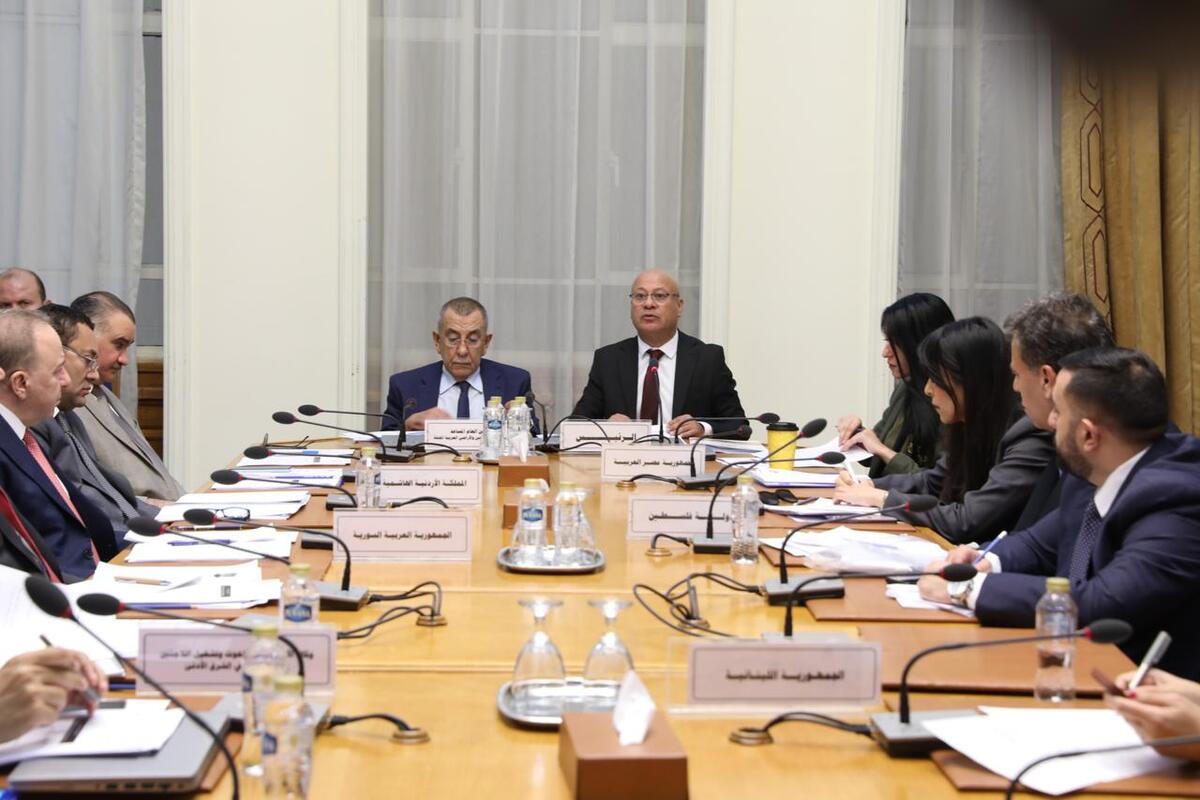







The 113th session of the Conference of Supervisors of Palestinian Refugee Affairs in Host Arab Countries opened today, Sunday (July 20, 2025), with the participation of official delegations from member states from Jordan, Syria, Palestine, Egypt, Lebanon, the Arab League Educational, Cultural and Scientific Organization (ALECSO), and the United Nations Relief and Works Agency for Palestine Refugees in the Near East (UNRWA).
On its first day, the conference discussed the financial crisis facing UNRWA and ways to provide the necessary support. It also discussed securing the necessary mobilization to renew UNRWA's mandate for the next three years, as well as the Arab position on the agency's strategic evaluation report.
The participating delegations stressed the need to support UNRWA financially and politically, confront attempts to liquidate it, and work together to preserve the rights of Palestinian refugees, ensuring their return to their homes in accordance with UN Resolution 194.
Assistant Secretary-General of the League of Arab States, Ambassador Saeed Abu Ali, said that what is happening in Gaza is a full-fledged war of extermination that embodies a resounding collapse of humanitarian values and principles. He added that the situation in the West Bank is no less dangerous, as the aggression has resulted in more than 1,000 martyrs and 7,000 wounded, in addition to the destruction of more than 1,500 buildings in the camps and the displacement of approximately 52,000 refugees in light of the attacks of settlers supported by the occupation army as part of a systematic policy of annexation, Judaization and ethnic cleansing.
Ambassador Abu Ali added that UNRWA "remains a living witness to the Nakba and represents the international community's commitment to the Palestinian refugee issue," warning against attempts to liquidate it.
For his part, Assistant Minister of Foreign Affairs and Director of the Palestine Department, Ambassador Mahmoud Omar, stressed that the meeting is being held at a very delicate and dangerous stage for our cause and the cause of our central region. This bleak atmosphere of killing and destruction requires an immediate and sustainable ceasefire and for the international community to fulfill its moral and humanitarian role in rebuilding the Gaza Strip by beginning to implement the Egyptian-Arab reconstruction plan and supporting the capabilities of the Palestinian National Authority*.
Ambassador Omar added that Egypt has been keen, since the first day of the war, to move forcefully on three tracks: humanitarian, security, and political. It has pushed for mediation efforts to reach a ceasefire to prevent bloodshed, worked to deliver humanitarian and relief aid, and evacuated the wounded for treatment. Now, in cooperation with its partners, it continues to work on formulating arrangements for the next day's management of the Gaza Strip.
Ambassador Omar added that Egypt has always loudly affirmed its categorical rejection of any schemes aimed at liquidating the Palestinian cause through calls to displace the Palestinian people from their lands, such as the proposed humanitarian city, which constitutes a grave violation of international law and undermines the two-state solution.
For his part, Ahmed Abu Holi, a member of the PLO Executive Committee and head of the Department of Refugee Affairs, said that the occupation seeks to undermine UNRWA's work and liquidate the refugee issue through campaigns of incitement and distortion, and the imposition of arbitrary measures on the agency's work, even attempting to establish an "alternative agency" and a "humanitarian city" in Rafah, describing it as a displacement project aimed at liquidating the Palestinian cause.
Abu Holi added that President Mahmoud Abbas's vision, announced at the extraordinary Arab Summit and the UN General Assembly, represents a clear Palestinian roadmap for halting aggression, preventing displacement, reconstructing, and achieving a just peace based on international legitimacy resolutions and the Arab Peace Initiative.
Sahar al-Jubouri, head of the UNRWA Representative Office in the Near East, confirmed that the agency is experiencing its most severe financial crisis since its founding, facing a deficit exceeding $200 million, forcing it to take exceptional measures, such as deferring supplier payments to ensure employee salaries are paid.



Share your opinion
UNRWA remains a living witness to the Nakba and represents the international community's commitment to the Palestinian refugee issue.