






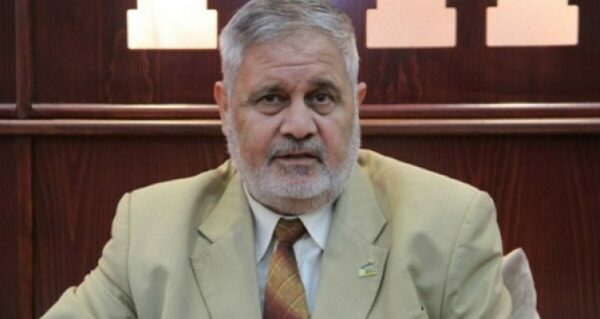

For me, Father Manuel Musallam was not just a Christian cleric from Palestine. He was an exceptional national figure, a unique humanitarian and militant symbol. I knew him closely during his years of residence in the Gaza Strip, and I am no exaggerator when I say that I found in him a spirit resembling the spirits of the prophets, a living conscience that spoke out for the truth in the face of injustice, uncompromising, and fearless in the name of God.
When Israel was attacking Gaza and destroying homes and mosques, Father Manuel would go out to the people, and in his deep fatherly voice, he would address his people:
“If they destroy your mosques, open our churches for you to pray in; we are one people, our blood is one, and our cause is one.”
Like other intellectuals and thinkers, I have often wondered: What is the secret behind Father Manuel's unique charisma? What makes his words leave such a profound impact? And how can a Christian man be accused of being a "Christian Hamasite" because of his staunch defense of the resistance and his public support for Hamas?
I followed his positions and writings with great interest, and I supervised the development of a knowledge and documentary encyclopedia about him, published in ten books by the Bayt al-Hikma Institute for Consulting and Conflict Resolution. I contributed three titles to the encyclopedia, through which I sought to document this unique model of struggle.
Father Manuel was a free Palestinian voice, uncompromising in his opposition to the occupation and unwavering in his opposition to injustice. He relentlessly criticized Israeli policies and denounced the atrocities of ethnic cleansing and mass killing, particularly in the ongoing war of extermination in the Gaza Strip. He also relentlessly criticized American and Western policies, viewing their complicity with Israel's war criminals, led by Netanyahu, as a blatant betrayal of human and moral values.
In the midst of the massacres, Father Manuel was among the first voices to speak out for the truth and call for breaking the wall of silence. He wrote, spoke out, appealed to living consciences, and called on the Christian world to stand with the oppressed, not the executioners. He believed that blind Western bias toward Israel does not serve peace, but rather perpetuates occupation, violence, and injustice.
As for Al-Aqsa Mosque, it held a special place in his heart. He visited it, met with Sheikh Ikrima Sabri, and repeatedly emphasized that defending Islamic holy sites is a national and moral duty, not unique to one religion. He would repeat:
"Jerusalem unites us, Al-Aqsa is the symbol of our unity, and resistance is the honor of the nation."
Therefore, it was not strange that he was accused of being a “Hamas Christian,” and he saw this accusation as nothing more than a badge to wear on his chest with pride.
In Gaza, he lived among the people, sharing their suffering and resilience. He didn't have a lavish home or a luxurious office, but rather a simple room, a warm smile, and a generous hand. His schools in Zababdeh and Gaza were beacons of education and patriotism, welcoming all Palestinians, regardless of sect or religion.
He always used to say:
"We are one people in the face of occupation. We do not care what extremists in the East or the West say, and we are not divided by beliefs if we are united by land and identity."
This deep understanding of the unity of destiny is what made him a unifying national symbol.
His positions were not the product of a momentary emotional outburst, but rather the fruit of a deeply held intellectual and spiritual conviction. He advocated for the reconversion of Hagia Sophia into a mosque, believing that the sanctity of the place is preserved through worship, not tourism. When faced with a fierce Western attack, he did not back down, but responded forcefully:
"Return the Mosque of Cordoba to the Muslims, then talk about Hagia Sophia!"
Over the long years I knew him, I never witnessed him back down from a word of truth or compromise on a principle. He was present at Ramadan iftars, in hospitals in solidarity with the victims of assassinations, and in every situation that called for a word of truth and a stand of honor.
Despite his Yemeni origins, which trace back to a family that passed through Jordan and settled in Palestine, he never felt like an "immigrant." Rather, he saw Palestine as the land of the message and the homeland that embraced all its children, Muslims and Christians, in unity of blood and destiny.
I collected some of his writings and testimonies in a book titled "Father Manuel Musallam: Inspired by the Nation." I saw in it a picture of a living conscience, a national conscience, and a resistant mindset that combined faith in humanity, belonging to the land, and the defense of justice, no matter the cost.
As I write about him today, I recall the image of a figure who remained proud despite the storms.
Father Manuel Musallam, as I saw him, was a national icon and a living human conscience, who knew no equivocation and was adept at speaking nothing but the truth.
In short:
A man passed by here... and left an unforgettable impression.
Share your opinion
A Voice Crying in the Wilderness: Father Manuel Moslem as I Knew Him