





The Israeli economic newspaper "The Marker" revealed that the Weizmann Institute of Science, one of the most important research centers in Israel and the world, suffered extensive damage following an Iranian missile attack targeting the institute in mid-June. The attack caused widespread destruction and enormous financial and scientific losses, threatening to halt vital research.
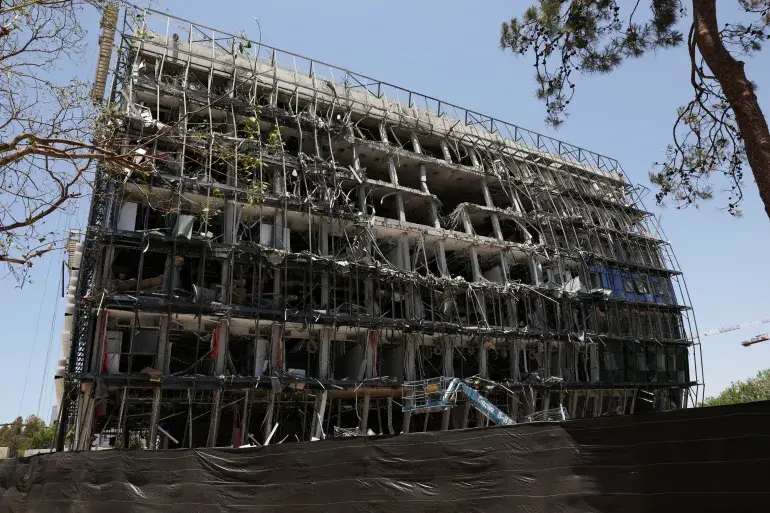
The newspaper report quoted Professor Alon Chen, head of the Weizmann Institute, as testifying before the Knesset Finance Committee, in which he admitted that two of the institute's buildings were directly hit by Iranian ballistic missiles. These were the Ullman Institute for Cancer Research and the Dolaro Building for Advanced Chemistry and Materials, which was built over the past five years at a cost of approximately $140 million. Chen did not address any other military-related damage that may have resulted from the bombing.
The institute is known as "Israel's nuclear mind," and it also provides research services to the Israeli military, including artificial intelligence, intelligence data analysis, and drone guidance.
The institute also works on developing autonomous or semi-autonomous weapons, precision tracking and guidance devices, electronic jamming and protection technologies, as well as research into directed energy and nuclear technologies, and support for military satellite systems.
Destruction in every corner
The institute's president said the chemistry building sustained a direct hit on its fifth floor, explaining that its demolition and reconstruction were inevitable. The institute's campus was closed for two full weeks after the attack, before partially reopening yesterday as rubble removal and damage assessments continued.
The newspaper quoted him as saying that the damage caused by the explosion extended throughout the university campus, and that five of the 112 damaged buildings will need to be completely rebuilt, including the Environmental Sciences Building, while approximately 60 other buildings will undergo restoration, with varying degrees of damage.
Even more serious, according to Chen, is that the destruction has affected pre-clinical research centers, which house more than 100,000 laboratory mice used in research into diseases such as Alzheimer's, Parkinson's, and various types of cancer.
"These are not just laboratory animals, but valuable scientific models upon which years of research have been based. Their loss would be a true scientific catastrophe," Chen told the committee.
The central machinery room, responsible for operating the campus's electrical, air conditioning, and water systems, was also damaged. The newspaper noted that the institute's residential area was also damaged, but fortunately, no human casualties were reported in the attack.
The Marker reported that Chen presented the Finance Committee with a color aerial map showing the extent of the damage. Entire areas were colored red, indicating severe damage, while other areas were labeled orange and yellow, depending on the extent of the damage and the need for restoration or reconstruction.
The newspaper noted that Israeli military censorship allowed these details to be published for the first time (meaning that damage to military components has not been disclosed), amid estimates that reconstruction work could take between three and five years, raising concerns among committee members about the impact on Israel's global research standing.
Threatening the future of research
The newspaper estimated the direct damage to buildings and equipment at between 1.5 and 2 billion shekels (about $443 million), but Chen explained that the long-term scientific and economic losses are much greater and cannot be measured in numbers.
"If we have a scientist who has collected clinical samples from cancer patients for 25 years, how do we account for this loss? How do we estimate the loss of decades of research work?" he asked the committee.
Chen also criticized the "inadequacies" of the property tax-based damage compensation mechanism, explaining, "If we bought a microscope for $1 million five years ago, its book value today might not exceed $200,000, while we would practically need to buy a new microscope for $1.5 million. Who will cover this gap?"
The newspaper claimed that the Weizmann Institute is run as a non-profit organization and receives only about 20% of its budget from state funding, compared to an average of 70% at other Israeli universities.
"Our development budget relies entirely on donations and self-reliance. We don't have tuition fees, and if we had to use our savings to rebuild, we wouldn't have anything left to fund day-to-day operations," Chen said.
The institute's president warned that the continuation of the crisis could force the institute to freeze the admission of new researchers, saying, "We accept between 10 and 15 new researchers each year. If we don't have 60 laboratories ready, we won't be able to accept any new researchers. This will create a serious gap in scientific research in Israel."
During the session, Knesset Member Oded Forer called for the establishment of a special mechanism to rehabilitate the institute, saying, "This is not an ordinary compensation case. We are dealing with direct, indirect, and exploratory damage. There must be a special mechanism run by a senior government official to bring all parties together."

PALESTINE
Wed 02 Jul 2025 9:12 am - Jerusalem Time
The Marker reveals: Iranian missiles inflicted heavy losses on the Weizmann Institute.
Tags
MORE FROM PALESTINE






Share your opinion
The Marker reveals: Iranian missiles inflicted heavy losses on the Weizmann Institute.